Showing posts with label Gods of the Fall. Show all posts

Friday, July 14, 2017

Gods of the Fall - Session Prep - Finding the Way


Once again we return to the Afterworld... kinda.

The characters have entered into the twisted and nonsensical interior of The Furnace. Or maybe they simply passed from one realm to another? Uncertainty about where they are combined with confusion about the rules of this place and its doors that lead to other realms has them flatfooted. In addition there are strange beings here who seem hostile in part, and who may be cypher-phages, consuming the divine energy of the cyphers the character bear.

The characters themselves are of course divinely powered and thus contain divine energy, that'll be the crux of this session as the creatures feed on that energy. This is the curse of this traveling space, as it turns mortals who stray too long into these phage creatures. The PCs will encounter some who are far more fargone than others, and may even be able to help the prior party return to the Afterworld and regain their humanity.

I have two main goals for this session:,
  1. The PCs should figure out what happened to the lost party. 
  2. The PCs should figure out how to control the traveling doors. 
The former should be easy enough as the last part of the prior session had them finding the campsite of the last party. I plan to drop clues as they investigate which combined with the behavior of one of the phages/party who has an uneasy truce with the group should point them in the right direction.
Turns out that either I wasn't adequately setting up the "riddle" or it was just a bit too obtuse, but it took the players some time to grasp the fact that the windows and doors were controlled by their wills. They did eventually figure it out, and before frustration boiled off all the fun. 
The latter calls back to the characters' trials from their first adventure during their trials within the shard of a past heaven. As divine beings they have the ability, nay the right, to enforce their will on the world(s) around them. This is something I feel strongly is a core theme to games where the players grasp at godhood: the power to change the world to your will, balanced (or not) by the wisdom to know when to do so and when not to.
I needed to take a little more direct approach with this, using a final GM intrusion to have "No-face," who had been following them around and eating their cyphers before attacking and trying to siphon off Polodius' divine power, slip through the doorway they'd opened back to the Afterworld. Removed from the doorway realm the creature vomited up some cyphers as it's body tried to return to normal, but injury and/or the duration of its stay meant that the man perished before he could become fully human once more. 

Friday, June 16, 2017

Gods of the Fall - Another Approach to Cyphers Redux


Previously, I brought up an idea to make Cyphers a feature of a PCs divine power. After receiving Predation recently (digital and then my backer's copy) I was reading and found that that game uses similar tactic with Cyphers being encoded into people's DNA via the temporal disturbances that cause them. Now I wonder if my idea was my own or something I subconsciously remembered from my playtest of Predation last year. Either way I still think there's merits to this idea for Gods of the Fall.

Going further (farther?) and taking a cue from the mode of cypher distribution via time anomaly a GM could give new cyphers out via fonts of divine power, wellsprings of magic, and slain foes in the form of spiritual energy (and possibly divine energy). This isn't too far from the current norm in which cyphers are divine energy that often is formless glowing orbs or crystals. Only the oldest of cyphers have become manifest in the form of common objects.

There's a single downside to adopting this method into the game, at least from my standpoint, and that's that it prevents any non-divine beings from using cyphers against the PCs. Frankly, it's not often I do so, but that's my prerogative and I'm loathe to throw something out of the toolbox that I may want later. And while I don't use it often I have used it, and so it's not something I want to retcon. Perhaps in future campaigns I'll make the change. Perhaps not. Either way it's an idea worth putting a little cognition on.

Friday, June 9, 2017

Gods of the Fall - Session Prep - ... Into the Furnace


FINALLY!

What do we know about the Furnace? Well the book says that its all iron, covered in glowing red runes, predates the city by hundreds or more years, and then there's the inside. The inside is bigger than the outside, has numerous rooms, some of which seem to look out on other parts of the world, and occasionally the howling of a predator can be heard. Oh yeah, and sometimes those who go in never come out.

So there's a lot of potential to the Furnace, but it's potential that needs work to tease out and make usable.

The setup of the thing is that the PCs are looking to go in after a recent expedition that hasn't returned. They're already motivated so, in my book, the hard part is done. Unfortunately that's all I have at the moment.
I wrote this WAAAY before we finally played this, so I had a little more than the nothing I claim above. 
Also, look, return of post play notes! 
But ... there's that bit about a predator, and that other one about windows that look out on other places. Both are pretty good hooks and very interesting complications to the story. The party that disappeared could have run afoul of the predator ... or they could have exited the furnace to somewhere else. Honestly, I don't yet know which will be "right."
Lies! I totally have a plan. I just don't know if I can pull it off...
Let's think about that predator. Looking through the Gods of the Fall bestiary I fail to find something that feels a good fit. The "bigger on the inside" and "windows to elsewhere" aspects of the Furnace however have me thinking about weird dimensions. One of my favorite Numenera creatures is also a dimensional creature, the Abykos is just the right kind of predator, and easily modified to consume divine energy instead of energy from Numenera devices.
I accidentally revealed the Numenera connection during play last night. Not a big deal, but I can't help but wonder if any of my players caught on to the abykos' nature. Still, I think they're working so far as an interesting threat/denizen. We'll see how things play out in the end. 
As for the windows that look out on ... somewhere else. That's easy enough to hold in reserve. I have a few ideas. They could just look out on some other place, another part of the world, acting as a form of fast travel. Or they could look out on a different world entirely, that's more difficult because the players will need to get back eventually anyways. As a third option they could open out to another time, the future or the past, either could offer interesting story options.
Yeah, the windows were probably my favorite part last night. It was fun being able to make up scenery on the fly. The first couple were somewhat "normal" but I redeemed myself with a forest of trees that had membranes between the branches in place of leaves, "kinda like bat wings" as I described it. Afterwards I wondered where I dredged up such a weird image, and I kinda hope I get the chance to use it again. 
Most of this session was getting the character thoroughly confused and "lost". Due to a timely "bad idea" and a GMI I split the party which I think worked out. The talky player got his own interaction with the abykos folk and may have made a friend. Or not, we'll see how that works out. We ended the evening just after getting the group back together. So the next session will be a probably wrap up of this story (unless things go long as they sometimes do).

Friday, June 2, 2017

Gods of the Fall - Godly Visage


Being a god isn't always about supreme power and limitless possibilities. The mortals who worship you feed you your power and through them you have ties to the mortal world. A god of war whose followers never get a hand winning probably won't be holding onto his mortal powerbase any more than a god of harvest who's too busy "sowing oats" to help ensure that the crops in the world grow. But beyond godly duties there are other downsides to being a god. You might get caught up in the turnings of the wheel of fate (or ensnared in fate's threads, pick your metaphor), or you may find that once you're known for something it becomes all but impossible to shake off.

And then there's the whole look of being a god. You may become known for having an animal head, or missing a body part, or being lame, or any other physical cue. It's possible that this may happen in a way that you aren't terribly happy with. With great power comes a terrible skin condition.

Gods of the Fall presents a fantasy world, one where the characters (and thus the upcoming gods) are all depicted looking like the mortal race into which they were born (I was about to say looking human, but I didn't want to be racists against the Taran and Sleen players out there). It is likely that in this setting the gods are more like those of the Norse and Greek/Roman pantheons; they look like "us," and probably act like us.

But maybe one of your players isn't too keen on looking like "just some guy with some glowy SFX"? The divine aura being those SFX. So what do we do for him? Well, that divine aura doesn't have to just be limited to some glowing and a symbol right? These are gods right? Why can't the "divine aura" be a whole different appearance? Perhaps the god of fire isn't simply wreathed with glowing red and a flamelike symbol, but actually takes on the appearance of a charred body as well? Or perhaps his glow comes from within, and flames roar within his mouth and eyes! The god of war may wear only a light armor, but her divine aura may take the form of ultra heavy battle armor festooned with the trophies of her kills!

So that's my point, the divine aura of the gods need no just be a nimbus glow and a simple symbol. It could represent a more complex appearance shift, in the form of physical attributes or illusory equipment that represents the god's domain.

Unless your game isn't set in a fantasy world. Using the ideas of Gods of the Fall in the modern world (similar to the base setting of White Wolf's Scion), or an alternate history (my idea of Legends of the Wild West), or some other setting idea, is something I've discussed before. In this case instead of the divine aura being an illusory sign of divinity it is mechanically tweaked to be the god's actual divine form, subtly or substantially different from the mortal guise that the gods use to move about within the world.

Regardless of how you decide to use it, the Divine Aura can be as simplistic or as complex as you and your players desire it to be, and can help to deepen the nature of your games where gods walk among mortals, either deliberately hidden, or simply not radiating their full power.

Friday, May 26, 2017

Gods of the Fall - End of the End

"I told you not to feed it after midnight!"

When does the Apocalypse end? No, I'm not just asking a silly sounding question (though I agree at first blush it seems a bit much), but really, at what point does the Apocalypse transition into the Post-Apocalypse? In the case of the world of Gods of the Fall it seems that transition was about 42 years in the past, but who decided as much and what is it that signaled that change?

The timeline in the back of the book says that Elanehtar's Fall marked the first year AF (After the Fall). The Fall of the world lasted a bit longer however. War and strife and death as mortals bereft of the gods who once walked among them spun out of control. For me the end of the apocalypse and the beginning of what comes next is seven years after the Fall when Nulumriel comes to power. Nulumriel began the process of stabilizing the Nightlands and the rest of the world began to follow, slowly. For all of her apparent evil (maybe I'll get into that in another column) she did help stabilize the region by proclaiming herself empress, and having the power to back that claim up.

What's my point here? Well, much like how the end of the world takes time so too will the end of the post-apocalyptic.

Case in point: along come the players and depending on how things proceed they may well put in the effort to kill Nulumriel while proclaiming themselves gods. Doing so is likely to be the capstone of a campaign. The final event that fulfills prophecy of the Return. But what about what comes next? As GM you can wrap up the story with simple narration, you could leave it open to the imagination, you could even allow the players to take it in rounds to describe how their gods save the world thereafter.

Narration on your part isn't a bad thing, and leaving things open can be appealing for parties with varied views, but I think that a collaborative narration in the round is probably the wisest choice for many groups. It will give the players a chance to say goodbye to their characters by putting them through their paces. The player a of god of death can describe how they restore the underworld. A player of a god of crafts may describe how they build a new kind of seraph to serve their pantheon. This kind of open ended storytelling will bring out a richer ending than any single player could describe, and allow everybody at the table to put a touch of their own into the setting.

Friday, May 19, 2017

Gods of the Fall - Gods of the [blank] part 6 - Gods of the Apocalypse


War, Pestilence, Famine, and Death. The Midgard Serpent and Fenris. Kalki. If you're a god of the end times you're in good (or bad, depending on your point of view) company. The end of things isn't always the end though. Gods of the Fall predicates a cyclical rise and fall of gods. So too does Norse myth and the Hindu faith.

In the west though if anybody has an edge on the market for end times tales its the Abrahamic faiths. Christianity in particular. War, Pestilence, Famine, and Death ride in on horses and bring out the beginning of the end. The thing is those four aren't evil, not as such, they are heralds. Harbingers. Agents of God (capital "g" here). The Bible has the four horsemen arrive when the first four of seven seals are broken. The horsemen are agents of the end, yes, but they aren't evil as such. More like forces of nature.

Or maybe they are normal folks who one day realize they are being called to service in God's name. What would you do if you realized on day that you were the incarnation of the Horseman of Famine? Would you embrace your destiny, and in so doing gain greater and greater power of your Dominion over Famine? Or would you find a way out of your fate, try and fight against the will of God? What happens if the Four Horsemen aren't terribly keen on the whole Armageddon thing?

It's not a far stretch at all to use Gods of the Fall's dominion rules for the Horsemen. With four players and four Horsemen you have ready made character arcs, and with the improvisation rules I discussed last week the players have a decent amount of room to play with their dominions. You could pitch this as a game about the players trying to skirt the end of all things, or as a "villains" game where they eagerly tear down the world with a goal of bringing about the promised paradise that comes after.

Friday, May 12, 2017

Gods of the Fall - Session Prep - Out of the Frying Pan...


I don't really want to belabor a journey, especially in a game that only runs monthly. As such it's about time for the players to reach Mehergan and the Furnace. The problem is the PCs decided not to enter the Furnace this session and I spent a good three hours improvising Innkeepers, guardsmen, and the proprietor of a dry goods store.

Now I know how +James Walls must feel in our DCC games!

I spent my time laying a bunch of possible hooks. Weird visions that the Taran had when he touched the furnace. Weird sounds that one of the other players heard when near the same. The Furnace itself I played up like some kind of M.C. Escher meets the TARDIS impossible structure. It seemed to have a fixed external size but the inside features of even the tunnel running through it and acting as a gate into Mehergan were in flux. There was 6 doors one way, a dozen on the way back, and then four when a character looked the third time! That tunnel was 150 feet, a 1/3 of a mile, and 500 feet at various points. I'd say the character's are interested!

I also got to give my players some crap during RP, which was fun. The Taran innkeeper didn't take too kindly to Demodamas' comments about Taran cuisine. And she wasn't initially very warm to Polodius' attempts to curry favor by learning her language.

Thankfully at the end of the session we were at the end of the night and a perfect place to stop. Come next session the players will be waking for an early morning jaunt into the unknown!

Monday, May 8, 2017

Story Seed - Shrine

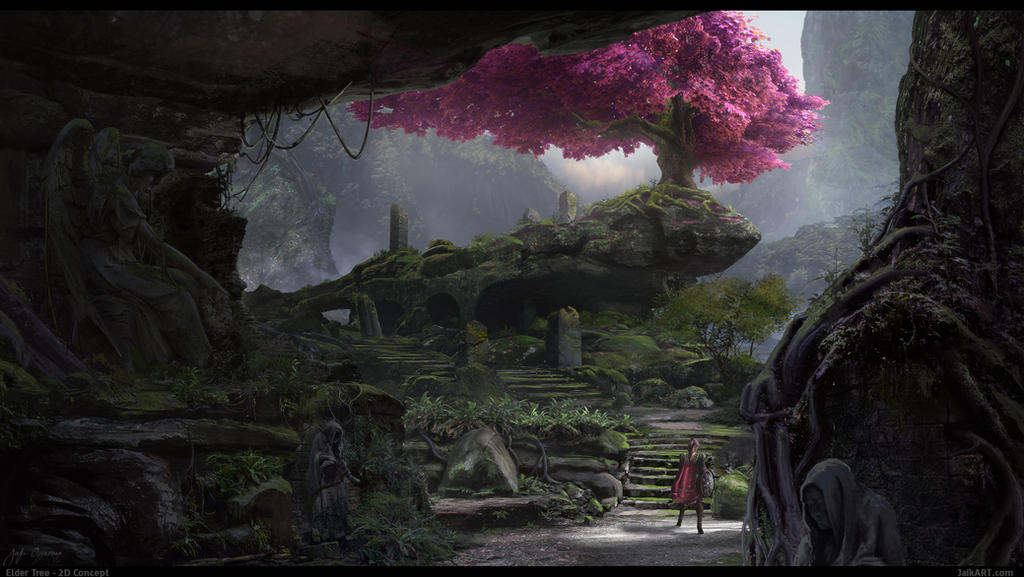
Image Source: http://jaikart.deviantart.com/art/The-Elder-Tree-560958156

The shrine was overgrown with growth. Roots and weather had damaged the statues and standing stones extensively. There was no sign of caretaker or inhabitants. Only the grotesque remains of the statues, now crippled and deformed by rooty growths, populated this place. Even unmoving they made for unnerving companions.

Shala moved forward along the damaged stone path, careful picking the most stable footing. The wind sighed through the canyon's stone walls, sometimes whistling as it caught one of the old stone sounding tubes just right. The effect sounded like the moaning of the long dead. Shala shivered, her grip going white knuckled on the mace hanging from her wide belt. The wind also brought a strange scent. One of cinnamon and rose, and incense and some fruit that Shala could not identify.

Shala rounded an open bend, skiriting wide the gnarled figures that may once have been saints or gods. The scent grew stronger. Peering up Shala at last laid her eys on the a great blooming tree, the last Tree of Ashsang. Once the Ashang grew in every city and every temple, a promise from the gods to the people. They smelled pleasant to all who beheld them, and bore fruit that were said to heal even the more grievous of maladies and filled the belly like a holiday feast. All that was before the Fall. Before the gods died, and with it their promise of protection and beneficence.

Shala approached the tree, and saw that though it flowered it bore no fruit. With no fruit there could be no seed, and no hope of restoring the trees throughout the land. With no fruit there was no promise from the gods to the people. Shala regarded the tree, and contemplated how she could restore the promise, and in so doing, make the tree bear fruit once more. The prophecies had proclaimed and promised restoration, if only Shala could determine how to fulfill them.

Friday, May 5, 2017

Gods of the Fall - Owning Your Dominion


I seldom speak negatively about the works of the MCG crew. I truly enjoy the Cypher System on multiple levels, and have made it one of my small handful of go to systems. However there are always places where even the best game, best setting book, best supplement can miss the mark, for a lone reader, or a whole community.

I think it's clear I love Gods of the Fall. As a setting it have really caught in the way that even Numenera didn't (and that's saying something). But if there's a fault to be found it's the limited support of dominion powers. There's not many in the book and they tend toward very broad (some may say generic) application. It's hard to fault this approach because the other end of the spectrum is an exhaustively comprehensive list that bloats the book with abilities and generally doesn't add a lot that players and GMs couldn't do with a little work.

Unfortunately not all players and GMs feel empowered to expand the game with new abilities to fit their need and their game. This is nothing to be ashamed of, it can be scary trying to build a new ability or power, especially as GM, for fear that you may throw your game a curveball it cannot recover from. Earlier this week I posted about the answer: Improv Powers.

Reader Tony Love pointed out that Improv Powers could help expand on a character's dominion in Gods of the Fall, and I agree wholeheartedly! In addition to helping to expand the utility of type and focus powers the "Modifying Abilities on the Fly" rules can be used to expand on Dominion Abilities. Even the simple Divine Aura could become a source of power within the purview of your Dominion.

Let's consider what a difficult modification of the Divine Aura could do. Difficult is defined as "modifying an ability to do something within the spirit and general idea of the ability." For Divine Aura this would be minor influence over the purview of their dominion such as:
  • Generating light equal to a torch - dominions of fire, light, sun, and possibly others
  • Generating enough warmth/heat to warm the immediate area around the god - dominions of fire, fun, hearth, etc
  • Providing an asset to attempts to calm an enraged lynch mob bent on vengeance - dominion of justice, law, order, etc
  • Providing an asset to attempts to stir a gathering into a rowdy mob and inciting violence - dominion of chaos, war, vengeance
As you can see showing your aura and making a difficult (level 4) roll can allow for some useful dominion themed uses of power that may not normally be in a character's repertoire.

How about  formidable (level 7) uses of a divine aura? Formidable is defined as "modifying an ability to do

something similar to the description or intent, but changing its nature". That's going to need a little more interpretation, so let's consider that we're probably going an order of magnitude beyond a difficult task.
  • Generating a fiery aura sufficient to set items ablaze and deal minor environmental damage to those nearby - dominions of fire and sun
  • Creating an area of health and beneficence that eases suffering and may aid in recover from injury and disease - dominions of health, hearth, life, etc
  • Providing an asset (or two) to incite a peaceful man to violence - dominions of war, chaos, etc
  • Pacifying enemy combatants of level less than or equal to your tier - dominion of war, peace, power, etc
These abilities really start to show the god-like power that these characters can possess. Even at Tier 2 a character with a good roll and some effort may be able to occasionally "stunt" abilities of this level of power. 

Lastly we have the "impossible" (I still prefer improbable) difficulty modifications (level 10). These are uses that "[modify] an ability to accomplish an effect that has nothing to do with its description or intent". At this level we're talking gods doing god things. This could literally be anything, though the farther (or is it further) from their purview the less power they will have. At this level we could have:
  • A god of war single-handedly carving a path through an opposing army to slay the enemy general.
  • A god of life raising the dead or curing even the most tenacious or deadly disease or poison.
  • A god of the sun bringing day to the night, or causing night during the day.
  • A god of chaos inciting civil war.
  • A god of winter bringing summer to an early end, or breaking winter's hold months early. 
As you can see, these are some considerable effects. GMs always have the power to say no, but should be encouraged to allow players to use these rules, and instead of saying no they should instead offer a more reasonable (to their mind) option. RPGs are a "team sport" and working together with your players or GM is always the better option when it comes to use of these kinds of improvisational rules.

More to the point though, by using these rules you can expand the Cypher System in such a way as to truly allow a game like Gods of the Fall to blossom. Better still, if a player uses the same improvisational ability multiple times without breaking the game they and the GM may just codify the ability into a Dominion, Type, or Focus power (as appropriate) with an easier use thereafter (after all, they did practice!). Empower yourself and your players and allow them to empower their gods to greatness. I don't think you'll be disappointed.

Friday, April 28, 2017

Gods of the Fall - Another Approach to Cyphers


Cyphers in Gods of the Fall are relatively unchanged from those we see in Numenera, The Strange, and other Cypher System games. The explanation of where they originate from is different but the core concept is the same: single use devices of fantastic power. In Gods of the Fall cyphers are explained as crystallized motes of divine energy, physical things that can be picked up, carried around, sold, traded, lost or stolen, and eventually used up, their physical form evaporating back into the aether as the divine energy is spent.

But what if we took a different tack?

The gods are dead and those that may yet become gods are only beginning their journey. Heaven (Elanehtar) is gone. Divine energy is at its least constrained. In prior times before the Fall there were dozens, possibly even hundreds, of gods, each brimming with divine energy. Elanehtar was whole and was itself a realm entirely divine. So in such a case why would free divine energy retain a static form?

Why would cyphers stay in the same form and function until they were used? Heck, why would divine energy even solidify into any form at all? Why wouldn't all this energy just return to some kind of formless and pervasive state waiting for the right person, place, or thing to render it into the world?

To put it plainly: Why even have cyphers be things, and why have those things be statically the same until used? It's all divine energy, and gods channel divine energy.

Here's my proposal. The characters are gods, and cyphers are part of their divine abilities. They are not physical things (though the can be MADE physical). Each session you roll up new cyphers for each character (unless continuing directly from a prior session). These cyphers are power the character can use by channeling divine energy. If they want they can make one manifest and pass it off as a minor miracle, but otherwise these cyphers are internal to the character and their power. Whenever the character rests they replenish their cyphers, and can also re-roll any they still have if they want.

Before you freak out about how this undermines some of your NPCs there's no reason that an evil god-to-be couldn't manifest and bestow cyphers to their followers or minions. It might even be possible for powerful soul sorcerers or bibliomancers to capture a young god and "milk" them daily for the cyphers that their divinity produces. Likewise slaying divinely empowered foes would offer people (NPC and PC) to capture the divine essence in cypher form for a short time after death.

This spin on cyphers could either justify making the cypher limits a hard cap, or could make the soft cap threat of ravers even more damning. After all, if you go over your cypher limit you probably did so by making your cyphers manifest and not giving them away, or by taking the divine power of others (in manifest form) and hoarding it.

Of course, if you take this approach it also means that the idea of cyphers as shard of Elanehtar is probably gone, and with it the idea of restoring that lost heaven once enough cyphers have been used up. It also makes divinely charged remnants of the prior gods and prior worlds more valuable because these are that much rarer and exceptional. The divine weapon of a dead god would potentially be a more precious artifact than an enchanted blade created in Corso. Not by virtue of ability (though very possibly) but because it represents a rare stable nexus of divinity.

Then again, the way cyphers are written works pretty well too.

Friday, April 21, 2017

Gods of the Fall - Gods of the [blank] part 5 - Gods of Modern Myth


I'm totally going to cheat here ...

Superhero comics are often called modern mythology. The stories are larger than life, the protagonists and antagonists resound with us on deep fundamental layers, and a lot of the best stories can be simplified down to essential plot points that are not dissimilar to those stories from antiquity.

But there's a difference in playing Cypher System Superheroes and a Gods of Modern Myth game.

Firstly, superheroes tend toward varying origin stories. There are often heavily co-joined themes (hello rich white guys with a very specific skill set, last aliens of their species just trying to make a life, and mutants/metahumans), but if you look at the big two you will see a diverse mix of origins within their upper tier of characters. Characters in a Gods of Modern Myth game are going to share a common origin: They. Are. Gods. Which brings me to ...

Secondly, We rarely spend any time with comic book superheroes when they don't have powers/skills. Sure after 70-odd years you get a Batman: Year One type story, but generally origins are quick and we move on to the superpowered "good parts". Not so with Gods of Modern Myth. These characters need to gestate and realize their powers. Depending on the players and GMs they may be little more than heroic but otherwise average people for 4 to 8 sessions before they finally gain their "super powers" (e.g. power/divine shifts). This has the advantage of both getting to know characters before they become larger than life heroes/gods, but also to help establish that the opposition is greater than the average person; in other words it lets the GM set the scale of the game.

Thirdly, the scope of a Gods of Modern Myth game should be broader than the average superhero comic. Gods of Modern Myth should be tackling citywide problems from the start and by tier 3 they should probably be saving the world Justice League style, or even the whole cosmos like the Guardians of the Galaxy. The scale, as I mentioned before, should be bigger, but so too should the scope. If your characters aren't shaking the pillars of the universe at tier 6 what are they going to be doing, and how could it possibly match up?

So yeah, Gods of the Fall reinterpreted as superheroic modern myth. It's probably not for everyone, but maybe it should be. 😄😄😄

Friday, April 14, 2017

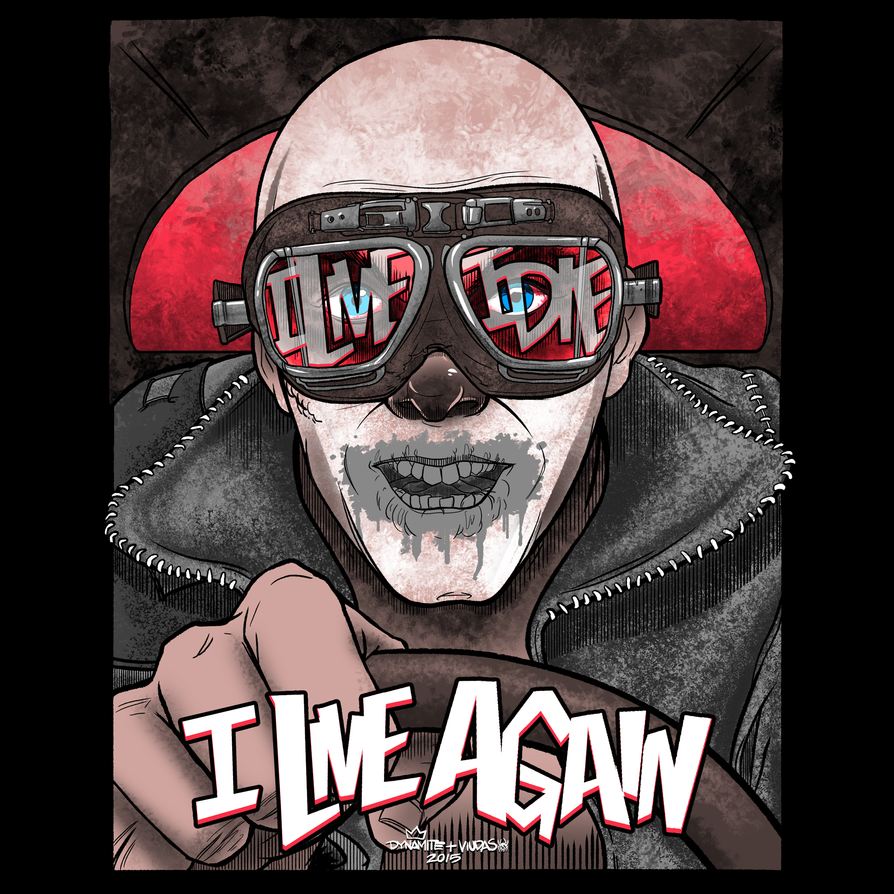
Gods of the Fall - I Live, I Die, I Live Again


Gods of the Fall is a game set in but a tiny portion of a much larger cycle. The Falls have happened before, and may well happen again. The gods of old weren't the first and, if the PCs have their say, will not be the last. This kind of cyclical story can be played in more than one way as well. Gods of the Fall implies that the new gods are probably not full-on reincarnations of the old gods. There are too many remnants and threads of the old that need to be plucked or cut or burned away. In addition the game's strong allowance for the PCs to be their own gods with nearly limitless choice further points to the PCs being entirely new.

But that doesn't have to be the case. Maybe you want to run things so that the PCs are specific gods reborn anew who must not just claim their divine right, but re-claim their old dominions and powers. In such a case you may want to lean in on Relics of the PCs past selves. In addition you may want to set the players to the task of designing their characters from the top down, or rather from the 6th tier down. Having a complete ultimate version of each player's character can allow the GM to both plan accordingly but also to make liberal use of foreshadowing. A character may find themselves on the receiving end of an ability they don't yet have for instance.

Additionally by helping to design the old gods the players will be able to have a little more in-character knowledge than usual, and may even be able to set up personal story arcs where their god rethinks their past selves' choices. A player may have the opportunity to fix mistakes of their past self, or even approach their dominions in a different way than their did in their prior incarnation. Sure, it's a little more work up front for both you and your players, but it also opens up opportunities that may not present themselves otherwise.

This kind of cyclical play also allows for something a little different within Gods of the Fall, starting as Gods and playing through the Fall. Think about it, it's the kind of opportunity that seldom comes along. Your players build their gods up to their ultimate point, the time just before the Fall when they are probably at their strongest. You, as GM, then run them through a session (or two, or three, or more) as their full-on god selves while the world falls to shit around them. Maybe they fight against it, maybe they try to escape it, maybe they try to lay contingency plans for their eventual return. In the end their gods die ... and are reborn as first tier gods to be, not yet aware of the auspicious destiny that awaits them!

If your group is really good you may even convince them to let other players run their prior god-selves. In this way they can truly see how the Fall and rebirth changed their gods. Or didn't. Sometimes the cyclical nature of things is a result of not progressing and advancing from iteration to iteration. In the end you may finish your campaign the same way you kicked it off, with the fully powered gods Falling once more...

Image Source: http://albert-lopez.deviantart.com/art/I-Live-I-Die-I-Live-Again-537322192

Friday, March 31, 2017

Gods of the Fall - Session Prep - Dreaming Under a Cursed Moon


I really need to stop putting things off. I coulda, shoulda, done this prep a month ago before the original play date before we had to push things out. Instead I waited ...

So here I am trying to plan a road trip session quickly. I want to do something that stands alone. Not every session needs to service the larger story for the campaign. I also know that the Nightlands are the geography I have to work with. So, what can I do with that and how can I do it?

Sleep. It's the thing that I can be sure the PCs will do, and it's a thing that, in the Nightlands, can lead to adventure, because in sleep there is Nod, the realm of dreams and nightmares, where a group of would be gods may find themselves off footing and struggling to adapt.

Sounds like a great start. It's also a good idea because I have a maybe in my group and the player has purchased sleep dust. If he's absent he's sleeping without dream. If he's there, it's an easy early session GM Intrusion to have him forget to use it, or have been swindled with fake product...

So easy enough start, drag the characters into the dream world. Now comes the hard work. The dreamworld should be memorable. Description of the scenery will be key, as will the flora and fauna. Things should be recognizable but also strange, warped, and different. Sometimes pleasantly so, otherwise nightmarishly so. Of course setting the scene is only as good as the scene to be set, and that includes setting up the plot of the session/adventure. So why have they ended up in the dreamlands? Or maybe more pertinently, what of consequence will happen?

I think early on I want to confront the characters (not the players, focus on the characters), with nightmares that reflect their journey, both past and ahead.
  • Iztal to be confronted with what being a God of Shadow truly means, riding the knife's edge between light and darkness
  • Utar desires dominion of strength, will he build something that lasts?
  • Polodius seeks knowledge, lost secrets could save the world, or damn it
  • Demondamus delved too deeply what darkness did he bring back with him and what does it mean for his pantheon?
I'll also seek to introduce the King of Nod for RP purposes. He is a figure steeped in power and knowledge but also held to his own agendas. Does he help them, harm them, or act indifferently?

This will be a RP heavy session as I suspect the follow up may be combat heavy by comparison, but in my pocket I can introduce nightmares to press the characters to act in seeking a means to wake. Once again the secret lies in embracing their godhood. Should they assert themselves as new gods they will wake safely, if not they may not wake at all...

Friday, March 24, 2017

Gods of the Fall - Inspirational


Today's a quick post in words, but a long one in duration, because I'm on vacation at Gary Con! I'm probably busy playing a game or wandering through the dealer hall. Regardless of my absence, I wanted to make those of you who may have missed it aware of a great resource for Gods of the Fall GMs...

Crash Course Mythology

If you are a fan of mythology (as I have been since I was a kid) you probably owe it to yourself to check out this series just for that alone. If you are a GM or player of Gods of the Fall I think there's some value here in seeing how myths are structured and evolve. I've embedded the first 3 episodes here but by the time this posts there will be two or three more beyond this I think. Well worth the 10-15 minute chunks of time in my opinion.


Friday, March 17, 2017

Gods of the Fall - The Name of the Thing


We all know the name of the game, but have you considered what it really means? It's pretty clear from the game's art that there was an overt attempt to stand away from the Western & European classical religions. There's a less obvious lean toward the religions of Middle Eastern antiquity, and more classical and modern India. That's all subtext. It's all in the art and presentation. There's nothing over to direct somebody away from Thor and Hermes, but the subtle touches of names, artwork, and even the mechanics of the game suggest these things.

And then there's the title: Gods of the Fall. It's evocative and creates a certain expectation. Unfortunately it may not be the right expectation for some. Because "god" (note the lowercase "g") and "God" are not the same, and given the Eastern lean of the material I started to do some digging. Turns out that that the East may have contributed more than just a visual aesthetic, because there seems to be more than a little Hinduism in the gameplay and mechanics. Take a look at the following I dredged up from Wikipedia when researching "deities" recently:
Difference between deity and monotheistic God (from Wikipedia here
A typical deity in Hinduism, differs from the monotheistic concept of God in other major religions, in that the deity need not be omniscient, omnipotent, omnibenevolent, or a combination of these. 
A deity – god or goddess – is typically conceptualized in Hindu tradition as a "supernatural, divine" concept manifesting in various ideas and knowledge, in a form that combine excellence in some aspects, wrestling with weakness and questions in other aspects, heroic in their outlook and actions, yet tied up with emotions and desires.
I'd say that the Hindu model of deities fits Gods of the Fall rather well wouldn't you? I'd even go as far as to say that while "Deities of the Fall" isn't a better title, it is a more accurate one. The characters that the players control are gods but too often that gets mixed up and confused with Gods. The characters are deities, they have limited scope and very real vulnerabilities that balance out their impressive strengths. They are prone to human failings, as were the gods before them.

This isn't a condemnation of the game or the title. Gods of the Fall sounds better and it catches the eye and imagination better. It's the title the game needs and even if it isn't perfectly accurate of the intended play style it's the right title for the game.

All that said I think it bears understanding that the characters should be defined by their limits and their humanness as much as they are by their powers and dominions. Allowing fear and greed and other failings and weakness mix with their divine attributes will help yield a better story. Either through pure roleplay or by helping you as GM to define stories and enemies that compliment and contrast the characters.

Gods of the Fall is a game of deities striving to both transcend their humanity and also lift the world from darkness into light. Keeping in mind that darkness can come from within as well as without will only help tell a better story.

Friday, March 10, 2017

Gods of the Fall - Rock You Like a Hurricane


Here I am ... with another look at the setting of the Afterworld. Or more accurately, one part of it; one feature really, and the secret I think it may contain: The Eye of Elanehtar.

The Eye is a complicated feature. One part everlasting storm, one part magical fallout, one part howling gang of ravers. Oh and the great granddaddy of ravers, the Delirium. The book dedicates only a small bit of space to the Eye, and with reasonable cause given that the majority of the Eye is centered over the sea-filled crater of what was once Cavazel.

As you can see there's a lot going on there. An everlasting storm by itself would be an interesting feature for a fantasy setting, but we get to add a bunch of other goodness to that. It's almost too much. But not really. I've discussed my thoughts on ravers before. The Delirium is basically a raver on steroids, inflicting madness on anybody nearby and spawning curses and chaos. It very likely represents the nearly complete soul of one of the dead gods, one whose death agony was so extreme that it lost all sanity. The Delirium may even be the "queen" raver, spawning and controlling its lesser brethren. Heck I could probably write this whole post just riffing on the Delirium.

But I won't.

The magical calamity that occurred when Elanehtar "smote" (Bruce's word not mine) Cavazel is very probably fueled by a great deal of released divine energy. The chaotic and sudden release can help explain the massive storm, and the curses that it flings about like almost living creatures. As does the presence of the Delirium.

Entering the storm is likely incredibly dangerous for gods and is surely lethal to mortals, though one can assume that such a death would be of the most unpleasant kind. Some may even posit that the danger is sufficient to make any entry entirely pointless. After all, Cavazel is gone there's nothing left but a watery grave presided over by a deadly storm. Who would ever find reason to enter and why?

For the first part: gods on the rise. For the second: Elanehtar's ruins.

Gods of the Fall is a Cypher System game and so it needed a reason for Cyphers. Bits of crystalized divine energy precipitated (literally) by the fall of Elanehtar provided more than enough reason and context for Cyphers in the game setting. There's even talk that people of the Afterworld believe that maybe, just maybe, Elanehtar could be restored if enough of its energy could be freed from Cyphers. But what if Elanehtar isn't utterly destroyed or cast asunder as Cyphers? What if the remains of Elanehtar are intact and whole and shrouded from the prying eyes of mortal ken by the everlasting storm known as the Eye of Elanehtar? What better place to hide the remains of a one-time heaven than in the calm center of a storm? In its eye?

Then again maybe a storm is just a storm. I dunno...


Friday, February 24, 2017

Gods of the Fall - A Plague Upon Your House


I've written about using illness in gaming before. That post was pretty general but I think there were a lot of salient points there for the average game.

Gods of the Fall isn't your average game however.

The setting of the Afterworld is, in a way, a two-fold setting. You have the mortal level of a high fantasy world where the gods have died, despots rule, and darkness pervades much of the land. And then you have the god level where the players can seize the power of heaven for themselves, eradicate despots, venture to hell to destroy demons like no other, and eventually bring about lasting change to the world.

Everything in that original post works just fine for the mortal level of Gods of the Fall (or any other setting), but when you have godlings as characters you have to up the ante a bit. Diseases that can effect young gods need to be more than just powerful versions of mortal disease. If you can normally run around calling down divine fire and slaying demons getting the sniffles is ... disappointing.

It's also somewhat silly. Characters can and likely will have a shift or two of divine stamina among them. These characters are going to be unlikely to fail a save versus disease. Godly diseases probably shouldn't infect characters the same way as mortal diseases. Communicable diseases of the mind, or magical (like a curse) or even those that infect based on beauty or hideousness, or skills of certain kind. Its also possible that one simply cannot resist some divine diseases and must either ride them out, or possibly even carry out a divine labor to become cured!

The symptoms should also be similarly grand in scope. A couple of points of damage is probably not going to be very interesting (or crippling), but those same couple of points will be downright terrifying if damage taken from the disease is not recoverable until the disease is first cured. Similarly a step down the damage track is debilitating but the loss of divine shifts is both more interesting and more in theme with a divine disease.

Another possible symptom of a divine disease could be a geas, a forced behavior that is brought on by the disease such as being unable to refuse hospitality, the inability to use certain items or consume certain foods, and similar. Look at Gaelic mythology for some examples of this. Breaking a geas, if the character is able, often strips them of their power or otherwise makes them weak.
A really brutal example of this is the Irish figure Cúchulainn. He has a geas to never eat dog meat, and he is also bound by a geas to eat any food offered to him by a woman. When a witch learns of these she is able to bring about his downfall by offering him dog meat. With no way to avoid breaking one of his geas he is rendered powerless and eventually perishes. 
When thinking up new diseases for god level characters the GM needs to be thinking WAY outside the box. So to close this blog out here's a couple of ideas to get you started.

  • Nod's Lament - This disease seems to come out of nowhere and causes horrific nightmare and paranoia and even waking visions of terror. It grips a potential god whenever they try and rest. Every time a character tried to take a rest to recover pool points they must succeed on an Intellect defense roll with a level equal to the number of points rolled to recover. Failure results in the character regaining none of the points and wasting the rest opportunity. Recovery is automatic after successfully resting three times.
  • Freedom's Bane - Contracted as a result of interacting with Seraph's of Sin the character gains a random geas as determined by the GM. This gaes remains until the character completes a labor or slays the seraph (if it still lives). 
    • Note you may want to use a GM Intrusion when using this one the first time as there is no chance to "save vs disease"

Monday, February 20, 2017

Story Seed - Across the Sea

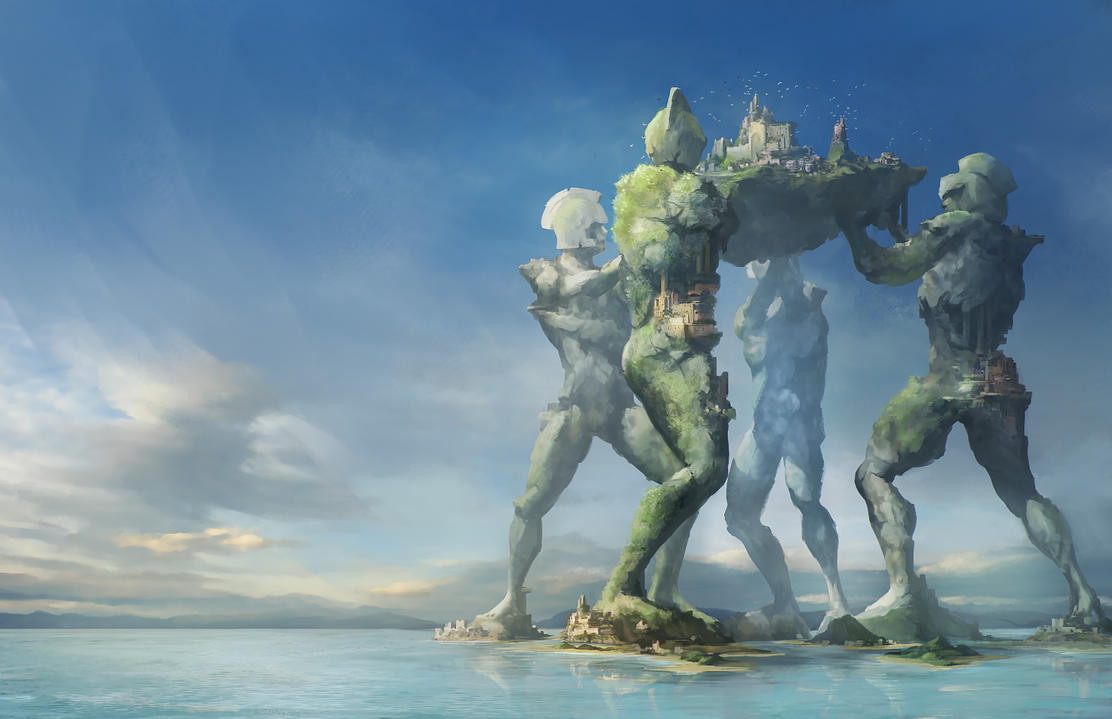
Image Source: http://franklinchan.deviantart.com/art/The-City-Of-Palaquin-608925394

"Tell me again about how the gods saved the city papa," Hiella pleaded as she wriggled under the covers.

"OK dear, ok, but tomorrow something different," Wollace said softly.

"Long ago, the old titans, those that came before the gods, lived in another realm and helped the people who worshiped them. Our city was a great center of their worship, and all the titans looked upon our ancestors with favor. The great temples held festivals and worship days and offered sacrifices to the titans and in return the city received their protection and grace.

"Many years passed. Many centuries. The city grew and the titans remained pleased by the devotion that the city gave them. The city was blessed, and obviously the favored home of the titans when they were on the mortal plane.

"None know what happened the day the titans died, or how a divine could even die, but there was a great sound of thunder from across the ocean. Soon a wave of water unlike any ever seen by man or divine came rushing over the ocean. The titans knew that whatever disaster had befallen the west was divine in nature, and would claim them as well. The four greatest patrons of the city sought to protect their worshipers and together they expended the last of their considerable might to raise the city above the water and out of reach of the great wave.

"The titans all perished that day, but the four who saved the city did not disappear. They became stone and continue to hold the city aloft to this day." Wollace leaned down to kiss his daughter on the head, "And that is how the titans saved our home."

Friday, February 17, 2017

Gods of the Fall - In Praise of Page 32

I'll stop using this art as soon as I get tired of looking at it.

OK, so let's talk about page 32 of Gods of the Fall. I'm going to start by directly addressing Monte Cook Games, author Bruce Cordell, and any other RPG publishers & writers paying attention: Do more of this.

Page 32 is a literal page from the Book of the Dead Gods. It contains a hymn to Avi the Sun, the words of Mudarak's Song, and a passage from Samiel 2:17. Page 32 is look directly into the game setting and directly at a document that a character in the game may be familiar with. More than this however Page 32 is a window into everything that the author cannot write into the text. It implies the content of an entire book in terms of style of writing and style of prose. In a game about fallen gods and new gods it gives us a glimpse at the way that the old gods were worshiped and a glimpse at how the new gods may likewise find themselves revered.

This one page is, in its own way, worth as much as the rest of the setting section. It does something that the remainder of the setting information cannot do, which is provide a sense of immersion. It does this not by telling us about the world, but showing it to us directly.

This is certainly not a new and unique way of presenting setting information. White Wolf made excellent use of such techniques in its Aeon product line back in the 90's and early 2000s by way of presenting massive in world records from the internet (or similar) or newpapers and other print media. This was then backed up by more traditional encyclopedia style world building. There are a few pages in The Strange presented as Estate case files and introductory packets. Games like Shadowrun and Interface Zero have presented their encyclopedic world information layered within the guise of matrix posts by various hackers, complete with snarky comments. I'm sure there are numerous more.

My first time through Gods of the Fall I paid this page little more heed than I did any other. I was intent on devouring the book, and wringing as much out of it as possible in the form of raw information. Page 32 stuck in my mind though and when I was planning my first session I decided to read directly from that page when I ran a scene featuring an Adherent street preacher. The effect was, I think, tremendous, as the passage sounded like something from an actual prayer book to the players.

Could I have done this on my own by writing my own poem, hymn, or such? Perhaps, though I doubt I would not have been half as successful at hitting the style, and less than that at the content. More to the point though I didn't have to. By providing in-setting material I was able to immerse the players with very little effort. 

So, to my fellow players and GMs, go read page 32 again. And maybe a second time, and consider what it tells you about the setting, from inside the setting. And to the RPG writing and publishing folks out there, consider including more of this in future products. These glimpses at the setting from within can do more to immerse your readers than a dozen pages telling us about the setting from the outside.

Friday, February 10, 2017

Gods of the Fall - You Are Not Alone


Unless your gaming group is HUGE you probably only have 3-6 players and therefore 3-6 emerging gods. That's not a lot. It's not nearly enough to fill the kinds of multitheistic pantheons that are implied within Gods of the Fall. Luckily there are always NPCs!

NPC gods are written into the book in spots but there is also plenty of room for your own creations. These NPC gods can be incredibly useful for a number of reasons.

  • They can be remnants of the past who have survived and act as patrons or antagonists. 
  • They could be new gods who are further along the road to godhood and can offer advice and aid to the PCs, or become bitter enemies who don't want to share the divine power gained from worship with other gods. 
  • They could be equals, gods to be who are following the same path and who act as allies or enemies. 
  • And lastly they can be up and coming gods who have not yet advanced as far as the PCs who need help and are potential friends, or who need help because they are a potential danger.

There's a lot of options there. Godly survivors of the prior age will have to wait for another column, that's just too much of a topic, but the rest are worth discussing here and now.

These NPCs, like any, may be freind, foe, or merely neutral. The important thing with these characters, as with most every NPC, is to give them enough detail and personality to stand out. These are gods and should have strong motivation tied to their godly journey and their dominions. They need to make sense.

They also need to not be cliché. Don't make your NPC antagonist gods all be gods of death, war, violence and the like. There's no reason why you can't twist a dominion into something antagonist by taking an extreme stance that would oppose the PCs. A god of nature who operates like the Afterworld's version of a militant Greenpeace would make for a great antagonist. So too would a god of health who euthanizes the sickly, or a god of hearth who refuses to allow people to leave their homes.

The opposite spin is also true. Player character gods may find unexpected allies in gods of their dominion's opposing force if those NPCs approach their domain in interesting non-cliché ways. A god of death who is not bloodthirsty but instead seeks to have death seen only a natural part of the cycle of life (as I got to watch +James Walls play in a game). A god of war who understands that without peace to stand counterpoint war becomes meaningless. A god of trickery who adheres to a strong code and deals fairly & honestly if you follow his ways (think of how traditional Faerie would act).

"Older Siblings"

Early on in your game the characters are more likely to meet gods who are closer to apotheosis than they are. As allies these NPCs can be invaluable, offering advice and guidance to the characters based on their own experience. If they come along early enough they may be able to provide a copy of the Seven Prophecies, or even guide the characters toward finding their dominions. The trick is to make sure that these NPCs provide assistance but don't monopolize the story or do the player's work for them.

Older god antagonists can be great. As enemies they can be terrible to behold and challenging to defeat, flush with power beyond that of the characters at that point. Defeating one may be able to fulfill a labor if they have fallen from their path and are working against the seven prophecies. They also may be ways that the GM can introduce artifacts to less exploration prone characters; relics that have been uncovered but are being used or abused can be taken as trophies. Defeating a more powerful NPC god may also provide a way for characters to gain followers or establish their own following from those that had been oppressed.

Peers

Allies and enemies. Peer gods can provide much needed help against powerful enemies like greater Ravers or even unique foes like the Hellmaw or the Nightwolf. They can also join the pantheon of the characters and provide plot hooks via their own quests.

Likewise, peer goods can, with assistance from monsters or followers, provide credible threats to the characters. More to the point antagonistic peer gods can often provide thematic contrast to the players, standing in opposition and acting as foils by using their dominions to hold the world back instead of redeeming it (or the opposite if running an evil game).

Those that Follow

Eventually the players will gain the chance to do for younger gods what they may have had done for them by providing guidance and aid to those who follow them. This allows the players and GMs a chance to show how their characters will welcome, or rebuke, upcoming gods who need their help far more than they are able to provide in return.

Regardless of how you use your NPC gods try to keep in mind their place in the world and how they will interact with the PCs as well as the world. These gods are movers and shakers in the world, regardless of their level of power and they may both shape the interactions of the players directly and indirectly. Similarly don't allow the PCs to be the only gods in the world, it's important both thematically and for game play and story to have peers, mentors, and neophytes to help populate the setting and make it as rich as possible.