So everything that was has gone all topsy-turvy and ended, but somehow people survived. You've laid out what happened, why it happened, when it happened, and how it happened. Maybe you've detailed the "before times" a little, maybe a lot, but now you are in the shit, you have to lay out what it's like now ...
Issue #23: It's The End of the World - Part 4: Post-Apocalypse II
It's the end of the world as we know it, and I feel fine ... Maybe. Maybe not. Let's find out. I think when it comes to a post apocalypse setting you do need to know what came before, even if only in the barest most general terms. 20th Century Earth. The 12 Colonies of Man. Generic Fantasy World. What have you. Knowing where you came from will help you answer the who, what, when, how and why questions, but also the big three that I think can sum up what you need to address when working on a P-A setting: What Changed? What Stayed the Same? and What's New?
What Changed? and What Stayed the Same?
Two questions, yes, but really the sides of the same coin. As you determine one the other will naturally fall into place. This is going to depend on what your apocalypse was, and how people survived it, as well as how much time has passed since it happened. If your apocalypse was biological it may have left the Earth with time to heal and a renewed ecosystem will be prominent to your setting (unless the bio-threat targeted all life indiscriminately), it's even possible, depending on the time passed, that infrastructure and technology may remain undamaged. If it was destruction and war, chances are pretty good that everything is a blasted and ruined wreck. If magic is involved, things can get very weird rather quickly.
The world itself isn't the only thing to change though. Society, what's left of it, survived and is likely changed by the experience. Survival of the fittest is the natural law here so there are likely to be wild animals, bandits and raiders, and, possibly, pockets of civilization (relative) where people band together. This is something that will follow for any setting. I personally have always thought of Firefly/Serenity as a P-A setting; here you have the core worlds, keeping to "civilization" and technology, you have the outer worlds, where people survive on grit, determination and gumption, and you have Reavers, who follow a sick and twisted "might makes right" philosophy. And all that in space. In this case the "death" of "Earth that was" is the apocalyptic event that happened some unknown time in the past.

Lastly (in a vastly generalized sense) there is likely a change in the tech level, again dependent on the time passed since the apocalypse as well as the starting point. With any significant loss of life there is going to be a commensurate loss of knowledge and loss of manual labor infrastructure. High technology like computers doesn't put food on the table, and after several generations it's possible that such luxuries may be lost entirely in the face of the base struggle to survive. On the opposite end, given a longer time frame a newly reborn society may well be able to quickly advance back to (and possibly beyond) the original tech level by cannibalizing the bones of the dead world.
Resources also fall into this balance. If food is scarce it will become a prize to be taken, or earned. In a world renewed, a veritable restored Garden of Eden, the opposite may prove true, when there is plenty to eat, and drink is easy to find what becomes the status items? What becomes the resource that drives the market?
It's also possible that "the more things change, the more they stay the same." A fantasy world laid low by the Godswar will likely not lose much. Peasants are still peasants after all. A "post Earth" setting is likely to retain much of the space-faring high technology that allowed humanity to flee from their dying home world.
In the same worlds things are going to remain. Human nature is what it is, and even in a trans-humanity type of setting greed, vanity, and the whole spectrum of human flaws are likely to remain. Basic biological needs and imperatives likewise remain, food, shelter, a safe place to sleep, procreation, etc. Outside of settlements and civilization the law of the gun, or "might makes right," will probably rule. Inside towns and cities (such as they are) there will likely remain some semblance of law, possibly actual law, possibly a communal enforcement of "might makes right" in the form of a lawman. Subtle details may change, but the larger themes will not.
What's New?
Superficially anything new is probably something that changed, but that's not always the case, and even if it isn't completely new some things may not ring true as "changes." Mutations, while technically changes, may prove drastic enough to be considered new, and the presence of mutants itself is something new to many P-A settings. Radiation does funny things, but so too can magic, and biotechnology, so there is plenty to work with here.
Entirely new and novel technology or magic may also crop up in the aftermath of an apocalypse. The nuclear war that kicked off things in the Rifts setting gave way to a surge of magic that altered the world immensely. New science like cloning and cybernetics or bionics may come about as a result of a fundamental loss of the ability to procreate (as in he Aeon Flux film). The risk of imminent destruction may spur technology to escape a dying world leading to space travel and FTL, or the creation of large scale space-based biospheres or habitats like O'Neill cylinders, or even Dyson Spheres.
The new can also represent things beyond humanity; an alien species (or many), new gods taking the place of those now dead, and the like. How do these elements interact with the survivors, do aliens prey on our world, taking our time of weakness and exploiting it, or do they come in peace to help rebuild? New Gods, rising from the bones and ashes of their predecessors may demand worship and sacrifice, thirsting for the power that they now hold. Or they might be drawn immediately into infighting with their fellows leaving mortals to make their own way or to be drafted into new service with the promise of protection for their faith.
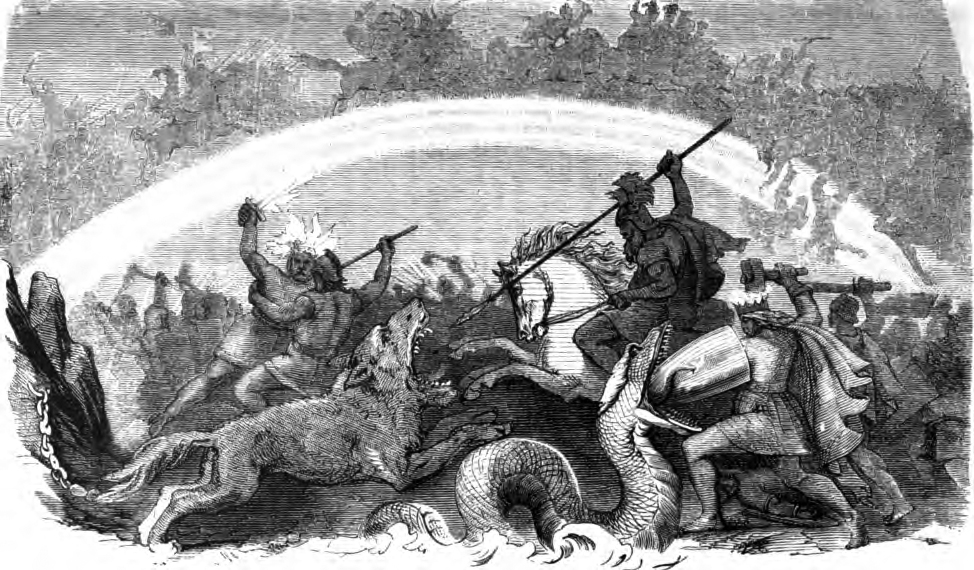
Setting Idea #1: The Day After Ragnarok
Food still needs to get onto the table. Peasants will still farm, hunt, and trap, while nobles will still war to protect their serfs or make allegiances to form fledgling nations. New gods are gathering power and vying for position among themselves and seeking new worship from Midgard. The effects of the blood of gods and monsters on the land creates new creatures, spawns new magics, and may give rise to new deities. Meanwhile old evils, once guarded against by the old gods are now able to resurface and reclaim power once theirs.
Setting Idea #2: After Magic
Steam. Gunpowder. Steel. Clockworks. With the gods dead and magic gone technology begins its slow rise to replace both magic and faith. Nations once based on powerful magics now find themselves third world countries while those who were always doing without magic are able to adapt quickly (if indeed they even need to adapt) to the changes in the world. New nations form, boundaries move, and craftsmen find themselves with eager patrons where before they had few.
Setting Idea #3: TransHumanity
The nanite plague reshaped the world in fundamental ways. The entire ecosphere reels in the wake of widespread genetic alterations, and the fusion of biological with technological. For two hundred years humankind totters on the edge of the abyss before pulling itself away. Now three species have risen to the top. The Chromed, who embraced the integration of man and machine and continued the process, become near ever-living constructs of robotics and cloned tissue, their minds transferable as data between bodies.
The Naturals, they represent that last of true humanity, having been born out of those who escaped the plague or were improved by it, they represent the apex of the human animal and have mastered genetic manipulation to continue refining the human form. The Deltas; the sliver of plague victims who found that the cure did not entirely disable the nanites. They learned to control the nanomachines within their bodies and were able to integrate them into their physiology. Earth's ecosphere is still a disaster, with techno-organic plant and animal life, chimeras, and even throwbacks having reclaimed much of the world.
Will these questions help you to design your next setting? Can this advice be useful for settings in other genres as well? I tend to think so, but what do you all think?