Wednesday, December 19, 2018

The Alphabet of Outer Beings - V is for Vengeance


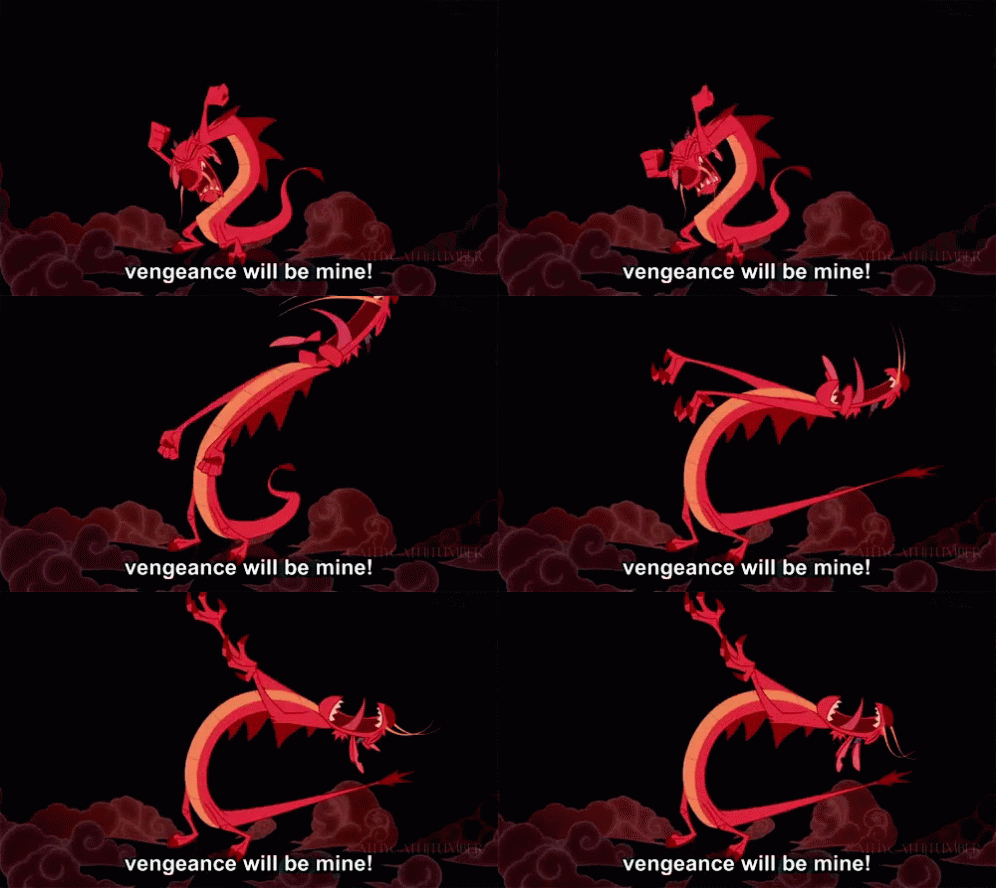
V is for Vengeance

Vengeance, the desire for a heaping bowl of revenge, best served cold and precise, like a good gazpacho. Vengeance, and revenge, can be either good or evil, lawful or chaotic. A paladin may seek vengeance by bringing the perpetrator to justice and, or they may fall from grace and descend into evil and chaos in order to exact their revenge. Revenge by itself is a neutral concept; a desire to balance an action (often an action perceived as wrong or harmful) with another.

Table V1: "Vengeance will be mine!" (roll 1d20)
  1. Said the Lord of Eternal Darkness to the God of the Blazing Sun at the birth of creation; and thus shall end the world. 
  2. Cried the holy champion after the razing of their deity's temple at the hands of the infidels.
  3. Exclaimed the child wielding the wooden toy sword.
  4. Screamed the sorcerer after his patron withdrew support at a crucial moment.
  5. Whispered the assassin as she removed another name from her list.
  6. Cried the king as he cursed the deity whose clerics failed to save his child.
  7. Said the master of the Guild of Larcenists after finding his safe open and empty. 
  8. Thought the captain of the merchant ship as he watched his cargo loaded onto a pirate vessel.
  9. Said the Wizard of the Red Tower as they recovered from a recently lost spell-duel.
  10. Proclaimed the King as he set his lords to ready for war.
  11. Groaned the necromancer as he felt his life ebb from his body.
  12. Swore the child of the chief amid the corpses of his tribe.
  13. Exclaimed the priest of dread Cthulhu as they fled the destruction of their temple. 
  14. Gibbered the goblin shaman as they set upon the killers of their tribe. 
  15. Growled the dragon upon finding its favorite bauble stolen.
  16. Proclaimed the Queen of the Winter Faerie upon learning of the death of her Winter Knight.
  17. Promised the immortal while cradling her lover's body.
  18. Thought the soul of the wizard as it observed its rival taking over its sanctum.
  19. Whispered the librarian after finding the stacks disorganized.
  20. Dreamed the Old One in its prison of eternal slumber.

Wednesday, December 12, 2018

The Alphabet of Outer Beings - K is for Knowledge


K is for Knowledge

Deities and patrons are immensely powerful beings, but they often have more than raw power to use to influence events to their liking and as trade for favors. This kind of knowledge can come from many sources and is often received in trade for other secrets. Some creatures even make the collection of secret knowledge their purpose, gathering it for safekeeping or for their own power.

Table K1: Things Known About ... (roll 1d4)

  1. Objects (proceed to table K5)
  2. Locations (proceed to table K4)
  3. Beings (proceed to table K2)
  4. Other (proceed to table K6)
Table K2: Things known about a being ... (roll 1d6, then roll on table K3)
  1. The true name of a...
  2. The location of the secret sanctum of a...
  3. The true weakness of a...
  4. The source of power for a...
  5. The location of a book of knowledge about a...
  6. The secret true identity of a...
Table K3: 1d8 Beings
  1. Deity
  2. Demon
  3. Wizard
  4. Lich
  5. Dragon
  6. Warlord
  7. Immortal
  8. Fey/Faerie
Table K4: Things known about a location... (roll 1d6)
  1. The location of hidden vault of a treasure. 
  2. The secret passcode to enter the library of the knowledge spirits.
  3. The location of portal between the mortal plain and the underworld.
  4. The true purpose of an ancient obelisk.
  5. The source of power within the fountain of youth.
  6. The purpose of the world.
Table K5: Things Known about an object... (roll 1d6)
  1. The location of the phylactery of a powerful lich.
  2. The identity of the soul contained within a powerful artifact.
  3. The identity of the next wielder of the sovereign sword.
  4. The contents of the Vault of Ages
  5. The reason why the Rod of Power was broken into pieces and hidden throughout the world. 
  6. The actual purpose of an artifact currently being used for completely different reasons.
Table K6: Other Knowledge... (roll 1d6)
  1. A long forgotten form of magic
  2. The truth behind the creation of the mortal races
  3. The techniques to alter fate.
  4. Detailed knowledge of the future.
  5. The secrets to immortality. 
  6. The being who holds the knowledge of (roll again from the beginning).

Wednesday, December 5, 2018

The Alphabet of Outer Beings - X is for Xenophobia


X is for Xenophobia

Xenophobia is a fear or hatred of foreigners and people from other cultures. In this instance it assumes that there are many deities and/or pantheons at work in the world and that the worship of a particular religion is a major defining characteristic of the people's culture. As such xenophobia represents not just a fear or hatred of other cultures but is conflated with the fear and/or hatred of followers of other deities. What follows is a means to determine how the deity and it's followers see and treat other religions and their followers.

Table X1: Attitude Toward Other Gods (roll 2d4)
Roll to determine how the god views another deity. This is often influenced by the cosmology of their religion; a god who exist as part of a pantheon of deities will have closer relations with others within their pantheon, and tend to be more distrustful of those gods from outside the pantheon. When rolling to determine the deity's attitude apply a -2 modifier to the roll for gods within their pantheon, and a +2 modifier for gods outside their pantheon. Lone gods without a pantheon gain a +3 modifier on all rolls. If the gods have opposing domains (such as a god of light and one of darkness) the roll is always +4. If the gods have opposing cosmic views (e.g. Law vs Chaos) apply an additional +1 atop any other modifier.
  • 2 or less: Friendly - The deity has a friendly relation with the other deity. They consider each other stalwart allies.
    • Apply a modifier of -3 to the roll on Table X2
  • 3: Accepted - The deity accepts the other deity. They are allied in most respects.
    • Apply a modifier of -2 to the roll on Table X2
  • 4: Tolerated - The deity generally tolerates the other deity, but they are allies only in certain circumstances.
    • Apply a modifier of -1 to the roll on Table X2
  • 5: Neutral - The deity has no strong relationship either way with the other deity. They generally will entreat when circumstances require, and ignore each other otherwise.
    • No modifier to the roll on Table X2
  • 6: Wary - The deity is war of the other and their relationship is, at best, strained.
    • Apply a modifier of +1 to the roll on Table X2
  • 7: Rejected - The deity generally rejects the other deity and avoids contact. They are enemies and only entreat when a great enemy forces their cooperation.
    • Apply a modifier of +2 to the roll on Table X2
  • 8:+ Hatred - The two deities hate each other to the very core of their beings. The will never entreat and will always seek the destruction of the other.
    • Apply a modifier of +3 to the roll on Table X2
Table X2: Typical Response to Followers of Other Religions (roll 2d4)
  • 2 or less: Friendly - Members of the other deity's religious cultures and viewpoints are welcomed and viewed as an opportunity to learn more about the nature of the world.
  • 3: Accepted - Members of other deity's religions live in peaceful coexistence.
  • 4: Tolerated - Members of the other deity's religions are not enemies, but there is not an active dialog between cultures.
  • 5: Neutral - The two religions generally ignore each other and do not interact.
  • 6: Wary - The two religions are not enemies, but they are often in conflict.
  • 7: Rejected - The religions are enemies, and conflict nearly always breaks out when they interact.
  • 8+: Hatred - Followers of the other religion are to be immediately slain without mercy as heretics and blasphemers.