Showing posts with label DCC. Show all posts

Wednesday, February 9, 2022

Nuts & Bolts #167 - Multiple Action Dice (DCC& MCC)


Let's talk about multiple action dice, or multiple actions per turn. 

I've played a lot of games that dealt with this in many different ways. In games were its more common characters might act across multiple initiative passes, where each character acts once, then you roll through initiative a second time, and then a 3rd or even 4th until all characters have used all their actions. This can work well for those games where all characters have at least 2 actions as it spreads the in game action around the table more evenly, but might not work as well when some characters only have a single action and others have 2 or 3 or more. 

For DCC and MCC this could work well at higher levels once characters get second action dice. This would allow a cleric or wizard to buff a fighter and have that benefit be gained in the same round regardless of this initiative. It would also prevent a bad initiative roll for the bad guys to just result in an utter beatdown. There are other alternatives though...

Which is where a second option comes in. I use this for creatures in DCC and MCC as it works well at to spread a single creature or a group of creatures actions around those of the characters. In this case it comes up less often for players (though it can, especially lucky MCC mutants), and more often for monsters and other creatures. I'm of the mind that a good combat in these games should have at least 1 monster action for every 2 PC actions. That ratio has some flexibility but 6 players vs a monster with a single action is likely to be a very boring combat. In these such cases I roll an initiative die for each action die the monster has. So a creature with 3 actions will roll 3 initiatives and get an action at each point rather than 3 on a single initiative value. This does require slightly more bookkeeping, but it also ensures (usually) that the monster goes throughout a combat instead of multiple actions back to back. This makes the combat more dynamic, and can allow the creature to direct its attacks in such a way that clever players can react and potentially avoid getting repeatedly beat down. With groups I use a unique initiative for each member of the NPC/monster group in the same way. 

You might be thinking, that seems like a lot to keep track of at the table, and its true. If I were playing in person more often I doubt I would do so, but since I do most of my gaming online I can easily keep a roster of PCs and NPCs in an Excel (or other spreadsheet) file and then sort on their initiative values for an easy way to run through combats. 

It works for me, and I feel like it keeps the players on their toes a little more during combat. 

Wednesday, January 12, 2022

Rulings Not Rules #2 - Missed Opportunity: Fear of the Dark


I hate missed opportunities. You always feel a little bad, no matter how much confidence you have in your own abilities as a Game Master. One of my players pointed this one out to me after the session, for which I am very appreciative as otherwise I might have not noticed my error and would not know to fix it later. 

In this case it was, once again, a game of Weird Frontiers. During a combat in a dark cave against some undead, the lone character with a light source fell. The lantern hit the ground. A quick roll to see if it stayed lit came up as a fail. The characters and the undead were plunged into total darkness. 

Total darkness.

While fighting undead.

For level zero characters. 

Now, Weird Frontiers has a mechanic called "Grit" which measures a character's guts, gumption, bravery, sanity, etc, The mechanics are simple enough, a Will save vs the source of the fear or horror, and if you fail you lose some grit and suffer a fear effect based on how much you failed by. 

Easy right? And yet as the Judge I just never thought to call for a Grit Check as the combat plunged into darkness and flailing about blindly. That was my missed opportunity. 

I shouldn't berate myself too much, but as I am trying to evoke a mix of western, horror, and action ... I missed a beat that could really have tied those genres together nicely. 

The next time it happens I'll certainly be better prepared. I've learned from my mistake (such as it was), and I'll remember, hey the dark sucks, and when something is trying to kill you it sucks that much more.


Wednesday, January 5, 2022

Rulings Not Rules #1 - Dynamite


As this is my first post in a while, and intended as the first in a series, I'll offer some explanation:

Rulings Not Rules is going to be something similar to my Hacking the Cypher System series. Instead of focusing on system hacks however its going to be where I can take a moment to reflect on off the cuff Rulings I make at my table during play to keep things rolling forward. This is especially useful in the space of my games within the Dungeon Crawl Classics extended family, as there are often times that come up in session where a ruling is needed either to prevent having to check the book, or because the book lacks the required info. 

OK, that that out of the way...


Dynamite!

What weird western RPG is complete without some ill advised use of that most iconic of explosives? 

Here's the thing with dynamite though. It's tricky, dangerous, and just because its as easy to use as lighting a fuse, doesn't make it idiot proof. Especially when a character wants to use it in the heat of combat at the spur of the moment. 

The situation: 

A large ritual chamber, the BBEG is working a ritual to raise a spirit from the beyond. The party is also dealing with bone golems and their general ineptitude (this was a level Zero "funnel" adventure). A character decides to place dynamite on the ritual altar in hope of stopping the BBEG with a boom. The character is not a miner, or any other relevant occupation, and has not previously used dynamite. Not possessing a death wish, they desire to place a 10 second length fuse. 

Now, here's where the rulings come in. Perhaps obviously there are no rules for determining proper fuse length for dynamite whilst in combat. So I asked myself in the moment, "Would it be fun if there was a chance that the character got the length of fuse wrong?" The answer was, 100% Yes. 

100%.

Yes.

So, Weird Frontiers has a Luck stat, and I asked for a luck check (a d20 roll under or equal to ones Luck at my table). In my mind the accuracy of the fuse was going to be the intended duration (10 seconds) plus or minus a die roll of d5 seconds. A successful luck check would be PLUS the d5 (because hey, at least it didn't go off early before you could flee), and a failed luck check would be MINUS the d5 (oh no, I'm getting blown up!). 

Needless to say the dice said to heck with you! A natural 20, which is a fumble result on a luck check. Not just bad luck, but horrifically bad luck. So, what to do? Clearly 10 seconds minus d5 seconds was my intent for a simply failed Luck check, but now I was looking at a fumbled Luck check. If 10-d5 seconds was bad, what does worse look like?

I decided to buy myself a few moments to think while the other player at the same Initiative value acted. Their character shot the fuse to activate the dynamite. Now, I don't know if that would work in the real world, but rule of cool 100% applied here. I did remind that the players that dynamite is just nitroglycerine that has been stabilized and is still prone to explosions from high impact; so a miss would be very bad. I also declared that the fuse, being rather a small target would be AC 18 to hit. 

The character managed a 24 to hit. So there we were. I had to decide on the fuse.

A fumble, I decided, would mean that the initial fuse length was just wrong. That length of 10-d5 became 5-d5 seconds. 0-4 seconds to get out of the blast radius of 2 sticks of dynamite. 

I explained the situation to the very tense group. Given that combat rounds in Weird Frontiers (and similar DCC adjacent games) is 10 seconds the best case was about half a round and the worst case was instant detonation. It all came down to the roll of that d5. And of course I wasn't going to roll it! I informed the player of the not-remotely-an-explosives-expert to roll that d5. 

A good roll of 2 meant the fuse had 3 seconds till ka-boom! That allowed the combat round to finish before the dynamite went off. The remaining PCs could try and flee and the villains would get their turns (since they had low initiatives). 

Sadly most of the PCs had already acted, and the BBEG completed his ritual that very turn, but then again ...


In hindsight I'm pretty happy with how this all played out. Maybe not the ill timed explosion, but that's not on me, that's the consequences of the players' actions, and I am always ok with those. I think in a non-combat situation or with a character who could reasonably be assumed to be familiar with dynamite I would have used a skill mechanic instead of a luck check, but again, only if there was something fun to be had from the fuse being the wrong length. If they have enough time to plan, prepare, and execute safely I always want to allow that to happen.

Tuesday, September 17, 2019

DCC Spell: Nuphon's Staff Infection


Stephen Newton made a joke about "Staph Infection" to which I replied (jokingly) about creating a spell called "Staff Infection" for DCC. However joke soon gave birth to reality so, please enjoy the punny fruits of a Twitter interaction...


Nuphon's Staff Infection

Level: 3
Range: 10'/CL
Duration: Permanent and/or Varies
Casting Time: 1 round
Save: Mundane staves get no save. Magical staves receive a save using the owner's Fortitude vs the Spell Check.

Description: 
The vile arch-wizard Nuphon crafted this spell specifically to destroy the elaborately crafted staves of a rival. When cast on a staff (magical or mundane) the spell will infect the staff and cause rot, mutation, and decay. Especially potent castings of this spell may also affect the owner of the target staff. If no staff is present the wizard may cast this spell on a tree within range at a penalty of -1d.

Manifestation: Roll 1d4:
  1. The caster coughs violently before expelling a disgusting blob of sputum that infects the target staff.
  2. The caster gestures forth with their hand and a gelatinous blast of sickly yellow-green energy strikes the target staff.
  3. The caster vomits forth a magically animated bile that flows over the target staff.
  4. The caster belches forth a noxious cloud of infectious gasses that travel to and surround the target staff. 
Corruption: Roll 1d4:
  1. The skin on the caster's hands splits open and falls away revealing rough wooden bark like skin.
  2. The caster's touch become inimical to wood and wooden items. Their very touch deals 1d3 damage per round to wood. This effect penetrates clothing and boots.
  3. The caster doubles over and begins to cough for 1 full round during which they expel 1d3 pounds of rotten wood chips, and suffer 1 point of Stamina damage per pound.
  4. The becomes highly allergic to tree pollen and suffer a -1d penalty to all actions while out of doors during the spring season. 
Misfire: Roll 1d4:
  1. The caster takes a point of Stamina damage and becomes riddled with disease and cancerous growths. Each day the caster must make a DC 15 Fortitude save or lose another point of Stamina. The disease rages until the caster is dead or succeeds on their save for 5 straight days. 
  2. The caster's own staff (or similar hand held item) cracks in half and is destroyed.
  3. The ground nearby caves in as a swarm of termites rushes forth and onto the caster inflicting a penalty of -1d on all action dice for 1d5 rounds.
  4. A nearby tree becomes diseased and begins to emit foul odors and drip caustic pus. Within 1 round its rotting trunk collapsed and the tree crashes onto the caster (or an ally within range) dealing 1d12 damage.
Results:
  • 1: Lost! Failure! WORSE! Roll 1d6 modified by Luck: (0 or less) corruption + patron taint + misfire; (1-2) corruption; (3) patron taint (or corruption if no patron); (4+) misfire.
  • 2-11: Lost. Failure.
  • 12-15: Failure, but spell is not lost.
  • 16-17: The caster targets a single staff within range. The staff becomes twisted and gnarled gaining 1d6 ugly cancerous growths. For each growth the fumble range of the staff when used in melee combat is increased by 1. On any fumble the staff breaks irreparably in addition to any other fumble effect. 
  • 18-21: The caster targets a single staff within range. The staff becomes thorny and rough as it splits and twists. The wielder of the staff suffers 1d10+CL damage as splinters and thorns tear through their flesh.  
  • 22-23: The caster targets a single staff within range. The staff becomes twisted and gnarled and gains 1d3+CL weeping sores. The holder must make an immediate Fortitude save against a DC of 10+ the number of sores or suffer stamina damage equal to the number of sores. 
  • 24-26: The caster targets a single staff within range. The staff becomes twisted and gnarled and gaining 1d6+CL corrupted growths that twist magical energy. These growths disappear at a rate of 1 per day. Additionally, the user suffers a penalty on all spell checks equal to the number of growths. On any spell misfire the staff explodes dealing damage equal to the number of growths remaining in addition to normal misfire effects. 
  • 32-33: The caster targets a single staff within range sundering it into kindling. Anybody within 5xCL feet of the staff takes 3d8+CL damage from flying splinters (Reflex save for half). 
  • 27-31: The caster targets a single staff within range which explodes in a fiery conflagration! Anybody within 5xCL feet of the staff takes 5d6+CL damage from burning cinders (Reflex save for half). 
  • 34-35: The caster targets a single staff within range which grows boils and festering wounds for 1 round before bursting in a shower of pus, ooze, and gore. Anybody within 5xCL feet of the staff takes 3d10+CL damage from diseased mucus (Reflex save for half) and must make a DC 15 Fortitude save against disease or lose 1d4 Stamina as boils and pustules break out on their skin.
  • 36+: The caster targets a single staff within range which instantly explodes in a shower of festering shards. Anybody within 5xCL feet of the staff takes 4d10+CL damage from diseased mucus (Reflex save for half) and must make a DC 20 Fortitude save against disease or lose 2d4 Stamina as boils and pustules break out on their skin.

Wednesday, November 14, 2018

Review - Primal Tales Issue One

Get it now

I don't do a lot of reviews, because reviews are hard, but I got this and thought it was worth my time to put some words out.

Vitals
Published By: Pandahead Publishing • Written by: Brandon LaSalle and Brett Brooks • 38 pages • $6.00 • B&W PDF (with a color cover) • $10.00 • B&W Softcover (with a color cover)

What's In It?

Primal Tales is a 3rd party product for Dungeon Crawl Classics (DCC; and fully compatible with Mutant Crawl Classics (MCC)). Contained herein are rules for anthropomorphic animal folk that differ from those contained within MCC. The primal are less of a race/class combo as commonly found in both DCC and MCC and more of a racial template in the way that humans are treated in those same games. The primal have the option of three character classes; the Savage Warrior, the Arcaster, and the Chimerae, which are analgous to a DCC Warrior, DCC Wizard, and a DCC Cleric with a more druidly bent. Lastly there is a write up for a new Patron, Lamia, and some of Lamia's servant creatures.

The primals are created very similarly to a standard DCC/MCC character with new tables to determine the animal species (or family) and occupation. The occupations are similar to those found in DCC, but the animal's family/species determine the type and damage of their natural weapons (teeth, claws, horns, etc.) as well as some innate natural abilities. These abilities are minor, like increased base movement, dice modifications for certain skill checks, or even specific capabilities like the ability to hold ones breath for an extended duration, the ability to glide for short distances, and more.

In this respect the primals may exceed the manimals of MCC at their base level for some players, and even if not expressly using these rules a Judge may use this to inform their own game. Conversely, the mutations that a manimal gets in MCC put them into an entirely different scope of play in some respects.

Of the classes the most interesting is the Chimerae which uses the divine spellcasting rules (using disapproval instead of corruption) forgoes the Cleric's Lay on Hands to instead gain Animal Transformation, and has a custom spell list built up from the Wizard and Cleric lists plus a handful of additional spells included in this book. Honestly this class is good enough to be included in an otherwise vanilla DCC game as a human Druid class without further modification; I really like it that much.

The Savage Warrior is basically a standard DCC warrior with improved damage and crit range on the primal's natural weapons. Meanwhile the Arcaster is very nearly a DCC wizard except for an automatic "Spirit Familiar" spell gained at level 1. Both of these classes are fine options for the primal but do very little to expand on the existing classes.

Lastly we get a new Patron in the form of Lamia, a figure from Greek myth, here given the full power of a patron. There are custom Invoke Patron, Patron Taint, and Patron Spells included as well as a handful of minions. All of these are interesting and new when compared to existing DCC Patrons and MCC AI Patrons. Again, I would include this material even in a DCC game without primals.

Closing Thoughts

If anthropomorphic animals are your thing this may well be a worthy product for you to consider. The different animal families/species all feel different and have traits to make them feel like the creatures they are meant to be, The primal classes range from interesting to fantastic (really the Chimerae is great!), and the introduction of Lamia provides an interesting new patron option that is both powerful and creepy.

Score: 90% Pretty much a grand slam, if only the Savage Warrior and Arcaster were a little more different from the base classes.

Thursday, April 19, 2018

Thoughts on a DCC monk

Image Source: https://www.deviantart.com/art/Monk-17-06-12-340307189

The monks of the far east rarely venture from their secluded monasteries, but from time to time a young monk will be too consumed with curiosity about the world or wanderlust to stay within their quiet and contemplative confines. These monks venture out into the world with very little to their name, a handful of coppers gained by begging in a nearby village, a stout stave, and the clothing typical of their order. Most of these monks eventually make their way back to the monasteries, but a truly scant few, of those scant few, decide to stay in the world, and of those few a bare handful pass their knowledge, incomplete as it is, on to a small number of worthy students. These students may seek out the monasteries in time to properly complete their own training and to complete the journey of spirit their teacher began. Others will take the lessons of inner strength and martial prowess into the world as adventurers.

Hit Dice: d8

Attack Bonus & Mighty Deed of Arms: as warrior

Weapons and Armor: The monk is trained only in the use of staves and unarmed combat. Monks rarely wear any armor and never armor with a fumble die greater than 1d8.

Flurry of blows: When fighting unarmed the monk may treat their fists and feet as dual weapons using the two weapon fighting rules. At first level a monk is always considered to have a minimum Agility of 16 (unless it is naturally higher) when fighting with bare hands and feet, at fifth level this increases to a minimum Agility of 18. When attacking unarmed and using the two weapon fighting rules the monk's unarmed attacks do 1d3 damage.

Chi Healing
Through meditation and mindful manipulation their internal energies a monk is able to speed up the healing of their own body. Once per day per level the monk may spend 1 turn in meditation to focus on healing themselves. Treat this effect as Lay on Hands (DCC pg. 30), rolling 1d20+Per+level. The monk is treated as "adjacent" and failure does not trigger disapproval, but does consume the use of the ability upon failure.

Be Like Water
Monks eschew armor in favor of staying mobile and nimble. On their turn a monk may add the result of their deed die to their Armor Class, and to their speed. This is in addition to any other effects of their Mighty Deed.

~~~~~~~~~

Now my thoughts on the design side.

  1. Hit Dice - While Monks are a martial class I knew I wanted to give them a recovery power and stepping down twice from the Warrior's d12 felt appropriate since they can self heal outside of combat.
  2. Armor and Weapons - I decided to take a hard stance here and basically rule out almost all forms of both armor and weapons. Weapons is a stylistic approach as I wanted to have them make many attacks with less damage per attack (at 5th level they can make 4 attacks per round but are still limited to 1d3 damage + STR and Deed Die). This might end up a little too powerful, but I'm unsure without playtesting.
  3. Flurry of blows - I copped this flat out from halflings and then added the 5th level boon since the monk is limited to their unarmed 1d3 damage. Again, this might end up a little too powerful, but I'm unsure without playtesting.
  4. Chi Healing - My sole concession to "mystical monks." My hope is that the 1 turn requirement and the limited uses per day will keep this from making them too durable compared to a warrior. 
  5. Be Like Water - This was the idea that spurred me to do this. Rather than approach "the armor problem" with a flat AC bonus scaled to their level why not utilize the existing Deed Die mechanic. This also means that the monk will occasionally roll poorly and be caught flat footed or in an open stance. The bonus movement was my way to also spice things up and allow these unarmored warriors to really move around the battlefield when they wanted. 

Feedback and comments are welcome, so long as they are constructive.

Wednesday, February 1, 2017

Nuts & Bolts #105 - Review: How to Write Adventure Modules That Don't Suck

Get it now from DriveThruRPG

Firstly, let me state as clearly as possible that this review is for the currently released 28 page version of How to Write Adventure Modules That Don't Suck, and should not be confused for a review of some kind of leaked or previewed version of the forthcoming 160 page How to Write Adventure Modules That Don't Suck that is currently on Kickstarter. I've been told that aside from the title and the subject the old and new versions don't share any text. I can't verify this at the moment, but let's go forward with that as gospel.


Now, all of that said, my intent in reviewing this was, in part, to get an idea of what to expect with with KS edition, and determine if I wanted to toss my hat into that proverbial ring. I'm somewhat, invested into Kickstarters and trying to back the monetary value of my outstanding pledges to something a bit more manageable you see, but Goodman Games puts out some good stuff, and so I want to make sure I don't dismiss this out of hand either. Ergo, a review of the original version.

Note: This is not DCC exclusive advice. It really can apply to ANY and ALL RPGs. 

Vitals

Published By: Goodman Games • 28 pages • $6.99 • B&W PDF

What's In It?

Nine articles by Joseph Goodman, Chris Doyle, Brendan LaSalle, Adrian Pommier, Rick Maffei, Mike Ferguson, Jeremy Simmons, Ken Hart, and Andrew Hind, that are written for GMs and writers working on adventure design. Each article broadly covers a different subject, from how to get the most out of puzzles or villains, to the importance of writing for your audience and proofreading.

I went into this as both a GM who is always looking for solid advice, and as a writer who has two adventures published at this point and is trying to understand how to make my next even better. I got my $7 worth for sure. Every article had something useful to take away. Something that had never occurred to me, or that having pointed out plainly made me look back and see how I could have done something different in an adventure I wrote that would have improved it.

I think that the stand out articles for me were the following:

  • Things I Look For by Joseph Goodman
    • This is more a bulleted list from a publisher, but it was eye opening to understand how a publisher who has hundreds of adventure modules in print looks at things. It also made me see at the highest level how to attack the "problem" of adventure design.
  • Designing Planar Adventures That Don’t Suck by Andrew Hind
    • I'm guessing that could easily be the title of it's own book, but as a short essay it still managed to convey the importance of setting your scale and scale for inter-planar adventures appropriately. 
  • Villains by Rick Maffei
    • You'd think that after 20+ years of GMing I'd know a thing or three about villains, and yet I was struck at how obvious and yet unknown to me the idea of contrasting sub-bosses was until I read it. Oy, how I could have made my Gods of the Fall adventure "Thirst" even better!
  • Verisimilitude by Adrian Pommier
    • I've written my own thoughts about this issue before, but usually from a specific subject base standpoint. This essay goes toward a more general all-encompassing approach and it works. It makes an argument for applying some simple logic rules to designing your adventures and encounters and even your dungeons. 

Closing Thoughts

Overall this little PDF really impressed me. More than once I wished I had read it a year ago. More than once I read something and found myself realizing that I'd made poor design choices in the past. I got something out of each of the nine articles and I suspect that most people will. Even if you just write for your own use at the game table I think you'll find some useful advice in here, and if your desire is to write for publishing this is one heck of a $7 investment in my opinion.

Look at this also convinced me to kick in for the Kickstarter edition, which is probably all the review that it really needs. The $25 bucks for a 160 page version of this with all new content seems like a no-brainer investment. I doubt I'll ever be hailed as a great writer of modules, and I'll almost certainly never be able to quit my day job, but if I get even half of the "revelation per page" density out of the KS edition I'll still be justified in my backing it.

Score: 100% - I almost never give perfect scores, but there is literally a wealth of advice in here if you are open to finding it.

Wednesday, October 12, 2016

Nuts & Bolts #94 - Review: Mind Games

Buy it now.

Dungeon Crawl Classics goes mental!

Vitals

Published By: Shield of Faith Studios • 67 pages • $4.99 (PDF) • B&W PDF with Full Color Cover

What's In It

I've always liked psionics. At times, and for some game systems, even more so than I like magic. There's something about the way a psion's power comes entirely from within. They are not beholden to a god, a patron, or finding spell tomes and other books to learn from. With nothing more than time and dedication a psion can develop their own powers.

So when I found out about this 3rd party supplement for Dungeon Crawl Classics (DCC) from +James Walls and that he was not only willing to allow us to play with it but willing to allow me to change classes after a couple of sessions I jumped at the chance & grabbed the PDF.

Mind Games is everything you need to add a Psion character class to the core DCC rules. It has the class, the powers, rules for psychic duels, a handful of psionic monsters, and rules for psychic weapons and baubles. Basically it's one stop shopping for all things of the mind.

The Psion is the kind of class that I think DCC really needed. It's a class that lends itself to almost any character regardless of stats, and can offer a legitimate alternative for players who don't feel like using one of the core options, but may feel pigeonholed to do so based on their stats. This works out because psionic powers are broken into four broad categories and each uses a different statistic to gain modifiers. Furthermore because of the way that psions invest in a focus dice (which act very much like a warrior's deed die) even psionic disciplines corresponding to a low statistic do not suffer overmuch.

The psionic power disciplines are psychokinesis (mind over matter), telepathy, psychometabolism (mind over body), and clairsentience (ESP). For each of these disciplines there are powers to attack, defend, assist, and utility powers; one of each in three levels, and finally a fourth level transcendent power that is very powerful but requires a great deal of dedication to gain.

The player can invest focus points into each discipline they want to use and gain a focus die that starts as d3 and steps upward from there to a maximum of d10. As mentioned before this functions like a warrior's deed die by adding to the psionic power check and also adding to the base psionic effect based on how well the deed die rolls. A dedicated student of one or two disciplines will be more powerful and more reliable with their abilities than a psion who dabbles in all the disciplines.
Example: At level 2 I had 4 Focus points to invest and could gain a maximum of 6 powers. I could have invested a Focus in each discipline for d3 Focus across each, but instead I invested 2 each in Telepathy and Psychokinesis, gaining a d4 Focus die in each. With 8 total powers available and a limit of six powers I chose the ones that would best compliment all aspects of play, exploration, roleplay, combat offense and combat defense. 
The choices involved with investing your Focus points and power slots helps to make for both meaningful choices but also to ensure that even 2 psions in a group will not play the same. Again these abilities also key off of different statistics and a player may choose to invest according to their strengths, or despite their weaknesses. All in all it's a strong system that ensures that psions do not feel too similar in play and can be accommodating of different characters and play styles.

While reading, I had concern that some of the psionic power may feel weak compared to wizard and cleric spells, but in play I found that, at least at second level, the abilities were pleasantly potent when used at opportune moments. Utilities like Psychic Hands provided a safe way for the party to cross rapids, while combat spells like Distraction and Kinetic Burst proved very useful in keeping our party safe. While higher level play will need still more time to evaluate I think that the psionic powers presented allow a breadth of options that may be less expansive than those of a wizard but are no less utile.

I cannot speak yet to the psychic monsters, though perhaps in time I will face them in a game. They are an interesting and varied lot ranging from cybernetic overminds to psychically powered lobster monstrosities, and a truly vicious psionic bear creature. Likewise the rules for psychic baubles and weapons read well but I have not yet played with them, though with luck perhaps a bauble will pop up in a soon to be raided swampy keep.

Closing Thoughts

I'm going to limit my thoughts here to the Psion class and the psychic powers because that's all I've really had any time with (and rather limited at that), but I rather like what I've read and in play the character was able to shine. The powers seem well balanced thus far, and offer a great deal of utility. My only real complaints stem from some typoes and a couple of rules that I thought could have been slightly more explicitly rendered, but I was able to suss out the correct answers, and gain confirmation from the author (+Reid San Filippo). If you are a fan of psychic powers and are looking to add an optional class that will feel truly different from the core DCC offerings the Psion is certainly set to fill your need.

Rating
  • Psionic Class & Powers - 95% really enjoying this so far!
  • Psychic Items - TBD, hopefully I'll be able to try these out soon
  • Psychic Creatures - TBD, these are interesting but I haven't seen them in play as of yet

Wednesday, July 13, 2016

Nuts & Bolts #86 - Why Mutant Crawl Classics?


On the odd chance that you are unaware of the current Mutant Crawl Classics (MCC) Kickstarter from Goodman Games it's a game based on their very successful Dungeon Crawl Classics (DCC) game mechanics but this time taking a OSR look at the post-apocalypse genre a la Gamma World. I happen to like DCC quite a bit thanks to my good friend +James Walls and I'm rather looking forward to MCC.  

But why am I backing?

Well that's complicated to answer. I love post-apocalypse as a genre, and while I have never once played Gamma World I have played another old pedigree post-apocalypse game rather extensively.


Oh yes, After the Bomb, Palladium Books' licence free spin off from their TMNT & Other Strangeness. Take a look at those five covers. Aside from the humans in power armor fighting mutant animals in the After the Bomb "core" book (really just a setting spin that used TMNT & Other Strangeness as its core rules) mutant animals are the core concept of the game. Guess what MCC has? MANIMALS! Yep, I'm getting MCC ...


I mean seriously, look at those covers, look at some of this art, mutant animals going all Mad Max? Check, Road Hogs does that (and yes, the Road Hogs were a motor gang of mutant pigs). Deep jungle survival struggles amid the ruins of pre-war tourism? Check out Mutants of the Yucatan (one of my all time fav covers. A long simmering cold war in the hot outback of Aussieland (Australia) where the bio-diversity of the continent has gone kinda bonkers? Mutants Down Under! Or perhaps you want a quasi-medieval, semi-fantasy take on Arthurian Legend using mutant animals riding around on giant snails (does +Darcy Ross know about this one?). Look no further than Mutants in Avalon!


I know there's going to be a lot more going on under the hood of Mutant Crawl Classics than just manimals and the ruins of the old world, but honestly I'm just looking forward to being able to haul out these old books to play in post-war America again.


Wednesday, April 29, 2015

Nuts & Bolts #30 - Fun(neling) with Tier Zero


Last week I wrote about my first experience with the Dungeon Crawl Classics funnel system. Granted it was Stormtroopers instead of sword and sorcery heroes but the idea was the same, and out of fifteen 0th level Stormtrooper newbs eight perished. I think each player was left with at least one living character, and, in theory at least, we could totally go on to become a squad of red clad imperial royal guard ... or not.

My point is that surprisingly playing a bunch of mediocre weak characters resulted in some pretty awesome game play, and gave the survivors some memorable backstory. In short, where I had been skeptical before, I was now converted.

There's only one problem; I don't usually play DCC. Not that its a bad system, I rather liked my time with it, but it's not what I play regularly and I don't know that it would jive with my group at home. What's a GM to do? Steal rules shamelessly and use them in their preferred system of choice, that's what!

For me that's Cypher System. I like how quick and simple it makes the mechanics, how I can "kitbash" an NPC or creature in seconds flat, and how I have a nice equitable system for screwing with the players via GM Intrusion. But Cypher doesn't use levels, and it doesn't roll stats, and it's both simpler and more complex than any class based system. OY! Now what?!

We build our own system.

I don't think that this is the only way, or even the best way, to do this. I know that's not true, but this is how I think I'd do it. Below is how I would have players create Tier Zero characters for Numenera. With a little effort & modification this could work for The Strange pretty well.
  1. Build a list of Descriptors that you are going to allow in your game. Trim it to some convenient to roll against number and build a random roll table.
    1. As a note, there is not a neat and tidy total number of Descriptors. As such, creating a random determination method may require leaving some out, and or using sub-tables so that the distribution curve will be flat. 
  2. Grab some scrap paper. Note that each of your pools Might, Speed, and Intellect, start with 7 points each. Note your Effort as 1. 
    1. tier 0 characters don't yet have a Type and so don't yet have any edge ...
  3. Roll 'dem bones, reference your table, write down the resulting Descriptor.
  4. Read your descriptor, note the skills and inabilities they provide on your scrap, add the bonus to the appropriate pool, note any other bonuses, and write down the additional equipment provided.
  5. Make four boxes for your recoveries, note that you only regain 1d6 points (zero tier, zero bonus). 
  6. Roll a d6, on a 1-2 roll a d20 on the Glaive Connection table (Numenera Core Rules pg 28), on a 3-4 roll a d20 on the Nano Connection table (pg. 36), and on a 5-6 roll on the Jack Connection table (pg 43). This is your background, you might be able to leverage it for an asset or two. (Note: rolling on these tables shouldn't lock you into that type, its just a quick and easy way to generate a background.
  7. Pick a name. Write it down. 
  8. Repeat steps 2 through 7 two or three times according to how much meat the GM wants to feed the grinder.
As an example ...
  • I note my starting pools of Might 7, Speed 7, Intellect 7, and starting Effort of 1
  • I roll on my theoretical table and get the descriptor Dishonorable ... hmm, I'm a dirtbag ...
  • I note my skills and pool bonus. Dishonorable doesn't have any bonus equipment so other than clothes I've got nothing of note (yet).
    • I'm not detailing the bonuses or skills for Dishonorable here. Go buy Character Options if you want to know.
  • I roll a d6 and get a 4, so I then roll a d20 against the Nano Connection table and get a 14. My result is "You worked the gardens in the palace of an influential noble. She wouldn’t remember you, but you made friends with her young daughter." 
    • since I am also dishonorable, I am thinking that I may have been working as a gardener to spy on this noble (or possibly worse).
    • I discuss with the GM that as a gardener I should probably have a shovel/spade and some gloves. A small spade would be a light weapon, a proper shovel would be a medium weapon. Both are improvised and may not last long. 
    • I note the name of the noble "Baroness Juutal" and her daughter "Kenit Juutal" on the off chance it comes up during play, or in the future if this character survives.
  • I pick a name "Rendarr Kalush" and I'm done.
I do that a couple more times, depending on how many PCs the GM wants to kill ...

After you play, any character's that survive get to become real PCs, they pick a type and a focus. They update their pools according to their type's base and then add the 6 bonus points. Note new skills, and abilities, and you're off to the races. 

+Jeremy Land suggested a different method in response to last week's column:
  1. Choose a Type and take the base starting pools, but do not add the 6 bonus points yet.
  2. Note your Effort, skills, and abilities. 
    1. Tier 0 characters do not start with their Type's normal Edge.
  3. Pick one Move/Esotery/Trick as appropriate.
  4. Roll on the appropriate Connection table.
  5. Repeat for each Type (3 total characters).
  6. Survivors get to add the 6 pool points, pick a second Move/Esotery/Trick, gain Edge, select a focus, and select a descriptor that fits how that PC played.
These characters have a little more oomph what with having a Move/Esotery/Trick, and a little bit more in pools (around 5 points more). However, without a Descriptor or Focus these characters will be far weaker than a full Tier 1 character, and would be appropriate for a funnel. 

I should note I haven't tried either of these, but I think I'd like to, and will probably look to do so in the relatively near future just to see how well they work. 

Wednesday, April 22, 2015

Nuts & Bolts #29 - Fun(nel) with Stormtroopers

Image Source: http://phantomxlord.deviantart.com/art/Stormtrooper-303710186

Earlier this year I got my first exposure to Dungeon Crawl Classics via the Quattro con Carnage experiment in cross-system gaming run by +James August Walls. Unfortunately, because we started the game with Basic Fantasy RPG, we didn't run through a funnel. While the idea of the funnel set-up had seemed odd on first hearing of it, seeing one of the other players go through the process after joining the group mid-way through I saw some of the charm of the meat grinder methodology.
For those who don't know, a funnel is a process where each player brings a number (4 per player is the norm) of level 0 characters (non-adventurers / commoners) and the GM runs them through an adventure. Life is cheap and character death is expected during this adventure because these characters are not yet "heroes". Any surviving characters are deemed worthy to become full fledged hero characters. 
Since Quattro con Carnage I've been curious about the funnel, and figured that in due time I'd get an opportunity to see for myself what kind of experience the funnel system is ... thankfully due time came swiftly.

Enter International Tabletop Day ...

As part of his plans for ITTD Jim had decided to create a Stormtroopers hack of DCC, and solicited advice and suggestions from the net to build a list of occupations for the Star Wars universe. Armed with that list he ran a one shot funnel using Stormtroopers in the sandy wastes of Tatooine.  Apparently he enjoyed the heck out of it, because with that game under his belt (or maybe burning a hole in his figurative pocket) Jim offered our usual Tuesday group the chance to take the role of a bunch of loser Stormtroopers in place of our regular game before we started the next chapter.

And thus D'erp, Saan Dyy, and Hau Berk were recruited into the ranks of the Emperor's "Finest"...

D'erp was the only character of mine to go. He wasn't the smartest guy (ok he was dumb as a box of hair), and the others convinced him to undertake the dubious task of setting up a zip-line from their crashed ship to the ground below. D'erp, being rather agile, managed to set the zip-line up and slide down safely. Feeling pretty awesome about himself he didn't see the womp rats until they were chewing his limbs off. *sigh* R.I.P. you magnificent moron.
D’erp - 0-level Occupation:  Hutt Informant
Strength: 10 (0)
Agility: 13 (+1)
Stamina: 12 (0)
Personality: 6 (-1)
Intelligence: 3 (-3)
The Force: 13 (+1)
AC: 13; HP: 3; Weapon: Blaster Rifle +1 (1d6), Speed: 30; Init: 1; Ref: 1; Fort: 0; Will: -1
Equipment:
One-way radio to Jabba the Hutt, blaster rifle that causes 1d6 damage, belt with compartments, stormtrooper armor (+2 AC), Starting Funds: 26 credits
Languages: Basic
Saan Dyy was the smartest of the group, and he made up for his lack of health with an abundance of brains. Towards the end of the adventure, as he group was facing down Obi-wan himself Saan mixed up an explosive concoction of imperial strength peroxide-based cleaner and suntan lotion. The improvised molotov failed to harm the jedi, but it did cause him to drop his weapon, and allowed for a fatal blow to be dealt to the jedi.

Saan Dyy
0-level Occupation:  Desert Comber
Strength: 13 (+1)
Agility: 12 (0)
Stamina: 9 (0)
Personality: 12 (0)
Intelligence: 15 (+1)
The Force: 12 (0)
AC: 12; HP: 1; Weapon: Blaster Rifle +0 (1d6), Speed: 30; Init: 0; Ref: 0; Fort: 0; Will: 0
Equipment:
Sunscreen, blaster rifle that causes 1d6 damage, belt with compartments, mop, bucket, peroxide cleaner, stormtrooper armor (+2 AC), Starting Funds: 35 credits
Languages: Basic, Huttese
Hau Berk the armorer was rather tough, with 6 hit points and some extra-heavy armor he'd modified partway through the game giving him an AC of 13 he was less concerned of getting into combat. Sadly he couldn't hit the broadside of a sand crawler, and proved largely impotent during the evening's activities (which is fitting I suppose). Hau's only two moments to shine involved taping himself to the crippled shuttle so he could shoot a womp rat two-handed, and being the only 'trooper to get shot and survive (at least I don't recall anybody else surviving blaster fire).

Hau Berk
0-level Occupation: Stormtrooper Armourer
Strength: 13 (+1)
Agility: 10 (0)
Stamina: 16 (+2)
Personality: 11 (0)
Intelligence: 13 (+1)
The Force: started with 5 (-2) ended with 3 (-3)
AC: 13; HP: 6 4; Weapon: Blaster Rifle +0 (1d6), Speed: 30; Init: 0; Ref: -2; Fort: 2; Will: 0 
Equipment:
Electrical Tape, blaster rifle that causes 1d6 damage, belt with compartments, Merit Badge (Awesome Use of Electrical/Duct Tape), modded stormtrooper armor (+3 AC, -2 reflex), Starting Funds: 33 credits
Languages: Basic, Wookie
Overall it was a fun game, a bunch of characters bit it in interesting ways (lightsaber, falling to their doom, womp rats, a blood clot), and I can see where the story of your 0-level nobody can help to drive a fun backstory and personality if you were to move forward into an ongoing game. I did find it strange how differently I played, how much more (in general) conservative I was with these fragile characters. I can certainly see the appeal, especially as the kick off to a campaign, and am considering how this might be something that could be ported into other game systems.

Tuesday, January 20, 2015

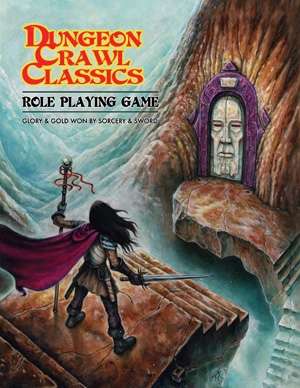
Nuts & Bolts #14 - Quattro con Carnage - Dungeon Crawl Classics RPG (a look at gaming across systems)

This blog references the Quattro con Carnage experiment being run by +James Walls and specifically the third and fourth sessions featuring the Dungeon Crawl Classics RPG segment, and my prior blog post discussing my thoughts on Basic Fantasy RPG.


This past week we completed session four of eight planned sessions (or four of ten if you wish to count the two session Dragon AGE expansion I will be running).  It was the second and final session with Dungeon Crawl Classics, an RPG which feels surprisingly modern in a lot of great ways even as it embraces (and occasionally wallows) in old school style.

I said previously how this experiment was my first experience with "OSR" rules since they were just "rules" about twenty years ago. Much like I had not played (or heard of) Basic Fantasy before this, I had not been exposed to Dungeon Crawl Classics. Coming to this RPG via this experiment was in some ways the ideal infection vector. Basic Fantasy was so stripped down and, well, basic, that it chaffed in a lot of ways due to its lack of certain aspects of game play that I prefer.

By comparison DCC felt like a breath of fresh air. Characters felt far more capable (I say felt because actual play did not always support this, more on that later though), with more usable abilities, and characteristics that lent themselves to more interesting options during play. At the same time the characters definitely felt grounded in the realm of pants-wetting mortality that BFRPG had, and I suspect is part of what some people like about OSR play. Likewise certain bits of DCC are most certainly rooted in tradition and not always a good way.

Our characters went from 3rd level to 2nd due in part of the level scaling of DCC vs BFRPG. My character, Lommán the cleric, retained similar stats, AC, and health, and so the change was more about his ability with combat and clerical power. Insofar as combat went I didn't notice a huge change; going from a +2 to hit to a +1 was what I would consider a negligible alteration given my character stats and his role in the party. On the other hand, going from a limited number of spells per day, including healing, to an at-will system balanced by a system of deity/sponsor disapproval altered Lommán's during-play feel immensely. From the get-go I knew that, so long as I could roll well enough, I could heal my group as often as needed, and likewise had the option to cast my other clerical spells more frequently.

The dice had something to say about that however; something not very kind, but I'll get to that in a second.

Unlike the spells of BFRPG that just work (like so many other spell systems), you need to make a spell check for DCC.  Success is variable, with the better results on the check yielding more powerful end effects. Scraping by with a healing check gave 1 or 2 dice of healing, while scoring a massive success granted 3 or 4 dice, potentially restoring the target to full health with a single act of justice healing. Similarly, spells like Sanctuary and Protection from Evil give better bonuses or last longer with better check results.

But let's get back to those damned dice, shall we? Remember how I said that actual play did not reflect how things looked on paper? Recall my comment about the dice having something rather unkind to say on the matter of our characters?

Over the course of two sessions Lommán proved fairly capable with healing hands (I think he only failed to heal twice), but his lord God Ogmios clearly felt that the cleric needed to rely on his own talents as much as his divinely given powers. When you need a 12+ to succeed with a spell and you have a +4 to that check you think "oh, an 8 is easy enough to roll, that's like 65% success rate" but when you tend heavily to roll 4's that doesn't work out so well.  Lommán was only successfully in casting two non-healing spells over the two sessions, and soon was worried that Ogmios would refuse any magic that was not used in conjunction with a personal sacrifice.  On the bright side it did lead the cleric to enter a room with known active traps to "take one (or three) for the team" under some holy protection.

The dice were not exclusively unkind to my character either. Our group's warrior, played by +Jeremy Land, had a pretty memorable stretch of poor dice rolling summed up best by the following quote:
Jim - "Has he ever hit anything?"
Jeremy - "Once… he killed a rat…" 
Despite rolling 1d20+1d4+2 for his attacks Umbrin simply accrued a truly epic string of failed dice rolls. This isn't a negative to the system of course, but it certainly makes it harder to assess just what a DCC warrior would play like. As an observer I can only feel bad for Jeremy's luck and hope that things go better in future sessions. Alternately maybe the rest of us can convince Jeremy to destroy those dice, if not for his benefit then for our own!

Back to the bad things for Lommán however. The flip side to divine magic is that each failed attempt also incurs disapproval from your god. The more disapproval you have the higher your chance for getting a divine wrist slap, or even a divine bitch slap, in for the form of an increasingly wide range of roll results that will incur a little retribution. You always suffer disapproval retribution on a "1" but each failed spell or ability check adds to the range going from "1" to "1-2", and so forth.

Naturally on his first attempt of the 2nd session Lommán rolled a "1". He was forced to roll on a table to find out the effects of his punishment, but luckily my penance was easy; Lommán just had to convert a new follower for Ogmios' church. Thankfully there were four level 0 characters nearby and a natural 20 later not only had he done just that, but his conversion roll was a "20" and Ogmios even forgave Lommán's earlier trespass and removed a point of disapproval.

I would be remiss to point out that the party's elf (since elf is a class in DCC, one of those times when DCC wallows in OSR in my opinion) had the opposite luck with spells. Magic Missile can become a deadly rain of destruction with a high enough check result and between good dice rolls and judicious use of spell burn there were some spectacular fireworks.  Spell burn is another not very OSR mechanic that really looked cool and fun. Basically it allows for the spell caster (I think it is only usable by arcane casters) to take ability score damage in trade for additional power/bonuses for their spell checks. You get weird results when you do it, and the scars and facial ticks of the party's elf certainly added additional dimension to that character in only two sessions, making me wonder how things would look over a full campaign.

We also saw the preferred method of new character introduction in DCC in our second session, with an new player coming to the table with four level 0 commoners. As expected not all of them survived the entire session, with only a single character standing at the end of the evening. Coincidentally, or perhaps not, it was the dwarf blacksmith who earlier in the evening had converted to worship of Ogmios who survived, showing that indeed the God of Justice was watching out for his followers.  That or maybe +Andreas Walters just got lucky with his rolls.

All is not perfect in the pages of DCC. Being a demi-human is a class, which makes me concerned that all such characters will end up with a certain sameyness. You can't play a halfling rogue or a elven cleric for instance, which is a real shame, and an aspect of game design that holds the game back. Meanwhile while certain buff spells seem weak to the point of uselessness (+1 for a single round, seriously?) at their lowest level of success. These really stand out to me as an unnecessary holdover from the "old school days"; a +1 bonus maybe wasn't so powerful when there was no risk to the caster for using the spell (aside from the risk of preparing a crappy spell).

At the end of the evening, and the end of our time with DCC, I felt pretty good about these two sessions. Where Basic Fantasy had reminded me about much of what I did not enjoy about my AD&D experiences in high school, Dungeon Crawl Classics felt like a game that balanced rewards and punishments with equal measure (dice not withstanding), and genuinely felt fun.

I don't know that I would ever look to play BFRPG again, but I would certainly be willing to play in more sessions of DCC as I feel that we only touched the tip of the iceberg of that game's potential. Is it the best RPG for OSR style fantasy? I dunno, two sessions isn't enough to make a real judgement, and personal taste for certain factors will also contribute to your like or dislike, but for short and medium term play I can get behind it.