Showing posts with label Time Travel. Show all posts

Wednesday, May 4, 2016

Nuts & Bolts #77 - Time and Again Part 6 - The (In)Finite Tree

Image Source: http://saretta1.deviantart.com/art/Time-Freeze-70324619.


This feels like deja vu ... unless of course you haven't read Parts One, Two, Three, Four, or Five yet.

What was done is done, and what will be will be ...

A single timeline of events that cannot be changed means that the setting will not change no matter what the players do in the past or learn about the future. What is written is written, but what is known may not be truth. In a game such as this characters may still have a role in shaping the past, and may yet find that their role in the future is not as clear as they believed. Going back the characters may find that they have always been an integral part of the history of events. Likewise seeing the future means being bound to the events they have witnessed, but possibly not in the way that they think.

Consider 12 Monkeys (the movie moreso than the TV show, although the show is pretty great). James Cole has seen his future, but isn't aware of it, and the scientists in the future end up causing the plague instead of helping to prevent it. Causation is a funny thing, and traveling through time just makes things complicated, but doesn't actually empower you.

If you plan your time travel game to feature a fixed timeline of events that unfold no matter what is done you'll need to lay a very strong foundation and have a very good grasp on cause and effect. That's not saying it can't be done, but it's going to be a lot of work to pull it off and have things turn out as planned.


An (in)finite multiverse

Pretty much the opposite of a single immutable timeline. Essentially every decision, every random occurrence that can happen does happen, and with divergent occurrences come divergent branching timelines. This can be taken to a logical and extreme end where everything is possible and there are infinite parallel worlds each slightly different. At that point traveling backward and changing something just creates a new timeline starting from the point of the change and moving forward. The actions of the characters don't change events in the grand sense, but they do create a new universe (or merely act to allow them entrance into said universe) where things are different. At this point time traveling is just a complicated version of dimensional travel, and worse, one where the things you sought to change still exist objectively, even if you no longer have to deal with them subjectively.

This can be really fun if the game is about exploring these other timelines and multiverses and the players don't have expectations that they can actually alter history "for the better." On the other hand, if the players want to try and go all Quantum Leap and "put right what once went wrong" this kind of setup is probably going to piss them off because they can't. Sure they can keep tweaking their multiversal location to end up living in a "better" timeline, but out there, somewhere and somewhen, all of those bad things will still exist.

The bright side of all this is that these kinds of games are pretty easy to run, because you don't really need to keep track of complicated loops in the timeline, instead its all just a new branch on an every growing tree of time. The complicated part might be the heavy lifting of history and alternate history you'll need to generate.

Alternately a multiverse can be finite in size and scope. Yes, there is huge potential for variation here, but there are also finite possibilities and finite worlds. These worlds could spin off in various ways from the "prime" world. Perhaps there are certain focal point events that are major enough to cause a new branch to the timeline to account for multiple paths. Or maybe these branching points are less significant and more arbitrary; perhaps there is only a schism point every 100 years regardless of the events in the meantime, or new timelines can only spring from acts of true and pure random chance.

This will require some degree of the above bookkeeping, but the limited nature also means that players have the ability to affect real change to the various branches of the timeline, and that may make for a better game for everybody involved.


You can't go home again ...

What about a single mutable timeline? You go back, you change something, and you return "home" to find everything different. Or maybe just small things. You go to the future, witness something horrible, and then resolve to return "home" and ensure it never comes to pass, and with effort, skill, and luck you can! For the characters these stories will offer them the greatest opportunity to feel as though they are creating meaningful change. Being able to go back and change the course of World War 2 should create a massively different present, for better or ill, based on the actions they took. Likewise staving off some horrible future event should result in a outcome, but that outcome may not always be better than what was previously seen.

Personally I think this is the most interesting form of time travel. It allows the characters to "play god" and allows the GM to really twist and alter the setting accordingly. It is a lot of work however, as each change means rewriting some portion of the setting's "history". Changes need not be good however, and even the most careful change can spin out of control due to the butterfly effect. You can engineer a situation where the PCs need to return and undo the changes they made, or possibly even become their own opposition in the past. 


Null Time

What about null time? Null time regions are usually outside of the normal space-time and exist in perfect stability regardless of what happens to the timeline(s). These spaces make good bases of operations for characters and groups dealing with time travel. It ensures that they won't accidentally erase their home during an excursion, and often provides proximal access to all parts of time with equal ease (instead of having shorter time jumps be easier than longer jump, or some such). The other great thing about null time regions is that they are paradox free, which means characters can meet themselves and all kinds of wackiness can occur within.


Hybrids

These are of course the most general concepts. There are likely continuums where there is a "strong prime" that resists change and many offshoots and loops that were strong enough to form "spurs" but not strong enough to force a change to the primary timeline. These "spurs" may eventually loop back to the prime to simply dissolve as they diverge and become increasingly more unlikely to have ever occurred. Or perhaps a setting where a limited multiverse is the result of a paradox "breaking the timeline" and the characters need to fix things so that the timelines will merge and prevent some kind of catastrophe.

Closing

I'm considering a home-brew setting (blog-brew?) time travel based setting using fragments of timelines that remain static alongside a mutable timeline. It's still in the brainstorming phase, but with time and effort it may well come together and make appearances here on the blog.

Monday, April 25, 2016

Story Seed - Travel Time

Image Source: http://www.deviantart.com/art/Times-square-290301030

Excerpt from the introduction to "A History of Temporal Travel" third edition:

First of all, let me just get this out of the way, yes, time travel is possible.

Secondly, time travel is either extremely difficult or appallingly easy, depending on which way you do it.

Thirdly, and you probably already figured this out, but mistakes do happen. 

We don't know when the technology to travel time was first invented, or discovered, as chronal navigation was subject to multiple thefts and subsequent anachronistic temporal inceptions. As a result we can only say that the technologies eventually came to crop up in the opening decades of the twenty second century at which point further anachronistic inceptions were impossible by virtue of lack of the fundamental prerequisite technologies.

More problematically there are unique people who, for reasons not well understood, find themselves no longer fully bound by time's flow, and exhibit strange abilities that seem supernatural to the unaware. A few of these rare individuals show evidence of being able to eschew the normal technological trappings normally required for chronal navigation. 

With regard to the so-called "timeline," as you will learn time is not a line, but a woven tapestry of events with multiple outcomes. Many of the lesser inflection points create only minor disturbances that a quickly reintegrated to the "prime" sequence, while major events spur offshoot sequences that may take considerable time to converge, if indeed they ever do. 

Wednesday, July 22, 2015

Nuts & Bolts #42 - Time and Again Part 5 - Temporal Stimulus

Image Source: http://saretta1.deviantart.com/art/Time-Freeze-70324619.

On the odd chance that you are finding this new without having read earlier entries you can find Parts One, Two, Three, or Four by clicking through.  We've reached the terminus (for now) of my ranting about time, but before I go I wanted to share my sources, and ask for your suggestions. Time travel is one of my favorite subjects and new movies and TV shows on the subject are always welcome, and given the spare few books dealing with time travel I have read I'm more than happy to entertain suggestions from my readers.
Histories that are, were, and might have been ...

This is a little "bibliography" of sorts, or perhaps more of an Appendix of whens, wases, and could have beens ...

Note: this is by no means an exhaustive list but these represent my favorites and inspirations...

Films

  • Back to the Future (series)
    • The first of these is the best, but the second gets in good with me because it dabbles more into the timey wimey of time travel. The third I enjoy because who doesn't like a little western steampunk with their sci-fi?
  • Terminator (series) 
    • Of the four I have thus far seen the first two are the best, but even the 3rd and 4th make decent action films. Only the first three have any time travel elements in them however.
  • Timecrimes
    • If you haven't seen this, go find it and watch it, it's an a amazingly convoluted time travel tale that somehow managed to be (at least as far as I can tell) completely consistent and 100% close looped without leaving anything dangling. Really very well done.
  • Predestination
    • Another lesser known movie, this one is as much a character study as it is an object lesson in time travel mechanics.
  • Primer
    • This is very much a character piece, but it is also noteworthy for its more unique take on the methods of time travel.
  • Bill and Ted's Excellent Adventure (and Bogus Journey)
    • These are comedies, and the treatment of time travel is pretty light, but they are pretty fun regardless. Look at the interesting time travel solution to a locked door problem late in the first movie as an example of how time traveling characters can get really creative.
  • Timecop
    • Van Damme-it this one is a real mixed bag of early '90s action-sci-fi. Notable for the paradox that occurs when the same person from two points in time intersect (it's messy).
  • 12 Monkeys
    • In my opinion Terry Gilliam's best film that doesn't include Monty Python. Predestination, bootstrapped information, and a delightful sense of paranoia (plus a young Brad Pitt being amazing). This one is so good it managed to spawn a TV series that even SyFy couldn't screw up.
  • Frequency
    • Another unique look at time "travel" (more like communication) that gets into the consequences of altering past events. The way that the main character starts to assimilate the new timeline's memories is nicely done.
  • Looper
    • Predestination and paradox (sort of). I really love the idea of characters having to outwit their earlier selves, or trying to off their own future selves. 
  • Project Almanac
    • Of note for the interesting paradox the results from a person encountering a copy of themselves and the chaos theory/butterfly effect of changes as the hero tries to fix things.
TV Series
  • 12 Monkeys
    • Considering how much I love the film that this is based on, and that it was going to be produced and aired on SyFy I went into it with a great deal of trepidation.  Thankfully the end result was not only good, but shockingly good, excellent even. They managed to take the concepts and ideas of the movie and expand them, alter them, and yet stay true to them in such a way that the end result is a rather amazing product all on its own. This one dives deep into the time travel aspects of paradox and predestination, but also starts to introduce the wild card of free will into the mix. I can't wait for season 2.
  • Doctor Who
    • Do I really need to explain myself here?
  • Quantum Leap
    • Another non-traditional take on time travel. The series ender confounds some people, but it's hardly enough to detract from the series as a whole.
  • Lost
    • Gripe all you want about the ending, but during its run Lost was a show that had the bravery to the kitchen sink of weird at the viewers. The time travel elements were surprisingly well put together too.
  • Flash Forward
    • It's a shame that this series never got past season one as it was looking at predestination versus free will in a very unique way that I found really interesting. 
  • Continuum
    • Along with 12 Monkeys above this one has some great looks at temporal mechanics. In this case alternate and multiple timelines, bootstrap paradox, and the consequences of changing the past. 
Books
  • The Time Machine
    • Arguably the grand-daddy of all time travel fiction. Far flung futures, human evolutionary offshoots, and the troubling nature of things beyond our control. 
  • A Sound of Thunder
    • I haven't actually read this yet but it's so well known as an early use of the "butterfly effect" to show the effects of unintended consequences. It's also spawned any number of other fictions...
  • Shockingly that is all I can think of for written fiction, which means that I am more than open to suggestions from my readers for good books or short fiction about time travel. Hit the comments below and let me know.

I unabashedly love time travel, and one of the things I didn't do with this series that I wanted to was to go into details on time travel continuums.  It's likely I will return to this series again in the future (sadly the past isn't possible) and explore the subject more, but for now I thank you for bearing with me and sincerely hope that if you actually read all of this you enjoyed it and got something useful out of my efforts. 

Wednesday, July 15, 2015

Nuts & Bolts #41 - Time and Again Part 4 - Conveyance Through Chronology

Image Source: http://saretta1.deviantart.com/art/Time-Freeze-70324619.

This feels like deja vu ... unless of course you haven't read Part 1, Part 2, or Part 3 yet. But don't worry, if you haven't I'll be discussing some of the ways that you can get back to the past to check them out, or maybe slip forward and read next week's blog early.


Time, and relative dimensions in space

Ever wonder what one of the simplest arguments against time travel is? Well consider that at no point during your life have you ever experienced absolute motionlessness. While you may have been still relative to your frame of reference you were moving quite rapidly through space.  At the equator the Earth spins at a speed of about 465 meters per second (that's 1674 kph, or 1040 mph), so you are moving along at a good clip right there, even if you are fairly far to the north of the equator. The Earth revolves around the sun at 29.78 kilometers per second (18.5 miles per second) which no doubt faster than you can jog on a good day. The sun, and by extension the rest of the solar system is cruising through space on its orbit around the galactic center at a speed of 220 kilometers per second. 

Suffice to say that one of the more plausible reasons for time travel to be impossible is that for each second you skip the place you were standing is going to put a couple hundred kilometers between you and it. For any meaningfully "distant" trip through time you'll also need to cover a rather large distance in space. Something a TARDIS doesn't have a problem with, but I think even the most heavily modified DeLorean is probably going to fail at.

Thankfully RPGs aren't the real world, and we can largely ignore these kinds of party pooping facts with a little hand waving.

Image Source: http://matchack.deviantart.com/art/City-Industrial-Final-390900525

Magic

So you want to travel through time, and due to the unfortunate trivialities of fate you were born or created into a world of magic and myth rather than science and technology. Luckily magic can still cover you.  Depending on the paradigm of the magic system you may looking at certain spells geared toward manipulation of the space-time fabric, or possibly even entire schools or styles of magic that deal with time.

For general magic, spells like slow or haste could work by changing time around the target or user, for instance allowing time control to become the trappings of existing spell effects. If that paradigm uses leveled spells these are probably going to start in the mid levels and go up from there. A spell that allows the user to travel in time for more than a second or two will probably be of a very high level and/or require a great deal of proficiency and power. 

On the other hand schools of magic specifically pertaining to time like Clockwork magic and Temporal magic may exist in a setting implying that control over time is more common and perhaps more common or less difficult. One would expect that a student of Clockwork magics will not need to gain multiple levels before learning the simplest of spells; at least not unless the school itself is some kind of "prestige" magic requiring mastery of other lesser schools before it can even be attempted.


In general magic just works. Maybe there is the requirement of a check to cast the spell successfully, maybe not. However, once cast successfully, spells like slow and haste will probably just work the way they always do, but spells with a grander scope, like Time Portal or Revisit the Past may have the additional requirement of a check to direct the spell properly. These are powerful effects and if you make a mistake you may jump backwards more years, or fewer, than you intended, or you may end up in the future instead of the past.  A portal may likewise fail to connect to the target time, but it could also become a two-way effect, or even slip sideways into a different dimensional timeline.

All things considered you probably don't have much to worry about with regards to getting home either. Unless you don't have the spell fully mastered and need a spellbook to re-prepare the spell for a homeward journey, or you relied on a spell effect built into a device (a scroll, staff, wand, etc) then you have nothing to lose. Nothing, at least, unless magic is cyclical in your world and your trip takes you to a time where magic has waned enough that the spell to return home requires more magic than you can muster from yourself and the environment.

While I wouldn't go so far as to claim that traveling through time with magic is easy, it may be true that it is easier than doing so in other ways.


Tech

Probably the most common way to travel through time if lumped into a single category. Technological means of moving through time come in so very many shapes and sizes.

At the smallest end you have wearable devices like a Vortex Manipulator from Doctor Who, or a Legion ring from DC's Legion of superheroes. These are convenient as they minimize the user's risk of getting separated from the item. If you can wear it, you can take it with you once you get to the past or future. You might want to consider making your device look inconspicuous as well. While style is important it does you no good to get robbed for the gaudy bauble that is also your only way home.

Of course the size of a wearable device is also a potential negative.  Small size means that such devices are easier to hide, and also easier to lose. Unlike a big vehicle which could be stolen but probably not well hidden a watch sized device could disappear in the hands of thief and never be seen again; not very good for your return home. Small devices may also have less robust power batteries. You'd better be certain before you leave that you have maximum charge or a way to re-charge at your destination.

The lack of full enclosure may or may not also be an issue. Depending on the specifics of time travel something you wear may end up exposing you to a very rough ride, dangerous chrono-radiation, or other forms of hazard as you move about the timeline. As a GM I look for opportunities such as these to make things interesting and add additional layers of risk and adventure.


Next you have the vehicular time machines. Note that this does not imply the machine is a vehicle through spatial dimensions, though it could be, but a vehicle through time in that it is something you can climb into and out of that travels through time with yourself, and possibly others, in tow. Being enclosed within ... whatever means that you are probably a lot better protected from the rigors of time travel than you would be with a wearable device. It's also going to be a little more difficult to lose or have stolen, but far from impossible depending on the era and the size and weight of the device.

One of the bigger advantages besides protection is that you can now take people and things along with you. Wearable devices are usually limited to the person carrying them (though it may be allowed to stress the device to carry and extra person for a single trip after which repair or replacement will be needed), but once you have a time vehicle you can bring along passengers, companions, even prisoners or booty.

At this point size begins to prevent you from blending in very well (unless you have invisibility or chameleon type features as well) and so style becomes something that may be of interest. While an icebox or a bathtub is no doubt functional it leaves a lot to be desired in terms of size and secondary features. A nice sports card is already capable of carrying two or more people around, adding time travel powers to that is a logical choice. Doing the same with a larger vehicle, a plane, boat, or even spacecraft has the potential to include more features (living space, repair facilities and supplies, library, etc) while also making said devices fairly conspicuous.

A big downside to all of this is that fuel consumption tends to increase with size, and repair becomes a greater concern as the device gets larger. A lone traveler will the skill to do so can maintain a small vehicle with little or no aid (provided they have the parts), but a damaged spacecraft or other large vehicle may quickly fall out of the scope of repair for a single individual.

Image Source: http://robertdbrown.deviantart.com/art/Terra-Nova-Portal-300822858

Lastly what about devices that don't travel through time, but instead create portals or tunnels in time through which people can travel. Thee device stays where it is, meaning that a return trip may or may not be possible. In some instances the time traveler may only have so much time (heh) at their destination before their unnatural existence at that point causes them to rebound to their original time. Travelers may even find that without a device capable to canceling this tendency that they cannot travel through the portals at all. Likewise it is possible that instead of snapping back to their home time the overwhelming temporal forces may tear the person apart. Aging a traveler into the future so that they "catch up" to the current time, or de-aging a traveler to the past for the same effect. In either instance this could kill the traveler, through extreme sudden old age, or by rendering them into constituent matter at the state it existed in before they were born. Temporal stresses might also simply tear the victim out of the timeline altogether like a form of paradox.

Even assuming that one can travel back safely, how does one return to their own time when the device that got them there only exists in the far future or the deep past - relatively speaking? Travel to the future may be easier to deal with, its possible the device is still available for use in the future and could send you "home" again just as easily as it did to the future. In the past you are probably going to be stuck, unless of course you planned ahead and have somebody who could open the portal home for you.

Devices like these might also act as more of a teleportation (teletemporal?) devices, meaning that there is no tunnel or portal through which a person could return through from the other end. In these instances any trave would be one-way unless there was a similar device at the other end, or a means for the device to recall in addition to its ability to send travelers. This could again require the user to have some kind of special device (a homing beacon) or be marked in some other way (a chemical or radioactive, possibly chrono-radiation, tracer). The traveler could still be lost if the device was broken or lost/stolen, or possibly if the tracer agent was flushed from their body in some way.


Natural 

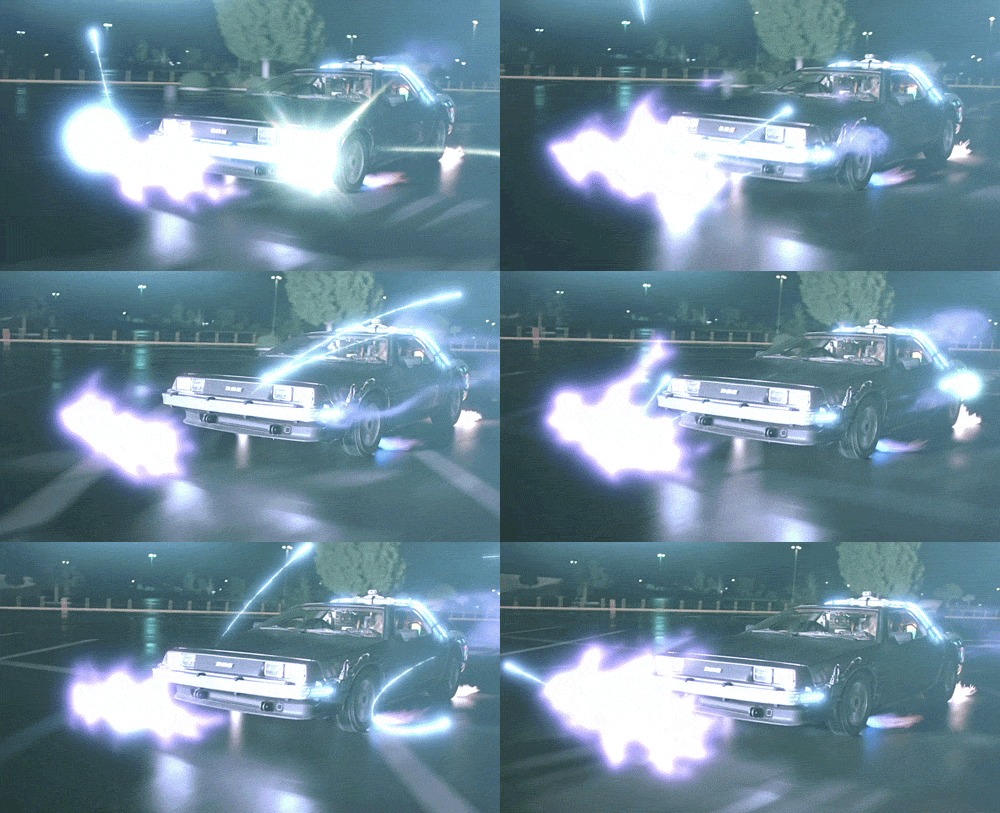
Time travel need not be a matter of magical skill or mechanical know-how. It's possible that in order to travel through time one must harness the raw power of nature in certain locations, or via certain phenomenon. For all the good that the DeLorean did getting Marty to 1955 it was the harnessed power of a bolt of lightning that got him home.

Black holes are one of the most powerful phenomenons in all of nature. Infinite gravity is capable of bending the fabric of space itself, capturing light, and altering the way that time passes for those within its sphere of influence. For all that we know and theorize about black holes there is a lot more we don't know. The nature of the phenomenon prevents us from actually observing them directly; we can only gather data from the matter and energy trapped in a black hole's embrace while the singularity itself lies hidden behind the event horizon.

We know that as you get closer to a black hole the warping of space-time imposes time dilation. While you observe time going by as normal those outside of the effect (or even just farther away) will see your frame of time moving slower and slower. Time is relative after all and as gravity increases time slows for the observer within the area. If you wanted to travel forward this would be a good way to do so; dip in close to a black hole and then sling yourself out. The short journey for you will have taken place at a slower pace of time than for those outside. Depending on how close you got and how quick your trip was you could skip decades, centuries, maybe even millennia or more.


But what about going backwards? In the real work we don't know that it's possible, though there are various untested theories. We don't know what goes on behind the curtain of a black hole's event horizon though and since RPGs are fiction we can start making things up. It's possible, for instance, that the singularity at the heart of a black hole may lead to any number of possible end states. Travel through time could be one of them. If gravity going up means that time passes more slowly than infinite gravity must mean that time stops (makes sense, right?). Perhaps passing through the singularity itself leads to a point outside of time and space and gravity. This exterior space might be able to see all of time and space and from there you could move about outside of the normal limitations of our universe. Eventually you could find a spot and breach back into the world, skipping backwards or forwards in time and ending up at any point in space you desired.

Black holes and singularities aren't the only ways that nature may allow you violate the normal flow of time however. Wormholes bridge two points in space, but if it was possible to keep a wormhole open and move one of its ends you could create a bridge between times as well.


Open a stable wormhole in the year 2100. Take your fastest ship and tow one end of the wormhole (end A) behind it while leaving the other (end B) to orbit Earth. Your ship now accelerates to it best speed; let's say that that is 90% the speed of light. The ship goes off at incredible speed on a journey that will take it one thousand years of time relative to Earth. When the ship returns in the year 3100 the crew, the ship, and the end of the wormhole that was being towed have experienced a mere fraction of that thousand years because of the relativistic speed they were moving at. I don't know how to do the math but let's say that for the crew their little jaunt around the galaxy and back felt like only one year. That means that while wormhole end B dumps out on the year 3100 wormhole end A terminates at the year 2101, meaning that you have built a time travel bridge of 999 years.

Other natural tunnels through time could exist. A tear in time could be the result of paradox, allowing people to pass between the past and future times that caused the paradox itself. A rift in time like this could possibly be a bootstrap where a traveler from the future comes to the past via other means, creates a paradox that results in a temporal tear connecting past and future. People begin to use this portal as a natural resource of sorts until at some point in the future it collapses. The future society puts resources into inventing time travel via other ways and sends somebody back in time to find out what happened to the time tear. They cause a paradox which brings us right back to the beginning and the creation of the time tear. In such a timeline the rift in time is its own cause as it was a direct result of the portal closing that lead to a traveler to go back and cause the paradox that created the rift in the first place.


I'm sure that I am probably forgetting something important or glossing over something I meant to go into more detail on but this has proven longer than expected (2700+ words). I continue to hope that you all are enjoying this mini-series and getting something useful out of it; I know I am.

As is always the case I am more than willing to hear your thoughts on the matter. Did I miss something? Have I made a mistake? Please let me know. Meantime, for the next article in this series I will be planning to discuss changes to the timeline, and the damage that such actions can potentially cause. 

Wednesday, July 1, 2015

Nuts & Bolts #39 - Time and Again Part 3 - What will be, will have had been

Image Source: http://saretta1.deviantart.com/art/Time-Freeze-70324619.

Welcome back intrepid temporal agents! Unless you plan to risk paradox you might want to go back and check out Part 1 and Part 2, before moving forward, but then again maybe you don't care about the consequences ...


Time will catch up to you

I noted during the first week that sometimes time travel itself isn't instantaneous. That's an important feature in some instances, especially if it also relates to the propagation of changes and the effects of paradox. Sometimes it takes a while for a change to catch up to the time traveler. Maybe whatever they did isn't irreparable, like in Back to the Future where Marty has a chance to make sure is parents fall in love before the changes catch up and paradox erases him.

Of course once he fixes things he is restored instantly, but the argument could be made that that's either movie logic, or the result of the paradox effect being undone. If you liked you could easily have a group of time travelers need an extended recovery period during which they are still under partial effect of their paradox or other edits.

Einstein said that time was relative to the observer. That the faster you go the greater the discontinuity between the time you experience and the time measured by an outside observer. The speeds required a more than we can reach for any appreciable difference (though not for measurable effect, we've done that), but these theories may apply to how long before time "catches up" with the traveler. This would likely be an absolute value so if you travel a year into the past it'll take a year for any changes to catch up to you. Go back far enough and you won't live long enough to suffer the consequences.

Alternately any changes wrought by the traveler might catch up with him at about the same speed that time travel takes. So if moving between time is instant then any changes would be too. Likewise if it took an hour to travel 100 years maybe you have a grace period before your murder of a distant direct ancestor wipes you out.

Alternately though things might be interesting to play with that dynamic. Instant time travel combined with changes that have to "catch up" to the future might allow for interesting temporal chases between past, present, and future. The opposite might also be interesting as it would underscore the importance of being careful with your changes. Step wrong and *poof* you never existed.


It's all relative..

So what about the non-time traveler? If I go back and change something will anybody in the here and now know about it? Will the change occur to them without being noticed? Will they experience some kind of wave of edits? Or maybe that is what causes us to have deja vu?

Usually the answer to most of those is "no." The non-time traveller is simply adjusted along with everybody and everything else to fit the new sequence of events. This is the normal state, and it means that when coming back to the present the time traveler will be in a situation where they have to carefully figure out the more subtle changes or ask somebody and risk looking like a lunatic.

There are exceptions though. Those who have traveled time in the previously are sometimes granted a form of immunity, or an ability to sense changes even if they don't specifically have the knowledge of both realities. If it is the former they may remember how things are "supposed to be," while if its the latter they will know that something "isn't right," but not what. These are good ways for GMs to have time travel capable PCs start an adventure. They know somebody else has been altering events and they have to fix them. One way they are likely to know (with a little research) what was changed and needs to be repaired, the other way they may just have a sense that something is "wrong" and the repairs will be up to them to decide on or discover.

There are also those for whom a major temporal shift caused a major change. Similar to the second case above, these people may not understand exactly what happened, but they will have a feeling that something is out of place. In cases where paradox erases the time traveler this may even include the new timeline's version of the person who made the change in the first place. PCs might go from positions of power and authority to being lowly grunts or the poor and downtrodden. Of course without any idea that time travel exists finding a way to right things may be a very long road indeed.

Lastly (?) there are those who are in some way shielded from the changes to the timeline. This could be by mechanisms supporting time travel, such as "temporal energies" that leak from the machinery, Alternately a more physical factor like the very complex in which the machinery of time travel resides is heavily shielded in some way. This might mean that the time travel mechanism becomes a sort of "null time zone" where anybody within will be able to ride out any changes brought about in the past. This likewise opens up story possibilities including ways to get your characters pulled into your adventures.

“So, it wasn’t until his twenty-first birthday that Biff had will have placed his first bet …”


You may have noticed some rather torturous language above, and the truth is that time travel can generate some really bizarre sequences of events that lead to even more bizarre sequences of verb tenses when you try to convey said events. The fact is that telling somebody in the present about something that they did in the past that is still in their personal subject future is ... messy. "Hey Bob you need to watch out, if you keep down this course of actions you will have had caused a paradox if I had have stopped you." That hurt to write, and I'm not even sure if it's technically correct. Suffice to say that when dealing with time travel and verb tenses it's best to keep it simple. Granted that's difficult but that's what you get for messing with causality. 

I don't have any more to say on this subject so here is a confused chicken...


This week is a little shorter than last, but I think the prior topic was one that lends itself to verbosity. We'll be taking next week off from time travel while I do the monthly GMs Roundtable of Doom, but I'll probably be back the following with some talk about the methods of time travel.

As is always the case I am more than willing to hear your thoughts on the matter. Did I miss something? Have I made a mistake? Please let me know. Meantime, for the next article in this series I will be planning to discuss changes to the timeline, and the damage that such actions can potentially cause. 

Wednesday, June 24, 2015

Nuts & Bolts #38 - Time and Again Part 2 - A Pair of Docs

Image Source: http://saretta1.deviantart.com/art/Time-Freeze-70324619.

Welcome back intrepid temporal agents! Last week, I kicked this whole shebang off with a breakdown of the structure of time and the modes of time travel. So far that column has a modest number of views (around 60) and since I didn't receive any scathing feedback on stuff I missed or got wrong I am chalking that up to 1) the modest number of views and 2) that I hopefully didn't miss or mess up anything.

Including time travel into your RPGs isn't easy, and knowing the structure of time and defining some rules by which time travel works is going to help, but it doesn't really deal with the lion's share of the difficult bits. No, the hard part of dealing with time travel is dealing with change and the impact of change...


Enable Editing to Save

Now that you've decided which way(s) you can move through time you have to decide what kinds of changes you can make. This is also pretty straightforward; as I see it there are three major options here:
  • Immutable Time - No matter what you do you cannot change the past, or prevent the future. You can witness events, but that's about it, any involvement you may have in the past was always there, and your influence on future events is preordained. 
  • Mutable Time - Change is possible, it may or may not be easy however. Either way, changing events is possible, which opens up all kinds of exciting storytelling opportunities. 
    • Easy changes - Watch your step and don't sneeze, because any little thing could set off a chain reaction of alterations that will wipe out the future you came from
    • Standard changes - Time is mutable if you do the work. You have to put some effort in and target the big lynchpin people, places, things, and events though, and the downstream events are still pretty catastrophic if you make a mess of things. 
    • Difficult changes - Time is actively trying for a certain outcome. Having any kind of impact on the future involves a great deal of research and effort and usually a lot of sustaining activities to ensure that time doesn't course correct to minimize the damage you did.
  • Branching Time/Multiverse - You could argue that this is just a version of the above, but I like to consider it as its own thing. Branching time means that any change you make breaks off an entirely new timeline from the primary while leaving the original timeline to continue onward untouched (though without your presence). This also can go hand in hand with the idea that every decision or action creates branches resulting in massively complex cascading trees of alternate timelines/dimensions. 
The first option is pretty boring. What's the value of a time travel story if you can't change things? Worse still, if you literally can't no matter how much you try? The third option is, in my opinion, a bit of a cop-out. Multiverse stories can be fun, but if the players keep trying to change things and are just spinning off new custom timelines while the old remains behind it can lead to a degree of lost agency and a sense that their actions don't actually have an impact on a grand scale.  I'm not a fan ...

Luckily there is a happy medium, not only can time be mutable, but you can dial up and down the ease at which time itself changes. If time is truly unstable, then just going back in time and breathing could be disastrous as you may release a germ that doesn't exist in that time and whose presence could touch any number of people and creatures. This is the classic chaos theory approach where stepping on a bug in the cenozoic somehow results in Dino-hominids instead of primates. 

Standard change is a pretty wide band. Your actions have consequences, but it is possible to be careful and leave minimal or no damage to the timeline. Conversely it becomes very much possible to go back and effect specific changes as well. Assassinate Hitler and end WW2 early if you like, but the downstream changes are not easy to predict and things may not go the way you wanted. On the other hand you can make transparent changes like swapping people who would perish with replicas and bringing them back with you. The timeline continues assuming the replica to be the person of note while the person gets to live a continued life wherever you leave them. The film Millennium had the protagonist stealing people from the past before their planes crashed and sending them to the future to try and rebuilt humanity. The past never knew the difference.

Lastly you have difficult changes, or resistant changes; timelines where you can effect alterations in the small scale, but the timeline itself will try to course correct to retain its larger pre-defined shape. Kill Hitler and his replacement is just as bad. Eliminate Thomas Edison and Tesla invents the lightbulb instead. This mode assumes that time has one or more "backup plans" that can keep events on their "natural" course. The fun then becomes finding a way to deal with the redundancies, or to ensure that the redundancies are able to activate before the villain can get to them too.

So here's the real pickle. You travel back in time because you learned about Hitler and how much of a jerk he was. You get to the late 1920's before the bastard has done too much damage. You do your research, you pick your moment, and you change history. Let's assume that whatever it is you do you succeed and time takes a new shape from that point forward... 


"It just doesn't work that way ..."

If you mess with time you run a decent chance of royally making a mess. If you make a bad enough mess you end up with a paradox because something simply cannot resolve. You can't go back and kill your dad before your conception because then you aren't alive to go back and kill your dad. Paradox is what happens when you broke something. Depending on the mutability of time you can end up with a few different options for paradox:
  • Immutable time also assumes paradox is impossible since everything works the way it is supposed to despite character actions.
  • Mutable time opens up the full spectrum of paradox. Since mutable time assumes a single timeline that can be changed it will be possible to "break stuff" and incur paradox. Usually paradox in these forms acts to correct the mistakes; it's what was erasing Marty McFly after he messed up his parents' first meeting.
  • Branching time is usually paradox free because instead of breaking something by ruining causality you just create a whole new timeline/temporal dimension. However paradox could still occur in such a temporal configuration as a force that strives to reunify the many branches. Small changes will be countered somewhere along the line so that a branch returns to the main. Meanwhile bigger changes may require a lengthy series of changes that slowly cascade the branch until to can merge once more with the "prime" timeline at some (possibly distant) point in the future.
How paradox interacts with the timeline is also up for determination. Whether time acts to repair the problem, punish the offender, or by simply ironing out the details to prevent any further disruptions (mitigation), deciding how paradoxes will work in your game is important to establish as it will impact the character's actions, and the repercussions thereof.

But what of paradox itself?


You broke it ...

Paradox generally falls into three categories:
  • Grandfather Paradox - This is probably the best known because it's the easiest understood. Basically if you go back in time you can't change anything that would impact your ability to go back in time. The famous example is killing your grandfather before he sires your father and thus ensuring you can never be born, in which case you can't go back to kill your grandpa. 
  • Predestination Paradox - This is basically the opposite of the grandfather paradox. Predestination says that you can go back in time to change an event but everything you do in the course of trying to change the event gets folded into that event's history to ensure the event's occurrence; basically you have essentially no control to change the past.  More to the point, not only are your actions part of the event's history, but they are the catalyst of it in some fashion. 12 Monkeys (the film or the TV show) is a good example of predestination paradox as Cole's actions to try and change the past eventually cause the events of the past to happen where they would not have before. His actions have the opposite effect and he has no (apparent) ability to actually affect the outcome. 
  • Bootstrap Paradox - Whereas the prior two forms of paradox involve actions which preclude themselves in some way either ensuring that something cannot possibly happen, or that it must happen, the Bootstrap paradox is rather different. Also called an ontological paradox, this involves an item, person, or piece of information that essentially has no origin. Imagine a young man who one day meets an elderly woman. She gifts him an object (a ring, a watch, whatever), later he meets a young woman, and gives the object to her. Many years later that woman, now old, travels back in time to see the young man, and in doing so decides to give him the object in question, the object that he gave her so very long before (to her perspective). Where does the object come from? It has no origin in the proper sense because its very existence is a circle in time; it appears in time with no history prior to it, travels forward in time until it disappears by traveling back to its own origin to become itself. That is the bootstrap paradox.
    • Clever folks may see a bit of a head scratcher here as that item would get older with each loop, and so there is also a bit of paradox pertaining to how the item survives within an infinite time loop.

The Terminator is actually a combination of a bootstrap and a predestination paradox. In the first movie, the terminator exists because it's CPU chip is used to create Skynet. Skynet then creates the terminator and sends it back in time where it is destroyed and its chip is used to create Skynet: Bootstrapped. Meanwhile Kyle Reese is locked in a predestination paradox. He's sent back in time to protect Sarah Conner, whom he falls in love with and impregnates. Their son, John, then becomes the leader of the resistance and is the one to send Kyle back in time. Kyle himself has an independent origin, he'd be born no matter if John existed or not, but John couldn't exist without sending his father back, and his father only went back because John sent him there.  

Granted this assumes that the later films don't exist, since they all just make a mess of the timeline even further.  Terminator 2 breaks the bootstrap loop of Skynet and the terminator (while preventing Kyle & John's predestination from being possible despite the fact that is must exist). Arguably Terminator 3 did solve the problem, by removing the bootstrap loop entirely and freeing Skynet from being its own predecessor. As for Salvation and the forthcoming Genisys ... whatever it's still a mess.


Fixing What's Broken

How exactly does paradox resolve itself? How does time repair these wounds? There are likely more ways than I could cover here, and no way I can cover everything but here are some common ones ...

  • Integration - This one is pretty simple. If a time traveler from the future changes something then as the change propagates their own existence will be updated accordingly. This may mean new or altered memories, changes to their physical being (don't go back and kill Dr. Salk unless you are willing to risk polio). Worst case they may cause their own erasure from time. Memory changes in this way may even be cumulative, allowing the time traveler to remember prior timelines.
  • Censure - The offending time meddler may experience some kind of punishment. Much as they change they make will re-write time they may experience mental or physical deterioration or changes. The results could leave the offending party deformed and/or insane. Alternately they could be removed from time entirely, closed off in a discrete bubble of time where they cannot cause more damage. 
  • Antibodies - Perhaps rather than some arbitrary force of nature like the above time has antibodies in the same way our own bodies do. Antibodies are likely to take an active form, be it something familiar like faceless men-in-black style "agents" who hunt down the source of the time damage and destroy it, to creatures that stalk the very "paths of time" actively searching for travelers even before they have tampered with events. An active countermeasure this fits right in with time systems where change is difficult, with "time agents" actively working against those seeking to alter the timeline.
  • Other options - There are probably plenty of other ways to deal with changes to time and paradoxes, more than I can list in all likelihood. 

That about covers this week. I'm topping 2000 words here and I feel like I probably only grazed the tip of the topic of using time travel to change events and the paradox and other changes that can result. Hopefully though the effort was as worth it to you my readers as it is to me. 

As is always the case I am more than willing to hear your thoughts on the matter. Did I miss something? Have I made a mistake? Please let me know. Meantime, for the next article in this series I will be planning to discuss changes to the timeline, and the damage that such actions can potentially cause. 

Wednesday, June 17, 2015

Nuts & Bolts #37 - Time and Again Part 1 - The Devil's in the Details

Image Source: http://saretta1.deviantart.com/art/Time-Freeze-70324619

One of the most universally difficult things in gaming for a GM to deal with in their games is probably time travel.  The difficulty with time travel stems from the nature of cause and effect, the conflicts between linear vs. non-linear storytelling, and ability to effect change vs. being bound by past events (objectively or subjectively) and/or predestination. That all of these things make the use of time travel difficult does not make it any less worth attempting, in fact these things are often what draw us to stories of time travel.

I had originally intended this topic to be a single column but as I started to write I realized that the scope of what I wanted to do was quite larger than a single column. As a result I'm going to break this into multiple parts over multiple weeks, hopefully it'll prove worthwhile. This week I'm going to start by discussing the structure of time itself and the (possible) nature of traveling to and fro within time.

Without further ado ...

The Structure of Time

If time travel is going to be part of your campaign you need to establish how it will function. Its shape and rules. Is time bound as a single series of events, or do choices and changes lead to multiple timelines? Is there some other option? How common is time travel? How easy? Are there limits to how far one can go? How time works is going to influence how travel through time, and changes to events will impact the setting of your game.

A single timeline means that travel backwards and forwards is going present the very real possibility of changing history, or gaining knowledge of future events, and possibly the ability to change those events. Is time mutable, or are events fixed and inflexible? If events are mutable, how easily do changes come about? What about paradox?

And what about travel itself? Can you travel backwards and forwards at will? Are you limited to certain windows of opportunity; nexus points or junctions between timelines? Or can you only move forward in time, skipping over events, but never being able to go back, even to return to your starting point?

All of these are important factors to think about, and to determine before you start adding time travel into your games. I'm going to dive a little deeper into these topics and then in subsequent columns I'm going to dive deep into what I see as the three major ways to use time travel in an RPG.


Upstream, Downstream

When it comes to time travel the first thing to decide on is the allowed directions. This is pretty simple really as there aren't all that many choices.
  • Not Possible - Time travel isn't possible, which puts it outside the scope of this blog column, but I mention it for completeness.
    • And yes, I realize that you could be pedantic and argue that you can always move forward in time at a rate of 1 second per second ... 
  • Bi-directional - You can travel backwards and forwards through time in equal measure. This means you can go back, by a lottery ticket, and then pop back "home" to collect your winnings. Alternately you can go forward, find out the winning numbers, and head home to get a ticket before the drawing. If your game is going to have any degree of time travel this is most likely what you'll be using.
  • Forward Only - This is how it works in reality (as far as we understand). It's possible to go forward, skipping time, by means of velocities nearing that of light. The person traveling experiences subjective time at one rate while the universe outside experiences time at a greatly accelerated rate (subjectively to the time traveler). On the flip side we can't go back, its a one way trip to the future.
  • Backwards Only - This isn't all that common. I can only think of a single example, the movie Primer. In this case once you arrive in the past you need to live through the time to catch back up to your home time. This also means that unless you go way back, or you die, there is the potential for multiple yous being in existence at the same time. Multiple trips back could make for quite a messy reunion with yourself.
  • Others? Possibly ...

"Sir, do you know how fast you were going?"

As mentioned before, while I was being pedantic, that under normal circumstances we all travel forward through time at a nice leisurely rate of one second per second (1 s/s). A lot of times in fiction time travel is a reasonably instantaneous process. You leave time point A and arrive at time point B with only an instant's travel time.

What if that wasn't the way it worked?  Time travel in Doctor Who does seem to take at least some amount of time, even if only a couple of minutes. As mentioned before, the movie Primer shows shows a form of backwards only time travel; the catch is that you need to spend the same amount of time in the device as you want to go back. Basically you can only achieve a temporal velocity of minus two seconds per second (-2 s/s).

Want to go back five hours and buy a lottery ticket with winning numbers? You need to spend five hours in your time machine, which actually results to a ten hour one way trip.  This makes longer trips increasingly more difficult and less feasible, though at the end of the movie it was hinted that one character was building an entire apartment sized machine to be able to travel for longer times and go farther back. Imagine holing up in a massive time machine for ten years; you leave the year 2015 at the age of 30 and spend ten years in your time machine, finally arriving in the year 2005 where your 40 year old self can interact with your 20 year old self's timeline. Not terribly efficient, but maybe you made a really bad mistake that year ...


You can't get there from here.

Sometimes your very destination is limited. Maybe you can only move within a certain time frame, as shown in Quantum Leap where Sam could only move about within his lifetime. Or maybe you can only move to points of major energy disruptions within the time frame; Maxwell Mercer in the Æon Continuum RPGs could only move among the major telluric events (at least at first) apparently coinciding to the three RPGs within that product line.

Perhaps the very structure of time itself determines where you can travel.  If the twisting and winding shape of the timeline renders certain events, or certain eras, closer to some than others it may be possible to travel only between these "adjacent" points. Transdimensional TMNT, a supplement that I adore to this day (and don't just take my word for it), posits a form of time travel that works this way.

Trans-D TMNT explains that time is continuous flow, like a flow of water through a hose. It moves along at a constant rate of one second per second exerting a pressure on all occupants of the timeline as it pushes them along through the tube. Traveling backwards through time by trying to "swim upstream" (as it were) is difficult and energy intensive because you are swimming against the current. This high energy cost to increase or decrease your speed through time makes travel up- and down-stream basically impossible. Luckily for us the very structure of time allows for another solution.


The "hose" that time flows through isn't straight, it is curled up into the shape of a spring creating "Twists" of time. Each twist is a certain "length" of time; in the modern era each twist is around 125 years. While trying to swim up- or down-stream is really really difficult, stepping outside of the time-stream entirely and moving to a new twist is actually reasonably easy (or maybe just not implausibly difficult). The difficult part is that you can only go back in increments equal to the length of a twist; you can go back 125 years, 250 years, etc. but 50 years just doesn't work. To put it another way: you can hop forward and backward along the twists, but you cannot change your radial position along the outside edge of the spring. It's a little odd, but so is time travel.

Traveling really far back would seem to require skipping a lot of twists, but thankfully, when long enough, the spring itself is wound up. This creates even longer duration loops called "Cycles" that cover years in lengths ranging from thousands to millions (or even billions if you want to go all the way back) of years. Imagine it as taking a phone cord and coiling that up. Moving from the current era or "cycle" to the prior is much easier than trying to move the same amount of time back by traveling multiple twists into the past or future. Leaving 2015 and going a cycle backward will drop you in the year 13,245 B.C. Once there you can then move up or down local twists (which are 126 years apart) to get to a more exact location.

The coiled spring structure of time

This coiled spring structure also gets tighter as time progresses. The twists and coils of the early universe are bigger, with the early coils covering billions of years each and with twists that millions of years "around," while in the modern time the twists have shrunk to 125 years and the "prime cycle (e.g. the present)" is about 30,000 years long (ending a dozen or so centuries into our future). Go further into the future and the twists will continue to contract, as will the cycles.

Getting back to the point, instead of freely traveling to any time you want you are limited to those times that align to your own through the twists and cycles. You're also still subject to the flow of time so if you leave April 1, 2015 and go back 375 years and spend 5 days there before heading "home" you will arrive at April 6, 2015 because you still experienced 5 days of time.


As you can no doubt see after some 1600+ words there's a lot to consider if you want to use time travel in your games. It helps to lay down this kind of structure and information early as it will help you to plot out stories and will help to eliminate confusion. It also gives you an opportunity to look at what has been done before and maybe try and take a new approach. Having an RPG where the characters are able to travel freely in time can be fun, but so too can it be interesting to create a limit or limits that help to build a grander mythology.

As is always the case I am more than willing to hear your thoughts on the matter. Did I miss something? Have I made a mistake? Please let me know. Meantime, for the next article in this series I will be planning to discuss changes to the timeline, and the damage that such actions can potentially cause. 

Continue to Part 2

Wednesday, March 25, 2015

Story Seed - Inevitability

Image Source: http://movco.deviantart.com/art/The-Time-Machine-517522863
It felt wrong. The tunnel appeared both infinitely deep and yet flat like a two-dimensional image. From the edge it appeared like a distortion without depth or detail; little more than a heat shimmer. Still, standing before it Henry could feel the tug of some kind of force. It wasn't easily identifiable; it didn't push like a rushing of air, or tug like some kind of gravitic influence, and it seemed utterly ineffectual on inert matter. Henry frowned, it was more like a pull on his mind, as though it was compelling him to defy causality.

He wondered who built it. It certainly wasn't some phenomenon of nature, there were conduits and rings of metal within the gaping wound. Energy played over these, suggesting a compelling force that drove the machinery to inflict this paradox on reality. Henry looked down at the watch in his left hand, and then to the nearly identical one in his right. Nearly identical except for the woven cloth band that was worn and battered by some time in the elements. He had found the watch first, and then the tunnel, which had appeared only after he picked up and examined the watch. He'd have thought little of the coincidence of finding a match to his own had it not been for the engraving on the back; they were identical, right down to the divot he had put in himself with an awl. The watch was his, but looked to have been here for some time.

It was impossible; much like the tunnel that had appeared from nowhere and was visible only from one direction, with no apparent depth. Henry felt the tug of the tunnel, it seemed to be calling to him, compelling him to move closer, to try and enter it, and explore its mysterious length.

"It's a tear in time," a voice said behind him. Henry turned to see a man approaching. He wore a long coat, a wide hat, and sunglasses; Henry thought he looked like somebody trying not to be recognized. "It goes back nearly fifteen years," the man continued.

Henry backed away, unsure of the stranger. "I'm not supposed to talk to people I don't know," he said, thinking of the warning his parents had given him when they moved from their old familiar neighborhood to this new town.

The man laughed, "Yes, I remember saying the same when I was your age." He hunkered down, and took off his glasses and hat; to Henry he looked oddly familiar but he couldn't put a finger on it. "My name is James, what's yours?" he asked.

"That's my dad's man," the boy exclaimed, relaxing a bit now that he could see the stranger's face. It was a kind face he thought, but also a sad face, "Is something wrong mister?"

James considered the question for a moment, "I guess you could say I lost something."

"Want me to help you find it?" the boy asked feeling more at ease. "I already found a watch, though it's weird, it looks just like mine." He offered the battered watch to the man to look at.

James took the watch and regarded its stilled hands and weather worn appearance. He could feel the tugging of the portal, urging him to what needed to be done; what had been done before. "I had a watch just like this when I was your age," he said.

"Really?"

"Yup, even had the same engraving." The older man was now gritting his teeth, fighting the mental force from the tunnel, the force that was compelling him to push the boy into the fissure. He looked at the watch, frozen at 3:44. "What time is it? This one has stopped," he asked gesturing to the worn watch.

"Three forty three," Henry replied slowly peering down at his watch. He felt the odd pull strengthen, but still didn't understand what it was. He looked up to the that he man had come close. He was about to say something when the man shoved him toward the strange tunnel. He stumbled, and fell into its opening, blinding light and numbness washed over him as he seemed to fall forever.

The opening winked out of existence, and the man heaved a heavy sigh. "I'm so sorry, I thought I could stop it, but I realize now that I never had a choice. I couldn't because it had already happened." He looked at his old watch, and thought about the past fifteen years. He wondered what his father and mother would say, if they would recognize him after so many years. Then he laughed, knowing that for them it was not even an hour.

Friday, January 2, 2015

Story Seed - It's not as safe as it looks

Image Source: http://904photophactory.deviantart.com/art/Tunnel-Spin-1-504089592

"What the hell? It looks like it's going to explode or something."

"Don't be a drama queen. Haven't you seen a temporal instability before?" Travis asked, checking his gear one last time.

Saul shook his head, "No, and that one looks dangerous."

"Bah, its a rift in time itself, did you expect it to look like a hallway of pillows and cotton candy? Don't worry, it's not as safe as it looks, so we need to act quick." Travis said it so quickly, so calmly, that Sail didn't even register. He just nodded and shouldered his own pack. "I'm like 99% certain this goes back in time, in which case we use future knowledge to make ton of cash and live on easy street. If it goes to the future, well our investments will have plenty of time to accrue while they wait for us to catch up. Either way, we're golden!"

"S-sounds good" Saul said looking at the instability again. "What about meeting our past selves and creating a paradox? Or changing history?"

"Don't worry about it. We're here now so clearly history hasn't changed, right?" Travis made it sound so simple, and once more Saul nodded.  "Ready? OK let's go. You first. Remember, focus on the past, ten years ago."

Saul charged ahead with Travis shortly behind him.  As soon as he hit the instability he exploded, his personal timeline torn into a a trillion trillion threads of chance and choice. At the center the a ring began to form as the threads curled around a stable point. Travis could see through to the past, about ten years ago. He stepped through, it was time to go home.