
A blog about RPG gaming, ideas, and writing.
Friday, April 3, 2015

Thursday, April 2, 2015
Back Issues #25 - Mirror Mirror
Mirrors have a lot of power in fiction. Alice in Wonderland/Through the Looking Glass presents a world on the other side. Snow White features an enchanted mirror that has gone well beyond the confines of the fantasy genre in its use. Horror tales often use mirrors as a window to the supernatural, either by inclusion, showing what cannot otherwise be seen within the mirror, or exclusion, removing the supernatural from the reflected image, e.g. Dracula and vampires. The technique is seen in films as well, not limited to horror, where a character's reflection takes on the voice of their inner self. The image in the mirror; is it live or just a reflection of life?
 Issue #25: Mirror Mirror
In our RPGs mirrors are most often the figurative or literal windows to the supernatural. Occasionally the psychological use of a mirror to reflect a character onto themselves can be seen, but in a game that is often played at a table with other people that kind of introspection is often difficult or impossible to achieve without monopolizing the session. Likewise mirrors don't tend to factor into games of hard science, with those grounded in a very real-world setting, or a science fiction one. They are after-all just silvered glass or highly polished metal, with no properties beyond their ability to reflect light. At least when used literally.
Gateway to another realm.
The same, but different. The mirror worlds of fiction follow these guidelines. In games where magic figures high mirrors can become the gateways to alternate worlds. The enchanted mirror becomes a literal portal to the world in the reflection, which often is seen as it would be, slightly or radically different from what the reflection ought to be in a normal mirror. Other times the mirror displays no hint of the world on the other side and it is only the power of the user than can allow travel between here and there.
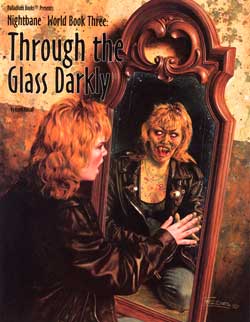
In Alice's case Wonderland was at least partially informed by her own psyche. In the game Nightbane, mirrors provide a very real window to a new world. Much in the way of Alice stepping through the looking glass, a Nightbane can move through a mirror to a dark reflection of Earth. The Nightlands are a place inhabited by doppelgangers and ruled by the Night Lords who may have once been Earthly sorcerer kings. The world itself is a twisted reflection of our own, distorted through a lens of darkness and evil. The doppelganger of a policeman is probably a warlord or killer, while that of a sociopath is great hero; that is assuming that they are even aware of themselves. Unlike our free will these doppelgangers are often subjugated and "half-asleep" barely aware of the world around them. The physical world too is different, cities tend to be reflected buy with vastly different architecture and landscapes. The oceans are replaced by endless deserts; in fact much of these lands are dead and barren.
In science fiction gaming (as well as some fantasy) the mirror is figurative, pertaining more to the relationship between the alternate world and the "real" world. The portal may be a wormhole of sorts, as in the TV show Sliders, or may be an entirely unique device like the column Ter'angreal in the Wheel of Time. These stories tend to feature worlds that are closer to the one which the characters left, functioning as a sort of "what if" portal on the world.
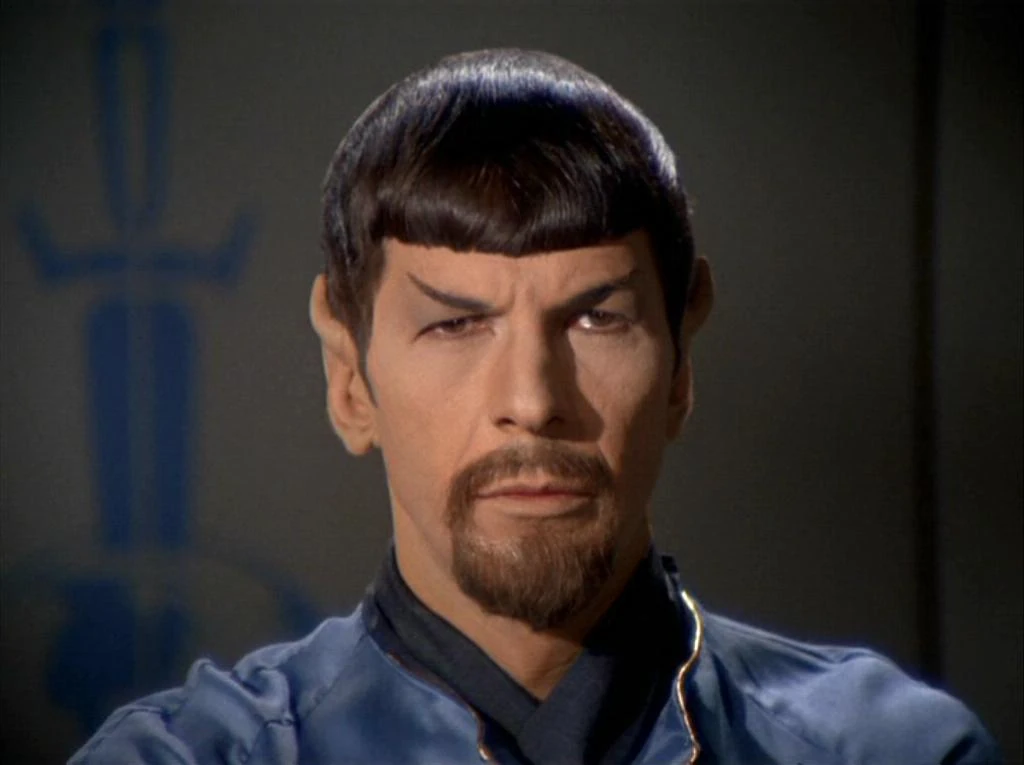
Perhaps the best known example is the Star Trek Mirror Universe. That of the evil goatee. The evil Trek verse is initially a direct reflection on the Federation with the Terran Empire. Where the Federation was peaceful and explored for the sake of exploration and knowledge the Empire was violent and explored to conquer and subjugate others. Plus everybody was apparently way more ... slutty. The same, but different.
Later, during the Deep Space Nine mirror episodes, we see that Kirk's speech to mirror Spock has resulted in the Terran Empire crumbling and being overrun by the Alliance of Klingons and Cardassians (who pretty much hate each other in the main universe). With humans and vulcans enslaved these stories feature the character's fighting a revolutionary war for freedom that echoes the slow burning war with the Dominion, a war to maintain freedom.
Mirror worlds can be anything from the typical trope of "evil is good and good is evil," to any of various alternate/divergent histories (as I discussed last week). The real key is "the same, but different" providing you, the storyteller, with the ability to show familiar characters, places, or events in a new light.
Issue #25: Mirror MirrorIn our RPGs mirrors are most often the figurative or literal windows to the supernatural. Occasionally the psychological use of a mirror to reflect a character onto themselves can be seen, but in a game that is often played at a table with other people that kind of introspection is often difficult or impossible to achieve without monopolizing the session. Likewise mirrors don't tend to factor into games of hard science, with those grounded in a very real-world setting, or a science fiction one. They are after-all just silvered glass or highly polished metal, with no properties beyond their ability to reflect light. At least when used literally.
Gateway to another realm.
The same, but different. The mirror worlds of fiction follow these guidelines. In games where magic figures high mirrors can become the gateways to alternate worlds. The enchanted mirror becomes a literal portal to the world in the reflection, which often is seen as it would be, slightly or radically different from what the reflection ought to be in a normal mirror. Other times the mirror displays no hint of the world on the other side and it is only the power of the user than can allow travel between here and there.
In Alice's case Wonderland was at least partially informed by her own psyche. In the game Nightbane, mirrors provide a very real window to a new world. Much in the way of Alice stepping through the looking glass, a Nightbane can move through a mirror to a dark reflection of Earth. The Nightlands are a place inhabited by doppelgangers and ruled by the Night Lords who may have once been Earthly sorcerer kings. The world itself is a twisted reflection of our own, distorted through a lens of darkness and evil. The doppelganger of a policeman is probably a warlord or killer, while that of a sociopath is great hero; that is assuming that they are even aware of themselves. Unlike our free will these doppelgangers are often subjugated and "half-asleep" barely aware of the world around them. The physical world too is different, cities tend to be reflected buy with vastly different architecture and landscapes. The oceans are replaced by endless deserts; in fact much of these lands are dead and barren.
In science fiction gaming (as well as some fantasy) the mirror is figurative, pertaining more to the relationship between the alternate world and the "real" world. The portal may be a wormhole of sorts, as in the TV show Sliders, or may be an entirely unique device like the column Ter'angreal in the Wheel of Time. These stories tend to feature worlds that are closer to the one which the characters left, functioning as a sort of "what if" portal on the world.
Perhaps the best known example is the Star Trek Mirror Universe. That of the evil goatee. The evil Trek verse is initially a direct reflection on the Federation with the Terran Empire. Where the Federation was peaceful and explored for the sake of exploration and knowledge the Empire was violent and explored to conquer and subjugate others. Plus everybody was apparently way more ... slutty. The same, but different.
Later, during the Deep Space Nine mirror episodes, we see that Kirk's speech to mirror Spock has resulted in the Terran Empire crumbling and being overrun by the Alliance of Klingons and Cardassians (who pretty much hate each other in the main universe). With humans and vulcans enslaved these stories feature the character's fighting a revolutionary war for freedom that echoes the slow burning war with the Dominion, a war to maintain freedom.
Mirror worlds can be anything from the typical trope of "evil is good and good is evil," to any of various alternate/divergent histories (as I discussed last week). The real key is "the same, but different" providing you, the storyteller, with the ability to show familiar characters, places, or events in a new light.
Wednesday, April 1, 2015
Story Seed - Respite
 |
| Image Source: http://juliedillon.deviantart.com/art/Sleeping-Giant-521001305 |
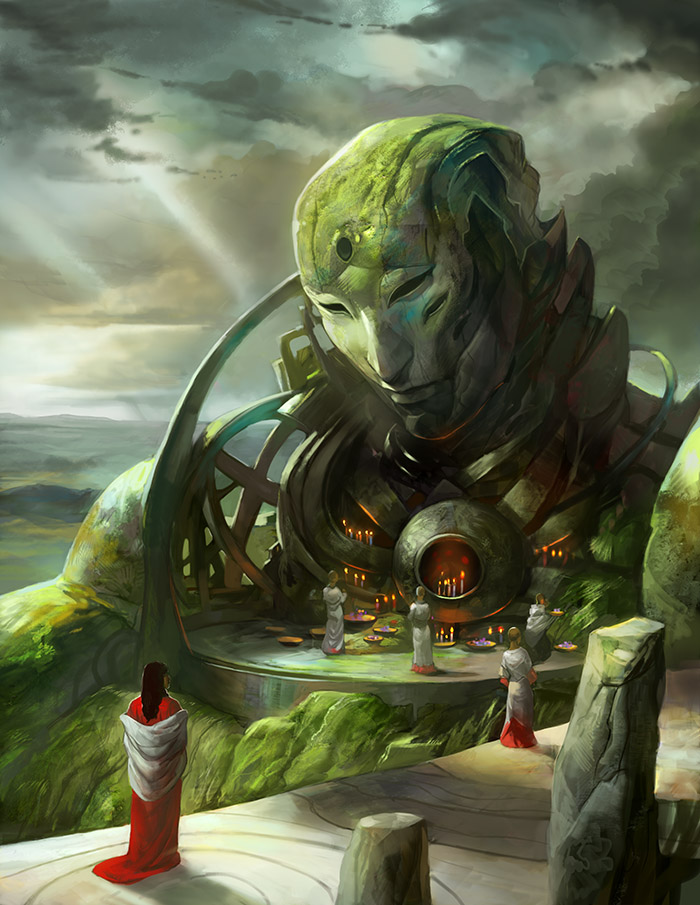
The disciples tended to their god's heart. They placed offerings of food and wine, of herb and drug, of flesh and spirit, upon the altar of the god's broad chest. They lit candles and ensured through their rites and sacrifice that the sullen glowing of the great slumbering heart remained. For centuries the pulsing red of the heart waxed and waned, glowing like some great iron thing being heated and cooled in the forge of their faith.
For centuries their god remained insensate, unmoved by their devotion as it was unmoved by weather and geology. With time the order soon waned, taking in fewer new members each year, the order soon came to a final few; a dying cult forgotten and forgone by the people. Still their faith was strong. Still they made their offerings, their sacrifices, their rites. And still the great heart glowed, pulsing from deep within day after day, year upon year, for centuries.
At last there was only one. An aged master with no disciples. No pupils to teach, or congregation to teach to; a man alone tending to a relic of the past. The aged master knew death was approaching, and made preparations for what would be the final offering, the last sacrifice, and the very last of the rites to be performed for the sleeping god. Quietly the master died, passing beyond life on the altar of the god's chest, bathed in the ruddy glow of the heart's pulsing light.
Some time later, perhaps a minute, perhaps a year, or a decade, one of the great being's eyes began to glow ever so softly. Slowly the light increased as the eye inched open, peering at the decaying remains of the religion that had lived and died tending its heart. The great sleeping god sighed, a sound like a relieved gale. In a quiet whisper that seemed impossible for one so great to utter, it spoke.
"Oh good, they're gone."
Subscribe to:
Posts (Atom)