Showing posts with label Predation. Show all posts

Wednesday, January 19, 2022

Nuts & Bolts #166 - Hacking the Cypher System: Predation


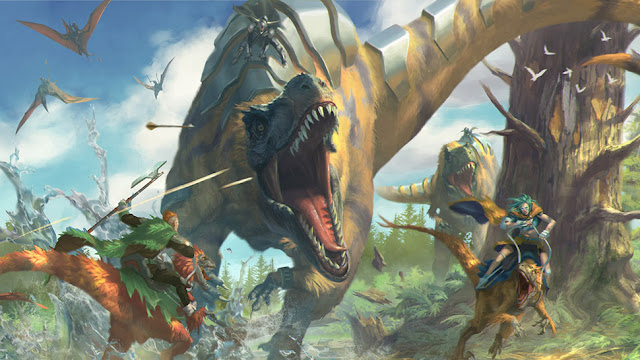
This past weekend I got the chance to play Predation again for the first time in a long time. The session was fun and I was reminded about how interesting the setting was. I was also reminded how the characters each have a dinosaur companion and how each player at the table role-plays the companion for another player. 

After the session I got to thinking about how the companion mechanics were fun, but...

That but really got me though. But, it was sometimes tough to juggle two character sheets. But, it was difficult to remember who was playing which character and which dino (this was exacerbated by using Zoom so it wasn't as easy as just looking to ones left or right). But, I was having a lot more fun with the dino companion than I was with my human character.

Lots of buts. That last one was the kicker tho. I really did have more fun playing a prehistoric chicken than I did playing my (checks papers) Creative Osteon who Crafts Unique Objects.

I wonder if there is any reason why one could not instead split your players roughly into two groups and have half of them play people, and half of them play dinosaurs. Give the dinosaurs actual types and foci to make them more fully realized characters. Problem solved?

Well, doing this would make play a little easier as you wouldn't have to try and play two characters at once. It would also mean less to track for the GM and other folks at the table. It would allow players to get more fully into character since they wouldn't have to worry about the companion dino for another player, or for their primary human. Best of all it would allow for a lot of role-play between players at the table. Imagine the player-player relationship between a "Disobedient t-rex" and an "Uptight scientist," or between a "stealthy warrior" and a "clumsy brontosaur"! By cutting the number of characters in half and allowing the dinosaurs to be more fully realized I think you could gain some really interesting role-play at the table that would otherwise often be minimized during play.

Of course, if you prefer Predation as it stands right now you should keep enjoying it, but I think if I run a game in the future I may consider this as an option to allow the players to choose before we start.

Sunday, May 31, 2020

Nuts & Bolts #163 - Hacking the Cypher System - Sidekicks


Editor's note: It's been WAY too long, but sometimes you just don't have anything to give. You can't squeeze blood from a stone. I'm going to try and be better about posting here but these are uncertain times and it's hard to think about happy fun times games when the world is burning down around you.

Superhero RPGs are an occasional fun diversion for me. I don't play regularly for various reason, and as a result I find some of the better superhero RPGs a bit cumbersome because I have to relearn the rules a bit each time. Thankfully the Cypher System is pretty capable for superheroics in most cases (some weirdness aside when it comes to the ability to fly).

One thing that Cypher doesn't do well (IMO anyways) is sidekicks and support characters. Most the time you get a low level critter, robot, or hireling who is some use at Tier 1, and decreasingly useful as you gain Tiers. Often they are rolling unmodified for most actions other than a small handful that they have training for. Without ability to apply effort they can feel very weak against tasks and enemies at level 5 of higher.

In supers games the sidekick can often be very important for certain characters, and they can help a smaller group of PCs punch a little higher than they could otherwise with the power of numbers. Thankfully there is one Cypher game that made an effort to make companions a little more interesting and stronger: Predation.

Predation is a pretty great setting with some interesting rules to support the Dinosaur companions that are nearly ubiquitous within the setting. These rules, like most rules, can be easily adapted or modified to suit other settings and genres to enable PC companions. I already discussed this idea a while back in regards to a high tech or cyberpunk game where PCs can be reasonably expected to have AI assisted drones. Another common genre with a historic trope that fits well with these rules is comic books & superheroes. Oh hey, how topical!

I think the companion rules will work wonderfully for this purpose. With a minimum of additional work required to fit the rules to the genre. While I presented the idea of this prior but did not elaborate on what those changes would look like, this time I would like to present my full hack for Sidekicks.

First thing's first, we need to skin over the dinosaurs into sidekicks. This is really just a matter of renaming them to fit a superheroic game:

  • Tyrannosaurus become Brawlers, sidekicks who are bigger more aggressive fighters than most of their peers (though not likely as big and tough as their hero).
  • Raptors become Hunters, sidekicks who use teamwork and stealth to stalk the the enemy. 
  • Ornithomimids become Speedsters, sidekicks who use their speed to avoid enemy attacks while drawing fire from their hero.   
  • Ceratopsians and Ankylosaurs become Tanks, bigger and tougher but slower than their peers, Tanks can take a lot of abuse and help their hero by sticking in combat for the duration.
  • Pterosaurs become Fliers, sidekicks who can take to the air and aid their hero from a position of advantage above the city.
  • Early Mammals become Scouts, who make up for for their weaker physical ability by being premier scouts, reconnoitering ahead and searching out the enemy's weaknesses. 
The companion ability lists for each type can stay as is, and even those ability names can be retained for the superhero genre. The exception to this is the Temporal Hunter ability which can either be removed, or rejiggered for the setting (example, Mutant/Metahuman Hunter, or the like).

Lastly the companion dispositions from the book. These are the biggest change as I would not use these and instead use the same Descriptor list as the main player characters in the game. This will allow more options and better suit the fact that sidekicks are people, not animals. Descriptor bonuses to pools can instead be applied directly to the sidekick's health stat, and the skills and inabilities can be applied as normal. 

When your hero interacts with their sidekick they should still use the Interaction mechanisms from Predation (pg 49) to represent the development of the sidekick from a trainee to an eventual highly trained hero in their own right. This means that initially they may misunderstand their hero's instructions, or may balk at their orders/mission due to lack of experience. As your hero gains experience so too will their sidekick and they will be more confident and capable following your hero's lead. 

Since superheroes use the power shift rules I would also allow sidekicks to apply 1/2 rounded down the number of shifts that their hero has. These might be different from the hero's shifts as in the case of mutants or sidekicks with different themes from their hero, or they may be the same because of training and similar power themes. Likewise I would grant each sidekick a choice of +4 Health or an level of skill training at Tier 1, and then apply a bonus of +2 Health per tier in addition to the normal progress. This will help these sidekicks last a little longer as the superheroes they serve get stronger and the super-villains they fight likewise gain more power.

Lastly I would definitely suggest that other players at the table play the sidekicks of other heroes. This will allow far more interesting roleplay than if the sidekicks are played by the same player as the hero. Predation got this perfectly and I see no reason why it should change with a new genre.

That's it (I think), a set of perfectly useful rules for making genuinely interesting Sidekicks for use with Superheroic gaming using Cypher System. 

Friday, July 21, 2017

Predation - Paradoxical

Just gonna check my texts real quick here ...

So, previously I've discussed my thoughts on the "c" and my opinion of the cause of time travel failure and, by extension, the time anomalies found in Grevakc. Those time anomalies though, I haven't said much about them. Till now...

Firstly, there's not much information in the book. The game isn't about Time Travel after all. The time travel created the universe but that's not what the game is about. As such we're pretty much limited to whatever we decide for ourselves and the information on page 74, under climate and weather.

What we do know is that the time anomalies seem to be a development that occurred in the wake of the failure of the time travel apparatus. There's nothing to indicate that these anomalies existed prior to that event. There's even a sidebar that says as much, indicating no records of anomalies prior to the failure of the time travel devices. Given my opinion on the why and wherefore of the failure of time travel I think it's a safe jump to the conclusion that the time anomalies are in fact the manifestation of Temporal Paradox.

Time Anomalies

The run of the mill time anomaly is described as sometimes looking like
[...] glitches in the landscape, places where the edges don’t line up. Occasionally, they seem to look like a mirage, the flickering image of a place or structure that doesn’t belong. (Predation, pg 74)
People in Grevakc hunt these anomalies down because with them come cyphers, and rarely artifacts and remnants. I like to think of the latter two as the detritus of a paradox destroyed future timeline, the world to which the time bridge (for lack of a better term) once connected and the characters' ancestors originated.

To me this adds an interesting layer to the game with a touch of post-apocalypse scavenging the remains of the old world. These items come from a dead world; a time that was once future, but is now no longer anything more than a fragment causing paradox effects as the new timeline continues forward. I also view these pieces of the timeline that was, and possibly the future that was, as "temporally stable" items. Things that were real enough by some virtue to survive the paradox.

Cyphers on the other hand are more ephemeral and also more indicative of the temporal paradox that is Grevakc. These unnatural powers that somehow encode into human DNA are perhaps holdovers from genetic lines that have been wiped out. Or perhaps they are simply bits on another reality crystallized into "time bombs" usable by those who find them. Perhaps the nature of cyphers is even tied to whatever enabled the paradox to occur in the first place.

Time Terrors

Time terrors are weird. They are described like some kind of pop-up thunderstorm on steroids, a force to be reckoned with that causes ball lightning to be flung around, temperatures to rise or drop rapidly, and high winds. Time terrors are described as being extremely deadly, with few people having managed to escape getting stuck in one.

In the wake of time terrors anomalies are more likely to be found, and some even believe that there may be a cause-effect relationship. Furthermore in some instances observers outside of a terror have noted seeing strange discontinuous landscape-like mirages. I like to that that if anomalies are the result of the timeline crushing paradox that broke contact between Grevakc and the future, then time terrors are actual active paradox.

Consider how tectonic plates pushing against each other cause earthquakes when the force built up exceeds the friction between plates and causes slippage. In this case the plates are the original timeline and the new Grevakcian timeline, the paradox of humans existing in the Cretaceous who originate from a future that can no longer exist is causing "pressure" between the timelines. As the new timeline overwrites the old there are slippages that result in massive "time quakes" which the characters perceive as time terrors.

In this is the paradigm then it also means that time anomalies can be looked at as aftershocks; smaller less damaging paradox effects. It also implies that the mirages may in fact be actual views of the dying timeline. It could even be possible to use a time terror to travel through to the other timeline (though that may be a fatally poor choice).

Friday, July 7, 2017

Predation - A Before B and Also C

See, I told you that would attract ants!

Why "c"? These things aren't arbitrary. Large corporations like SATI have rules that govern everything internal. So the Gre-Vakian c trials that brought our PC's ancestors to the cretaceous era were almost certain preceeded by Gre-Vakian a and b trials. But what about those trials? Very little is even implied, let alone said, of them, and their existence isn't confirmed, just conjecture based on a logical presumption.

Gre-Vakian a Trial

The "a" trial was probably the prototype phase, or the phase immediately after that. The commuters from the "a" trial clearly either failed in whatever mission SATI set forth (very possibly the same mission as the "c" trial) or had another mission entirely. I'm going to choose to think that they probably had a different mission, as SATI sending two groups of commuters back in time and then opting for "third time's a charm" seems a bit forced. So what was the intent of the "a" trial? Infrastructure.

Consider that the Last Commute has been described as a failure of the machinery in the cretaceous. This seems reasonable at face value, but give it some thought and you realize that there must be more to the story. I got into that last week, but suffice to say I think that the Last Commute was the result of Paradox biting SATI square in the butt. I think that SATI's time travel was one way; you can send but but your cannot retrieve. Trial "a" was very likely concerned with getting equipment in place in the past to verify that return trips were even possible. Imagine being part of the "a" trials and knowing that if the tech didn't work you were dino chow!

My guess is also that the "a" trial was very small scale. A small group of experts and technicians and the mechanism to send them home. A proof of concept that only barely counted as being a trial at all.

... but if that's true, then what about "b"?

Gre-Vakian b Trial

What exactly is SATI up to in the past? We may never know, unless we are the GM, or the GM chooses to reveal that to us in the game we play in. Or is Shanna writes a Predation novel. A novel with awesome dinosaurs ... I'll try and suggest that at Gen Con this year. I digress, while we may not know the point of SATI's expeditions we can make certain assumptions.

Assumption: The "b" trial was either a failure, or had a different goal from the "c" trial.

This seems pretty reasonable. SATI must have a reason to be sending thousands of its employees back in time. So either "b" failed but a "c" trial was still positive on the old risk vs reward analysis or "b" was doing something different from "c".

Assumption: The "b" trial was located elsewhere (or elsewhen) such that the "c" trial would not find evidence of the prior trial, or run into and interfere with the prior trial.

Yes, I'm implying that the "b" trial could be/have been concurrent with the "c" trial. I don't think this is too far fetched to assume that these could be concurrent in different locations, or that the "b" trial was taking place in a different time period. This feeds directly into ...

Assumption: The commuters of "c" trial were not in any danger from "b" trial, nor were they required for "b" trial as such.

Basically if SATI was putting this kind of investment into these trials they wouldn't sabotage themselves, and they probably wouldn't have the left hand unaware of the part they had to play in the right hand's projects.

So with all that what was trial "b" up to? I obviously cannot say for certain but I have a couple of ideas.

  • The Gre-Vakian b trial had the same/similar goal as the c trial but elsewhere/elsewhen. Possibly at the end of a prior era like the Jurassic or the late Paleogene. In this case I think they were essentially "mining" genetic information. Ancient DNA could give insight into the evolutionary process, provide treatments for diseases, and even yield means to improve crops by adding prehistoric DNA.
  • The Gre-Vakian b trial isn't even on Earth! SATI is and INTER-global corporation. I don't think that this is a mistake and there are references to other planets. I think SATI could have sent a trial back in time to study Mars when it was livable. It's even possible that they had reach beyond our solar system, and if so there are any number of places they may have wanted to use time travel to exploit. 
  • The Gre-Vakian b trial "failed" and the "c" trial was initiated to pick up the pieces. The reason there seem to be a lot of "lost" SATI facilities in just the 100-ish years since the last commute is because they are facilities that were part of trial "b". Perhaps the commuters of "b" are dead and gone, or maybe they were recalled 
    • Could it be that "c" is just a ruse and the "b" project continues on even now?

Regardless of my thoughts there's plenty of room for your own interpretations, assumptions, and conclusions. Do you think the commuters of Gre-Vakian c trial are the first? If not, what do you think happened to "a" and "b"?

Friday, June 30, 2017

Predation - Last Commute

Can I get mine well done?

It was nice while it lasted. Nine years. Nine years after it began the Gre-Vakian c trial went off rails when the machinery that connected the commuters to the future stopped working.

But why?

Here's what I think ...

SATI discovered a method to travel time, but that method was one-way only. You love travel forward or backward from your starting point, but you couldn't go back without having access to the same or similar machinery at which point it once more becomes a one-way outbound trip. SATI's tech couldn't retrieve an object or person from another point in time.

Why do I think this? Well it's simple really; if they had the means in the future to retrieve persons and objects from the past why would they invest in the infrastructure of buildings, power generation, and machinery to build a time travel facility in the past? Housing for commuters, lab space, and the like would require a great deal less effort than building a massive time travel apparatus. The very fact that there was time travel machinery sent to, and constructed in, the Cretaceous is evidence enough for that technology to be limited to sending commuters, but not retrieving them.

As a result of the one-way nature of their time travel technology any expedition to the past was a virtual death sentence for the commuter without the machinery in the past to send them home. Trips to the future are easier since one can safely assume the tech will still be there. So when the Last Commute disabled the machinery in the Cretaceous era it prevented the commuters from returning to the future, but the future should have been able to send help back.

Unless the future was gone.

I think that the commuters of Predation's Gre-Vakian c trial are the victims of paradox. Their presence in the past has altered something. Perhaps it is the tampering with animal genetics that changed the very course of evolutionary history on earth, or perhaps the commuters stop the impact of the comet/asteroid responsible for the Cretaceous–Paleogene extinction event which, I can safely say, would probably have some repercussions on the future.

Regardless of HOW they caused it, the commuters accidentally altered the future and erased their history. Obviously this creates a significant paradox, the least of which is that you can't go home to a future that doesn't exist, nor can that future send back help. The result: the machinery of time travel failed spectacularly and has been impossible to repair since, because the future the commuters are trying to return to doesn't exist anymore.

I guess it's true what they say: "You can't go home again."

Friday, June 23, 2017

Predation - Early Thoughts

Predation Wraparound Cover, copyright Monte Cook Games
So, how 'bout them dinos?

I've had the PDF of Predation for a couple weeks now, and the print for about a week. I've started the process of reading through it, and at this point, I feel like I can start speaking about my initial thoughts. A year ago, around this time, I did the same for Gods of the Fall, and if you are a regular reader of this blog you know what kind of rabbit hole I fell down with that setting. Some of you are no doubt hoping I'll tumble down a bambiraptor hole with this game. So let's get into it.

The first twelve pages are introductory. The author's intro, a setting intro, and a concept intro. We get an overview of the everything we need to know going forward. Nothing overtly revelatory, but as an appetizer it does it's job well.

Chapters three through seven are character focused. A handful of new descriptors (savage for the win!), the four Predation-customized Types (Karns, Osteons, Tecs, and Pteryxs (Pteryxes? Pterii??)), and some new Foci (or maybe Focuses, YMMV) including some reskins for existing Foci and entirely new Foci like Predates and Plays God (among others). Some new equipment and such as well. All of this is on par with what we saw in Gods of the Fall in terms of setting customization and expanded options. Chapter six is where Predation really roars...
...or maybe coos? Dino's as birds may not be a new concept but I'm old enough that it still takes a conscious paradigm adjustment at times. 
At any rate Chapter Six is all about dinosaur (and primitive mammal) companions. These aren't your usual brand of generic animal pals that add very little to the game, and even go well beyond the more capable companions we've seen in Foci like Controls Beasts and Builds Robots (or even Leads). These dino companions are essentially secondary PCs. They are in fact played by players other than their "owners" which adds a fun twist since companions are not forced to follow the instruction of their humans.
I got to playtest this at Gen Con 2016 and it was fun to ignore the companion's "poorly worded" request and do what felt natural for the creature. I think in a campaign with a good group of players this could be really great in a lot of ways.
Companions get their own stats and a mini descriptor called "Dispositions" that helps breathe life into the companions and ensure that not all companions of the same type are the same. A Clever stegosaurus and a Clumsy stegosaurus are sure to be VERY different at the table.

Chapters eight through eleven give us the setting of the game, the "world" of Grevakc, or North America in the late cretaceous after some heavy contamination of the time stream. I'm about halfway through this part of the book, having read the "Welcome to..." chapter, the organizations, and a good chunk of the setting's regional descriptions.

The organizations are all unique and interesting. Being a setting that is noticeably difficult to describe (it's a pre-apocalyptic, post-apocalyptic, high tech, primitive world (frankly the time travel aspects are just enabling the rest of the setting's wackiness)) each of the groups has been given a very evolved feel (haha, puns). SATI, the setting's antagonistic source of order, has lost contact with the future and as a result they are falling apart in part and parcel for instance. Leadership tries to hold things together, but even they cannot manage their own employees. The group feels very realistically like the crumbling remains of a vast corporation.

The secretive Butterflies feel to me like the boy with his finger in the dam. The flood of temporal damage is probably too late to stop, but they will try their damndest all the same to prevent irreparable damage to the history of the future. Then there is the Genesix Fellowship who seek to prove the existence and location of the Biblical Garden of Eden. It's an interesting twist in a game that leans so heavily on science (and SCIENCE!!) to toss in a group that leans on both science and faith. The idea that "Eden's" location is somehow encoded into prehistoric DNA is one that dovetails into the rest of the setting nicely and ensures plenty of story space for groups that choose to use the Fellowship in their games.

Chapters twelve and thirteen are the bestiary, and present some truly terrifying predators, some awesome modified species, and a smattering of human NPCs. I've not fully read this section yet, but I just glancing through there's a ton to like in here, both in terms of the creature and the awesome artwork.

The remaining three chapters are GM advice, cyphers, and an adventure. I read the intro to the cyphers but otherwise I have not yet completed this section of the book. I'll be sure to give it a look before I attempt to run this setting, but until then it's not a priority. Plus I'm really hoping for a chance to play in this sandbox.

I've read more of this book at this point than I had of Gods of the Fall when I wrote my early thoughts for that setting. I'm not remotely disappointed with anything I've seen so far. If the quality of the remainder of the book only meets that of what I have read, and I have no reason to assume otherwise, then I am certain that this setting will capture the hearts and minds of many a gamer in the same way that Gods of the Fall did. It remains to be seen if I am beginning a long slide down that aforementioned bambiraptor hole or not, but I'd be surprised if I wasn't still discussing this game in six months at the least.