Showing posts with label Cypher System. Show all posts

Wednesday, July 1, 2020

Nuts & Bolts #165 - Hacking the Cypher System - Slow Burn Horror Mode

Image Source: Stay Alive! page 71, (c) Monte Cook Games


Horror Mode is one of the many "bolt on" rules introduced in the original Cypher System Rulebook and carried forward in both the Revised edition and the Stay Alive! horror themed book. It's a simple enough rule where the range for player rolled GM Intrusions expands beyond natural 1s. As written it can be really useful for horror games and really help to build tension as the rolling of dice becomes fraught with the risk of a GM Intrusion without the balm of XP. 

A while back I had tried an alien invasion horror survival game I called Invasion! It stumbled early on due to players being unable to make it and I ultimately shut it down rather than try and force it to work with an uncertain roster of players. Continuous stories really require a strong recurrence of the cast at the table, so I felt justified.

Recently I have been prepping to reboot and try again, and part of that is a conscious decision to look at what rules I could add or manipulate to further add to the tone and feel of their weird idea of mine. Horror Mode seems like a good choice but the way that it ebbs and flows wasn't what I wanted in my game. Instead I wanted a slow pressure that would build reliably over time as the alien invasion pressed onward. I built a timeline of events that would take place (assuming the players don't find ways to slow the aliens down), and in the process I had milestones that would put pressure and stress on the setting and characters. It started to resolve that as the aliens hit their milestones things would get more dire for the colonists. 

Horror Mode is the perfect fit here, but at a much slower pace. Days will pass as the aliens execute activities and so days will pass between increases in the GMI range due to Horror Mode. The players may experience several sessions at a GMI range of 1-2 until another alien milestone is hit, permanently raising the range to 1-3. The players may also decrease the range by setting in motion their own actions to either set the aliens back, or make their own positions stronger to either counter the aliens or escape the planet. 

By slowing the increases in GMI range for Horror Mode, and allowing player actions to help roll that range backwards I hope to create a palpable sense of slow burning dread that will help motivate the actions of the characters. Slowing the speed at which Horror Mode ramps up and down is a minor change, but I think it can pay off for Gamemasters who are looking for a very specific slow burn experience at the table. 

Sunday, June 28, 2020

Nuts & Bolts #164 - Hacking the Cypher System - Super Smash

Image Source: Cypher System Rulebook page 272 (1st edition), (c) Monte Cook Games

So, I really enjoy superhero RPGs as a palette cleanser, especially nowadays. Especially when I am kicking off a dark campaign shortly. I use Cypher System a lot of the time (most of the time) because it does a good job emulating the feel without also getting in the way rules wise.

One of the things I like is GM Intrusions (and Player Intrusions) can allow characters to do super stuff that may not be written down on their stats or sheets. I can use it to have a metal guy ring like a bell and stun nearby characters after being hit real hard, or to have a character who cannot fly use a fiery rocket blast to gain limited flight.

One thing that is darn near ever present in the superhero genre (regardless of the sub-genre tones you may use) is that people tend to go flying when hit knocking into objects, smashing walls, or just being tossed away from the melee scrum. Usually in Cypher games I would treat this as a GMI or PI depending on the character and situation, but that doesn't really work in a supers game where it should be happening a lot. And I do mean A LOT. Characters getting knocked and thrown around helps to make combat less static, it moves the action around, and makes players consider the environment more. I think sending a character flying will also help make some of the super strong characters feel stronger. It makes faster characters gain an advantage over slower ones (they can get back into combat faster), and it is exciting as a it gives the impression of the attack really impacting even if it doesn't do any extra damage in the process.

In other words, IT'S EXCITING.

Sadly, I realized this all to late for my most recent game. It was still fun and had some really memorable moments, but I think about the missed opportunities for sending heroes and villains alike hurtling through the air and I wish I hadn't been locked into a mindset that these kinds of reactions were GMIs/PIs.

Instead I should have played it as a feature of the game. A default that such hits would cause recoil and send characters smashing through walls, flying through the air, and skidding along the ground. In the future I will being making a more conscious effort to do this. Non-super strong characters shouldn't send others very far unless they are specifically trying (PI, special ability, or result of a Major or Minor Effect), maybe just one foot per level (or tier) which can largely be hand waived entirely unless geography dictates that it matters.

For the super strong however, each shift in strength will increase this from 1' to 5' to 10' to 20'. Similarly characters with Single Attack shifts should have their attacks hit so hard that they gain a similar increase. An NPC who is level 6 and have 2 shifts in strength could hit another character so hard they would fly 60 feet away! (10' for 2 shifts x level 6 = 60).

This seems an easy fix, and I would rule that a player could opt out of sending their opponent flying by holding back on Strength Shifts or by attacking in other ways. An overhead smash might instead drive their enemy through the street and into the subway or sewers, or simply drive them into the dirt like a nail. The goal in the end is to play up the over-the-top aspects of the supers genre so that not only does it feel like a comic book (or a Marvel movie), but so that it feels different from other games you may run with Cypher System.

Sunday, May 31, 2020

Nuts & Bolts #163 - Hacking the Cypher System - Sidekicks


Editor's note: It's been WAY too long, but sometimes you just don't have anything to give. You can't squeeze blood from a stone. I'm going to try and be better about posting here but these are uncertain times and it's hard to think about happy fun times games when the world is burning down around you.

Superhero RPGs are an occasional fun diversion for me. I don't play regularly for various reason, and as a result I find some of the better superhero RPGs a bit cumbersome because I have to relearn the rules a bit each time. Thankfully the Cypher System is pretty capable for superheroics in most cases (some weirdness aside when it comes to the ability to fly).

One thing that Cypher doesn't do well (IMO anyways) is sidekicks and support characters. Most the time you get a low level critter, robot, or hireling who is some use at Tier 1, and decreasingly useful as you gain Tiers. Often they are rolling unmodified for most actions other than a small handful that they have training for. Without ability to apply effort they can feel very weak against tasks and enemies at level 5 of higher.

In supers games the sidekick can often be very important for certain characters, and they can help a smaller group of PCs punch a little higher than they could otherwise with the power of numbers. Thankfully there is one Cypher game that made an effort to make companions a little more interesting and stronger: Predation.

Predation is a pretty great setting with some interesting rules to support the Dinosaur companions that are nearly ubiquitous within the setting. These rules, like most rules, can be easily adapted or modified to suit other settings and genres to enable PC companions. I already discussed this idea a while back in regards to a high tech or cyberpunk game where PCs can be reasonably expected to have AI assisted drones. Another common genre with a historic trope that fits well with these rules is comic books & superheroes. Oh hey, how topical!

I think the companion rules will work wonderfully for this purpose. With a minimum of additional work required to fit the rules to the genre. While I presented the idea of this prior but did not elaborate on what those changes would look like, this time I would like to present my full hack for Sidekicks.

First thing's first, we need to skin over the dinosaurs into sidekicks. This is really just a matter of renaming them to fit a superheroic game:

  • Tyrannosaurus become Brawlers, sidekicks who are bigger more aggressive fighters than most of their peers (though not likely as big and tough as their hero).
  • Raptors become Hunters, sidekicks who use teamwork and stealth to stalk the the enemy. 
  • Ornithomimids become Speedsters, sidekicks who use their speed to avoid enemy attacks while drawing fire from their hero.   
  • Ceratopsians and Ankylosaurs become Tanks, bigger and tougher but slower than their peers, Tanks can take a lot of abuse and help their hero by sticking in combat for the duration.
  • Pterosaurs become Fliers, sidekicks who can take to the air and aid their hero from a position of advantage above the city.
  • Early Mammals become Scouts, who make up for for their weaker physical ability by being premier scouts, reconnoitering ahead and searching out the enemy's weaknesses. 
The companion ability lists for each type can stay as is, and even those ability names can be retained for the superhero genre. The exception to this is the Temporal Hunter ability which can either be removed, or rejiggered for the setting (example, Mutant/Metahuman Hunter, or the like).

Lastly the companion dispositions from the book. These are the biggest change as I would not use these and instead use the same Descriptor list as the main player characters in the game. This will allow more options and better suit the fact that sidekicks are people, not animals. Descriptor bonuses to pools can instead be applied directly to the sidekick's health stat, and the skills and inabilities can be applied as normal. 

When your hero interacts with their sidekick they should still use the Interaction mechanisms from Predation (pg 49) to represent the development of the sidekick from a trainee to an eventual highly trained hero in their own right. This means that initially they may misunderstand their hero's instructions, or may balk at their orders/mission due to lack of experience. As your hero gains experience so too will their sidekick and they will be more confident and capable following your hero's lead. 

Since superheroes use the power shift rules I would also allow sidekicks to apply 1/2 rounded down the number of shifts that their hero has. These might be different from the hero's shifts as in the case of mutants or sidekicks with different themes from their hero, or they may be the same because of training and similar power themes. Likewise I would grant each sidekick a choice of +4 Health or an level of skill training at Tier 1, and then apply a bonus of +2 Health per tier in addition to the normal progress. This will help these sidekicks last a little longer as the superheroes they serve get stronger and the super-villains they fight likewise gain more power.

Lastly I would definitely suggest that other players at the table play the sidekicks of other heroes. This will allow far more interesting roleplay than if the sidekicks are played by the same player as the hero. Predation got this perfectly and I see no reason why it should change with a new genre.

That's it (I think), a set of perfectly useful rules for making genuinely interesting Sidekicks for use with Superheroic gaming using Cypher System. 

Wednesday, August 28, 2019

Nuts & Bolts #158 - Invasion!


Author's Note: I've been away from regular blogging for a bit, and even before I stopped I was posting a self made module for a while. Returning to this hobby has been on my mind for bit but I finally decided to do so with a kick in the pants from a few friends and an idea to potentially generate a sort of discussion via blog with my freind Andrew Cady over at my20sidedlife.com. We're going to give this a try and see how it goes, with one of us writing something and then the other responding either with a similar idea, or a rebuttal of sorts (depending on the post content). Here's my kickoff offering, a bit of discussion around my current Cypher campaign, and alien invasion story... you can find Andrew's offering here.

Welcome to Gideon IV, a world nearly 200 light years from Earth. A fringe colony; the people of Gideon IV are self sufficient in a way that the inner colonies are not; the travel time to Earth is nearly 2 years, and so they have to be. Not all is well on Gideon IV however. An alien object entered the system mere days ago at great speed and just three days ago it reached Gideon V where it apparently wiped out the terraformers there before continuing onward. Two days ago Gideon IV had two moons, but the aliens diced the smaller moon into chunks and harvested it in mere hours before moving toward the larger moon.

This is the setting for my current Cypher System campaign, which I call "Invasion!" It was pitched as an alien invasion, which it absolutely is, but in many ways I am running it as a horror game. The PCs, normal folks trying to go about their lives, a scout, a mechanic, a tough criminal, a drug manufacturer, and a cop. They are caught in events that they cannot escape, and may not be able to avoid. the aliens possess technology that is well beyond that of the colony. Even the colonial defense is unable to put up meaningful defense of the two moons of Gideon IV.

Why am I using the Cypher System? Because, it's actually pretty good at horror without also making the player characters helpless in the process. The characters have agency and they can strike out at the aliens. They have destroyed two robotic aliens (probes or scouts? who knows) with their combined effort of arms, but they also know that the aliens can harvest moons with ease, and swat the colonial fleet like they are pests.

Invasion isn't going to be a story that will get the Hollywood treatment. The players are unlikely to form a plucky resistance that will defeat the alien menace and win the day for the colony. Instead they must figure out how best to survive, for however long that requires. With Cypher they can do that. I can put them to the test, but still let them do impressive things. WIll they survive? Will they escape? How?

Not every RPG is about being the hero. Not every RPG set-up can be won. Sometimes survival is all you can ask for, but then maybe that just redefines what "winning" means. Getting out alive can be all the reward the characters want if the likelihood is very much the opposite.

Wednesday, January 23, 2019

Nuts & Bolts #157 - Hacking the Cypher System - Role Play Informed Modifications


I've mentioned before my current Cypher campaign in the Nightbane setting (a Palladium RPG that's proving way more fun in Cypher System). The players are really getting into things and exceeding my expectations for role playing in a horror setting. Horror games can be tough if the players aren't on board for playing horror, but so far this hasn't been the case for this tale of people turned monsters. In the course of the campaign thus far fear and paranoia on the part of the characters has been playing strongly into the actions of the players. Even better the dice seem to be in on the fun and have been supporting things.

Picture the scene ... one of the characters has found that by traveling through mirrors he can access a parallel shadowy earth; a twisted realm known as the Nightlands. He convinces a second character to help him take the bodies of two doppelgangers they killed to the Nightlands for "disposal." This second PC has been pretty freaked out by everything and is reluctant to go to this scary sounding Nightlands place, but he mans up and tries ... and fails. He spends a moment to put some effort into it and tries again ... and fails, again. He spends and XP, and still fails (mind you a lvl 4 task with effort he only needs a 9+). He takes a recovery to get some points back and collect himself and tries, and fails, again.

I mention this not because these moments are amusing and memorable but because I've been taking these role playing moments, and using them in conjunction with a little use portion of the optional rules: XP Advances.

You'll find the text for XP advances in the Cypher System Rulebook on page 230-231. The basic gist is that the player can trade negative character traits for XP. For example a character who is wanted by the law might get ~4-6 bonus XP. Normally such traits and their trade off bonuses are the domain of character creation, but I've started to use the rule in the situations above to give role-play informed modifications to characters in exchange for Advancements.

So in the example above I offered the player a permanent Inability in tasks related to traveling through mirrors (a pretty big deal since the Nightlands are the only place to get Cyphers for this character in this game) and in exchange an advancement for extra edge in a pool of his choice. I did similar for another player whose character continually refused to transform back into their human guise. These are optional for the players and I only offer them when it feels right for the character and the story, but so far it has been well received and has made for interesting character development and roleplay.

If a GM wasn't willing to give out entire advancements they could hand out XP, or other short, medium, or long term benefits. These types of character impacting modifications should obviously be taken carefully and not abused. Let the game guide you and only offer them when it feels earned by the direction of the role-play and the game.

Friday, November 23, 2018

Nuts & Bolts #154 - Hacking the Cypher System - Nightbane & Cyphers


This is a follow up to this post about using the Cypher System, and especially the design aspects laid out by Unmasked, to resurrect one of my favorite game settings: Nightbane.

So after kicking things off successfully with the characters finding their true nature as shape-shifting monsters of shadow and darkness (though really they are more dual nature, and they aren't evil per-se, so monsters may be a bit racist) the third session finally found myself as GM with an opportunity to expand the setting for the characters. While washing the blood off himself one of the PCs found himself drawn into the bathroom mirror and into the shadow-Earth known as the Nightlands.

With his arrival into this place I also had the first opportunity to provide one of the PCs with a cypher. I'm using this game to try out something a little different for cyphers. Firstly, cyphers are going to be PC abilities and not physical objects, kind of like a subtle cypher, but without the need for the effects to be subtle. Secondly the source of cyphers will depend on the character's supernatural nature. A nightspawn (because Todd McFarland can't sue me for using the game's original title!) gain cyphers from the nightlands, the shadowy alternate earth which may also be their home dimension. They essentially get to charge up strange and powerful one off abilities when visiting that realm; abilities that will stick with them until used.

The half-vampire dhampirs gain cyphers by consuming blood, providing them with a very real hero vs. monster struggle for players to (hopefully) have fun with. Human psychics will need to spend time in the astral realm, the dream realm, or during intense meditation (depending on their particular psychic leaning). Ordinary humans will almost certainly be associated with the covert remnants of the legitimate US government (a.k.a. the Spook Squad) and have access to prototypes and special devices that with act as more traditional cyphers.

I'm hoping that this will work to make cyphers feel integral to the setting in the way that they do for Numenera. Likewise, I hope that this will give the players something to sink their teeth into for role-play purposes. Time and more sessions will determine how well this works.

Wednesday, September 26, 2018

Nuts & Bolts #153 - Hacking the Cypher System - Nightbane


Nightbane is not a game that a lot of folks know. I've mentioned it in the past. It's an older game from Palladium Books that I first picked up in college back in 1996 (a fact that I know because I found the receipt in the back of the book last night). I've long since given up on Palladium's house system because I just find it to be too much, and as a result a lot of the games I played when I started gaming have sat on bookshelves and waited for their turn to come back around again. Always I would see them and want to play but every time I tried the rules stopped me cold.

When the Cypher System Rulebook came out a couple of years back I really started to look at Cypher as a way to bring back Nightbane for myself and my friends. The focus changing aspects of The Strange had shown me that there a way forward, but I still couldn't quite break the problem of the core characters, the titular nightbane. Nightbane are supernatural shapeshifters. The have a human facade and a monstrous morphus. The facade form is just human, no powers, no abilities beyond that of a normal non-heroic person, but the morphus is a powerhouse.

Thankfully Unmasked came along and gave me the final piece of the puzzle. A duality for form can exist no just by replacing a part of the character's sentence as in The Strange, but by omitting it entirely. The teens in Unmasked are given only a few pool points and a descriptor. Their masked alter egos gain not only a full character sentence but shifts as well. My eyes were opened and I knew, at last, how to make the nightbane work.

I started my players with a descriptor and an occupation, a Hideous Gravedigger, a Perceptive Electrician, and a Creative Tech Consultant. These were the human guises of the players, the as yet unaware of their true nature nightbane player characters. Each character started with 5 points in each pool, modified by their descriptor as appropriate, and that was it. This is less than the teens in Unmasked, and may seem harsh, but Nightbane is, in part, a horror game and the mortal facade form needs to feel weak and vulnerable.

Their morphus forms however gained not just a type and descriptor, becoming a Hideous Warrior who Rages, a Perceptive Explorer who is Sworn to the Seal*, and a Creative Adept who Needs no Weapons, but they also gained shifts, assigned by me, based on the appearance of their twisted and monstrous nightbane morphuses. These we determined the old fashioned way, using the tables in the original RPG's book.
*Sworn to the Seal is a rename of Sworn to the Crown, but this character is loyal to the US Government instead.
Getting back to my gaming past proved a wonderful experience and CYpher proved more than equal to the task of taking an old Palladium Books game and breathing new life into it for my friends and I, much in the same way that it had for Palladium's After the Bomb at Gen Con 2017 when I ran Furry Road.

Wednesday, September 12, 2018

Nuts & Bolts #152 - Hacking the Cypher System - Minions & NPCs


Minions in Cypher System have always been a bit of a mixed bag. The level system makes minion stats very easy to determine and their approximate power easy to gage. However because of the simplified way that minions operate they tend to suffer diminishing returns later in the game state as their skills do not generally increase nor do they gain the ability to apply effort to their rolls. As a result as antagonist NPC levels rise the target numbers for NPCs and Minions steadily increase and reduce the effectivity of the Minion or NPC.

This has been observed and discussed in the past with both fans and creators proposing ways for NPCs & Minions to grant assets, or apply effort out of their health, and similar. Ultimately however, none of these solutions have really solved the core problem. If a level 5 NPC face off against a level 6 NPC that level 5 is pretty much destined to lose. While defeat may be inevitable, there should be a way for that level 5 NPC to affect the level 6 without relying on 15% of rolls to be able to do anything. Likewise a level 6 NPC should be able to make short work of a level 2 NPC without the risk of poor dice rolling.

I'm proposing a simple fix, one that doesn't require the GM to pick up dice, that will help even low level creatures contribute (even if only a little), but that also allows high level NPCs to act accordingly. Best of all, it's super simple.

  1. Determine level of task the NPC/Minion is attempting
  2. Subtract the NPC/Minion level from the level of the task, the remainder is the final difficulty level
    1. If the remainder is positive this number x3 is the d20 target for the player rolling the dice.
    2. If the remainder is zero no roll is needed, the NPC performs the task, and if an attack deals their normal damage.
    3. If the remainder is a negative number the NPC/Minion applies that many levels of free effort, or may provide an asset to the PCs or other NPCs on a one for one basis. 
Easy right? How about some quick examples:
  • A level 4 minion attacking a level 7 creature that it's master is fighting. The player rolls at a level 3 (9+) for the minion (instead of a 21+ using the rules as written).
  • A level 6 NPC ally attacks a level 2 creature ambushing the group. It applies 4 levels of effort (potentially one hit killing it) or can provide as many as 4 assets to the PCs.
  • A level 3 minion trying to defend against a level 3 creature succeeds with no roll required. 
The GM can always use an intrusion to allow lower level NPCs to succeed on higher level tasks of course, which also means that the GM gains the leverage to keep the story momentum going where they need it. 

Wednesday, March 21, 2018

Nuts & Bolts #149 - Hacking the Cypher System - Shifting into Theme

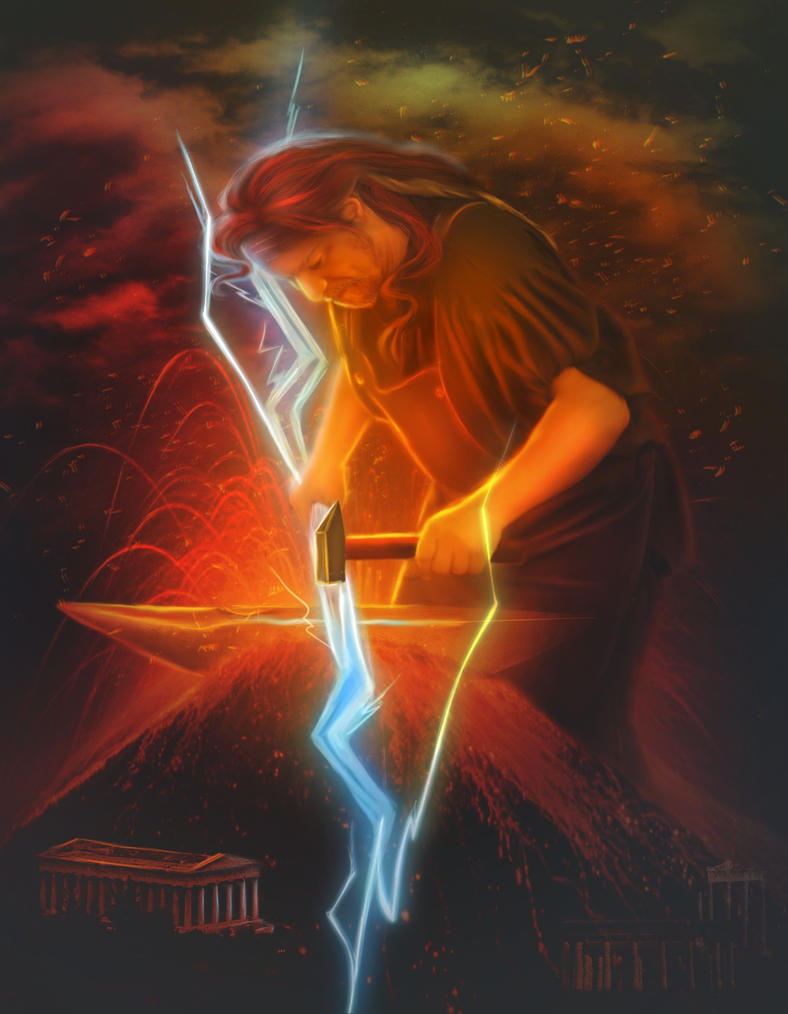
Image Source: https://www.deviantart.com/art/Vulcan-210359334

I mentioned a while back (here and here) how I liked that Unmasked really embraced Shifts as a tool rather than a set list of options. Part of that is that there are so many ways to use Shifts in this way that weren't really possible before. I like this not just for Unmasked, and not just for other super-heroic games, but especially because of what it means for Gods of the Fall. I think that this kind of approach will make it easier to generate god PCs and NPCs in Gods of the Fall because a godly dominion can be used nearly directly for the character's shifts.

Consider a god of Fire. Previously when gaining shifts one would allocate perhaps a shift to Resilience and two more to Power for a specific fire power. Instead you could allocate all three to God of Fire and this would allow true divine mastery over the dominion of fire. Instead of having 1 armor against all attacks and 1 step better with all Might Defense the character is now +3 armor against heat and fire and 3 steps better on Might defense to resists heat, fire, smoke, and the like. In addition in place of having a single fire power that is two steps better all of their Fire themed powers are now 3 steps better.

Sure, this may result in a little more "bang for the buck" but it's also balanced into the character's theme. This also means that the player can champion their theme where appropriate, and allows the GM the freedom to adjudicate as they see fit for their game. This paves the way for less traditional themes which may not have been as easy to work with previously. It also still leaves room for the player to take other shifts accordingly; your god of fire may also be exceptional dexterous, or may also have a lesser dominion over crafts (in the way Vulcan did as god of fire, volcanoes, metalworking, and the forge).

This also means that if a GM wanted to create special shifts related to a given pantheon they could. In real world mythology gods of a given pantheon tended to share certain traits. The gods of Egyptian myth, for instance, all had strong relationships with the realm of Duat, the realm of the death. A divine shift in this pantheon specific shift would allow the god to enter the underworld, and provide them with some level of ability over the souls of the dead, based on their theme.

Opening up the design space of power shift rules with the guidelines of being "Clear," "Restricted in scope," and "Indicative of the PC they are attached to" will really help both players and GMs to create interesting and unique characters with powers that strongly match their themes rather than forcing a character to bend to accommodate their shifts.


Wednesday, February 21, 2018

Nuts & Bolts #148 - Hacking the Cypher System - Skinchangers: The Wolfkin

Image Source: https://www.deviantart.com/art/wolf-10458909

The wolfkin are born with the soul of a canine. Stuck between two very different states of being the wolfkin must find a path between their human and animal selves. Contrary to the myths and legends, and despite the appellation, wolfkin can be ensouled with the essence of dogs, coyotes, and even jackals in addition to wolves. Being wolfkin means having to find a balance with the animal inside. Depending on the cycle of the moon the wolfkin was born into that balance may be canted toward the human, the animal, or may truly be an equal share. Regardless each wolfkin can transform from human form to the form of their animal soul and back. Unlike the Hollywood stories of the man-animal hybrid the wolfkin most commonly transforms fully into the same animal type as their soul and can do so at any time regardless of the phase of the moon.

At Tier 1 you select a moon phase. This indicates the phase of the moon your character was under, and indicates where they have found balance with their animal soul.

Full Moon
You were born during the fullest portion of the moon, on or within a few days of true full on either side. Your animal nature is strongest and even in human form you tend to prefer the outdoors and a more natural lifestyle. This does not mean you are savage or uneducated, though this is also possible. Full moon wolfkin tend to act, and react, from instinct and think things over later. Likewise wolfkin of this phase tend to eschew technology in favor of natural abilities and simple tools. To be a full-moon wolfkin is to embrace your animal nature at the expense of your humanity.
  • You have Incompetence in Transformation to Human Form
  • You are Specialized in Transformation to Wolf Form 
Gibbous
The gibbous phase wolfkin are canted toward their animal nature, though not as much as full moons. Gibbous wolfkin struggle with their natures, with the animal winning out most often
To be a gibbous moon wolfkin is to struggle with your humanity and find it often out of reach, or to ignore it in favor of one's animal nature.
  • You have Inability in Transformation to Human Form
  • You are Trained in Transformation to Wolf Form 
Half-Moon
Being born during the period of half moon these wolfkin are the most able to balance the two sides of their natures. The half-moon embrace the best of both sides and most easy set aside the worst of each as well. They easily strike a balance between the animal's instinct and man's rationality, the animal's love of nature and man's use of technology. To be a half-moon wolfkin is to be at peace with both sides of yourself.
  • Gain no advantage, nor suffer any penalty, when transforming between man and wolf form , or back.  
Crescent
The crescent moon is nearly dark and as such the human side of your soul is the stronger for it. Wolfkin of the crescent moon tend to be less attuned to nature in general, and often view their wolf soul as an inconvenience or a tool, and less a true part of themselves.
  • You are Trained in Transformation to Human Form
  • You have Inability in Transformation to Wolf Form 
New Moon
Human nature is your nature. Your wolf self is distant and difficult to embrace. You probably grew up in a big city and seldom spent time in nature as a child. All of this gives you greater centering on the human side of your existence.
  • You are Specialized in Transformation to Human Form
  • You have Incompetence in Transformation to Wolf Form 
Because I needed a term for character with two negative steps of "training" I brought it up on the G+ group for ideas. Ultimately I liked "incompetence" best as I think it suits the condition the most.
Incompetence - Like an inability Incompetence represents an area of diminished ability. The opposite of Specialized a character attempting a task for which they have an Incompetence increases the difficulty of the task by 2 levels.
At Tier 1 a wolfkin character must give up one of their normal Type abilities to that the first rank of Wolfkin. Thereafter at each tier a character may give up a Type ability choice to instead choose from one of the corresponding Wolfkin tier options.

Wolfkin Tier 1
  • Transformation (1 Intellect) - The Wolfkin transforms from human form into wolf form, or back. This requires a successful Level 3 Transformation roll (and Intellect based Task). The GM should feel free to adjust this depending on circumstances. It is more difficult to become a beast when not in nature, and harder to become a human when in combat for instance. During the phase of the moon corresponding to their birth phase gains an asset to this task. Action to initiate, the transformation itself takes 1 minute.
    • While in the form of a wolf the character gains the following:
      • Movement increases by one increment, the character can move a short distance and still take an action, up to long range without a roll (or with a roll and still take an action), or up to 200 feet with a normal roll.
      • The character is considered to have an asset for all tasks related to seeing in the dark and stealth, and two assets for smell-based perception, and hearing-based perception.
      • The character's unarmed attack becomes a bite that acts as a medium weapon.
      • Pack tactics: The character gains an asset to any task the an ally has attempted this round (including attacks but not including defense). 
    • There are drawbacks to being a wolf however. In addition to looking like a wild animal you suffer the following:
      • The character lacks hands and is unable to activate and use even the simplest of devices designed for hands or requiring fine motor control. 
      • Your transformation does not extend to your clothing or any carried possessions. When you transform back to human you'll be naked. Your personal sense of modesty will determine what happens next. 
    Wolfkin Tier 2
    • Canine Communication (2 Intellect) - For the next hour you can communicate with other canines, being understood, and understanding their replies. They are generally favorably disposed to you (you gain an asset to all such tasks) but are still limited to animal intelligence and understanding. Action to initiate.
    • Faster Transformation - Your transformation is faster, if not any easier, and takes only a single round. Enabler.
    Wolfkin Tier 3
    • Improved Animal - As the tier 3 Howls at the Moon ability, Greater Beast Form (CSR pg. 135)
    • Partial Transformation - With a successful transformation roll when using the Tier 1 Transformation ability you can shift only part of your shape into your animal form. You may choose one of the four animal form bonuses and use that while remaining mostly human in appearance. Your form will shift to accommodate the ability (golden eyes, dogs ears, and a more animal-like nose for senses, quadrupedal running for speed, etc.
    Wolfkin Tier 4
    • Alpha (5 Intellect) - You can call and command up to a dozen canines to form a pack around you. They will follow you as their alpha to the best of their ability. This does not allow you to understand them or issue complex commands (see the Canine Communication ability) but they will follow you and try to anticipate you needs and come to your aid. The pack is made up of up to a dozen level 3 canines, or fewer level 4 canines (as determined by the GM). The pack will follow you for up to 12 hours, or indefinitely if you are their master normally. Action to initiate.
    • Hamstring - As the tier 4 Stealth Flavor ability, Debilitating Strike (CSR pg. 53).
    Wolfkin Tier 5
    • Dire Wolf - As the tier 5 Howls at the Moon ability, Enhanced Beast Form (CSR pg. 135)
    • Go for the Throat (4 Speed) - You know the right time and place to strike for maximum effectiveness. Your next attack deals 6 extra damage if it hits. Enabler.
    Wolfkin Tier 6
    • Unnatural Transformation (5 Intellect) - Instead of transforming into a wolf or a man you transform into an unnatural hybrid. Such creatures are the melding of the best, and worst of both and few wolfkin are willing to attempt such a transformation. 
      • You gain the following:
        • +15 points to your Might Pool
        • +10 points to your Speed Pool
        • +2 to your Might Edge
        • +2 to your Speed Edge
        • Regeneration: Any remaining Recovery Rolls you have for the day become 1 Turn Recovery Rolls
        • Tooth and Claw: Your unarmed bite and claw attacks do 6 damage. 
      • You also suffer the following:
        • Savage Instinct: All Intellect tasks other than Intellect Defense tasks are 3 levels more difficult. 
        • Apex Predator: Any round in which you suffered damage you must make an attack or move full out to get into attack range. Discerning friend from foe is a level 7 Intellect task (the penalties of Savage Instinct are already applied).
        • Horrifying to Behold: Any non-supernatural being witnessing you in this form must make a level 6 Intellect task to resist terror. If they fail they must attempt to flee from you. This includes allies, both human and canine.

    Wednesday, January 10, 2018

    Nuts & Bolts #146 - Hacking the Cypher System - Blowing Up Advancement


    The magic number is Sixteen right? Or is it? Four EXP per advancement. Yes, that's correct. Four advancements to gain the next Tier. Yes. No. Maybe.

    I've been running a Cypher System game set in Freeport since this summer. We try to play weekly, but it's working out more like 2x per month right now because we are at minimum group size (IMO, 3 players and a GM is minimum, I know some folks will run for fewer PCs, but for me 3 is the bare minimum). The players are all somewhere in the midst of Tier 2 right now. They are pretty capable. They can combat like the best of them. They have some cool toys. They even have some strengths in certain kinds of tasks.

    The more we play though, the more I am seeing that the characters are pretty threadbare for skills. This is the first time I'm really running into this in Cypher and I think it's because I've been making an effort to really throw in a variety of applicable skills. Lore: Local Knowledge helps when churning the rumor mill, or knowing current events. Lore: Magic for all those useful instances of "what the heck is going on"? Jumping, climbing, sneaking, speaking, running, tracking, and observing. Heck, even cooking has come up.

    Sometimes the players have the skills they need sometimes they don't. The Cypher System isn't a super skill heavy game system the way other systems can be. There's no barrier to entry for tasks based on skill. If you aren't trained in locating secret doors or navigating that just means it'll be tougher for you. This works well and I wouldn't change that aspect of the system, but one thing I do thing I want to change is the acquisition of skill training.

    And in the process I'm going to change the advancement process for my game. Possibly for all my games henceforth.

    At the moment Advancements include: Effort, Pools, Edge, and Skill. BUT there's the option to ditch one Advancement for one of a number of other options. Note that while this is commonly thought to replace the Skill it can replace ANY of the "core four" Advancements. Also note that the list of options is different depending on the book you're using. Numenera (pg. 112) allows for a Type ability, while the Cypher System Rulebook (pg. 223) and The Strange (pg. 124) do not. Maybe this is a change Monte made after getting more time with the system, or maybe it was a matter of layout space and not wanting drift onto the next page (since all three of those pages are also the last of their respective chapters).

    I mentioned to my group that I was going to change this last option. Instead of allowing it as a replacement for the standard four, I'm going to add it as a new Advancement entirely. Edge, Effort, Pools, Skill, and "Training". Personally I prefer the Numenera allowance of an extra Type ability so "Training" will be either, a recovery bonus, an armor penalty reduction, or a new Type Ability. This would also be a prime place to place "Guild training" for character's who join organizations that grant special abilities.

    This has two immediate effects on character advancement of course. The first and most obvious is that characters now have to buy 5 Advancements before they tier up. They also will always gain training in a skill, the most commonly replaced Advancement, as a result of this. However there is a derived effect that may not be initially obvious. Each Tier get's a little longer. It now takes 20 EXP to tier up rather than 16 EXP. That means that Tier 6 is a minimum of 100 EXP away rather than 80 EXP. This may help some of you to run longer campaigns (I see people asking about that from time to time).

    What's the in-game impact? Well, the direct impact is that character's will be even stronger late in the game. They'll either have more Type abilities to draw on, or they will have much more powerful Recovery rolls, or be able to wear the heaviest of armor without care. They'll also have more skills in all likelihood. Is this a problem? It could be. I have never GMed a game for Tier 6 PCs. I've never even played in a game past the Tier 4/5 tipping point.

    Maybe it's a terrible idea.

    I would imagine that in a Gods of the Fall game it would have barely any impact on the PCs who with shifts and Divine Cyphers will certainly be absurdly capable at Tier 6 already. On the other hand it'll make PCs in a "grim n gritty" game too strong. They'll have too much power.

    Which is why I think I'd be OK doing the opposite for such games and having only 3 Advancements per Tier (or even 2 if you were planning an intentionally short campaign). If you wanted to give the players less power make them have to choose between their gains because they simply cannot do everything. You can alter the cost of Advancements as well. A game where players have to spend 8 EXP for an Advancement but gain a tier after only two Advancements is still 16 EXP per Tier, but results in weaker characters. I suspect that this would actually run longer as a campaign as well because the players will have more EXP available during games as they need to bank more. This will mean that they will more often have the ability to re-roll or reject a GMI, and need to choose which is more important in the moment; all of which will probably help to build the risk-reward balance that a "gritty" campaign style needs.

    Lastly (because this is already a long and rambly post), if you decide to run with fewer Advancements per Tier that cost more EXP each, you can also start to play with either/or choices. Effort OR Edge but buying one locks you out of the other for that Tier, for instance. This will further drive the players to make critical choices and have limited resources. I'd suggest a pairing of Skill/Effort and Pools/Edge personally, but you may have different ideas. In a gritty style game I'd probably do away with the optional armor training and recovery roll Advancement awards entirely to help keep the game firmly grounded.

    I'm sure there's other ways that a GM could tweak the Advancement and Tier mechanics to suit their game. I've heard of people charging EXP for Divine Shifts in Gods of the Fall, and I could imagine using EXP mechanics for Companion upgrades in Predation. Advancement is just another type of Long-Term Benefit so perhaps in certain games a GM may require players to buy one of those for Advancement (I could see needing wealth or a home in a Birthright-esque game for instance). Hmm, now that gives me other ideas for Gods of the Fall ... but that'll need to wait for another column.

    Wednesday, December 20, 2017

    Holiday Interlude 2017 #2 - Father Time

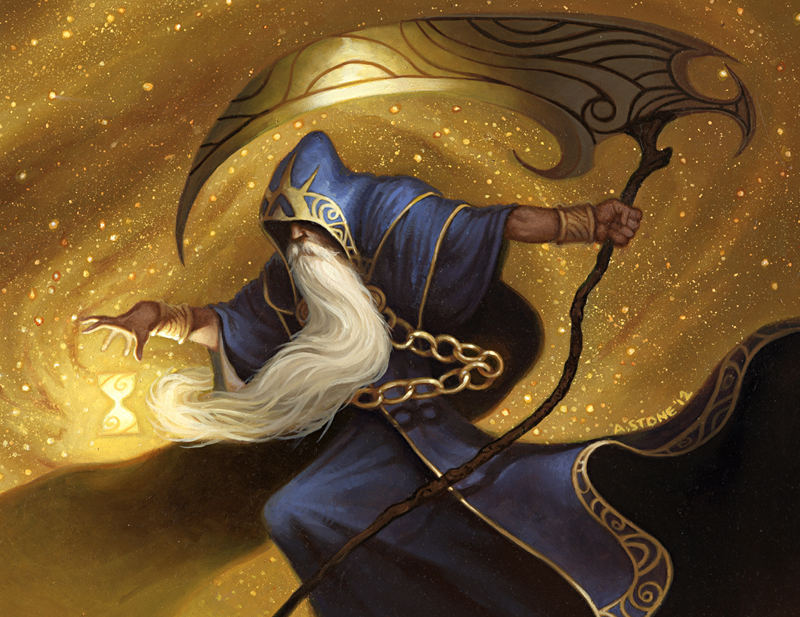
    Image Source: https://alexstoneart.deviantart.com/art/Father-Time-318943657

    Holiday Interludes
    The godly personification of time itself. Father Time is typically encountered in the form of an old and wizened man carrying a scythe. On occasion he displays an hourglass, watch, sundial, or similar timekeeping device, often when manipulating time itself. In all practical ways immortal, when "slain" Father Time becomes an infant who's very cry can tear down the old and usher in the new. 

    Name: Father Time

    Level: 15 (TN 45)

    Health: 200 • Armor: 0

    Damage: Special.

    Movement: Immediate

    Modifications: Father Time is Eternal, if he should ever be reduced to Zero Heath a new age begins and Father Time is reborn as an infant. In his infant form Father Time's wails bring down what was old and usher in what is yet to come.

    Combat: Father Time attack with his scythe, reaping what has been sown and moving his target one step down the damage track.

    Interaction: Father Time is usually encountered in the form of an elderly man with a scythe. He is pleasant to talk to and willing to hear all petitioners out, he does have all eternity afterall.

    Use: Father Time is immeasurably powerful but he is also old and bored. He can often be convinced to send a person or persons back to an earlier to change the flow of events for the sheer novelty of the unfolding new timeline.

    Loot: Father Time's Scythe is a level 10 artifact weapon dealing 10 damage that bypasses armor to a random pool with each attack when wielded by any being who is not Father Time. The depletion of the Scythe is often agreed upon between the borrower and Father Time and is usually limited to a specific number of uses after which the Scythe crumbles to dust and returns to Father Time.

    GM Intrusion: Father Time sends the target forward or backward in time allowing them a chance to change history, or the ability to bypass events. 

    Wednesday, December 13, 2017

    Nuts & Bolts #143 - Hacking the Cypher System - Still More on Shifts


    Unmasked was released recently. I wrote about it last week (here), and mentioned that regarding the Cypher System's Power Shift mechanic there was "more that enough for a whole different article about that specifically." Well, welcome to this week and another article about power shifts! I have written about the topic a few times previously.

    Unmasked's chapter on Shifts actually resonates with that second article, and I think there's a lot to unpack and a lot to learn, not just for Unmasked, not just for using Cypher System for Supers, but for any use of Shifts in a Cypher game, including those in Gods of the Fall.

    Chapter 8 isn't a long one, which makes it all the more powerful. It's the mechanical and narrative equivalent of Bruce Banner. It looks unassuming but it contains a powerful force. Heck I guess that fits with the whole theme of Unmasked. By page count the chapter looks like a Teen, but the content reveals that it's more of a Prodigy, and mask-form capable of wielding tremendous power that seems to defy logic. Perhaps I'm hyperbolizing a bit, but you'll have to be the judge of that for you. Me, I think there's some amazing stuff in these three, yes 3, pages!

    Firstly, Unmasked basically rips the training wheels off. Instead of just pointing back to the Shift categories in the CSR (page 270) it offers the following.
    Players should feel free to be creative with the three power shifts they can place on abilities in their new mask-form. There is no definitive list, because power shifts can be used on nearly anything. GMs should work with their players to establish what does and does not make sense for a power shift. (Unmasked, page 62)
    That's HUGE. Instead of limiting players and GMs to the list in the book (insomuch as they are actually limited, MCG isn't going to HALO drop into your dining room to force you to follow the rules strictly) they are explicitly opening Shifts up to 11. This game goes full throttle in a way even Gods of the Fall didn't. However, you can't just tell players and GMs to make stuff up without giving some guidelines (at least not without people then asking you for guidelines). And guide it does. With three simple suggestions it gives people all the tools they need, it's now in the hands of the players and GMs to use them.

    Power Shifts are suggested to be "Clear," "Restricted in scope," and "Indicative of the PC they are attached to." And with those three simple suggestions, and some prose to explain the intent, Power Shifts go from a pick and play assortment of prefabricated cookie cutter boosts to something that can be incredibly versatile and, best of all, flavorful and thematic. A whipping sixteen examples, a mix of the CSR shifts and entirely new ones, are then presented and further drive home just how much you can do when given the right tools.

    I think this will be incredibly useful for Gods of the Fall where sometimes shifts were really difficult to fit for Gods with more esoteric Dominions. A God of Shadows for instance could have a shift called "At Home in Shadows" that would give a boost to any action where the God was hiding in shadows, attacking from shadows, or the like. A God of Chance could take a shift in "The Odds are With Me" and gain a shift on games of chance/gambling, and all re-rolls from spending XP as another example.

    Lastly in a sidebar this chapter tosses out an interesting new optional rule: Pushing It. This reminds me of similar mechanics from other supers games like Power Stunts and Extra Effort from Mutant & Masterminds, or the effects of Hero Point or the like in any number of other games such as Savage Worlds.

    The idea is that during a dire situation the player can spend some XP to have the hero temporarily move shifts from one area to another to affect the outcome of a roll. A mastermine character with shifts in "Smart as Sin," which usually affects their Intelligence and knowledge skills, to a one round bonus to Speed defense to avoid being hit by a bus thrown at them by a villain. It's a nice way to help balance the huge disparity in power that can come from shifts and I think it also fits the superheroic genre quite well. It'll also fit nicely into Gods of the Fall, because it's hard to think that a God can't occasionally do a little extra something something when needed.

    All in all I think that despite being rather a short chapter the value of the advice here is going to come back tenfold or more. The Cypher System has always been open and welcoming to player and GM innovation but never has that mindset been so fiercely and advocated for and embraced. Taking these steps to a more toolkit oriented ruleset is something I encourage every GM to try. I think it'll help you and your players to engage more with both the settings and characters.

    Wednesday, December 6, 2017

    Nuts & Bolts #142 - First Impressions: Unmasked


    It's here at last. The final release from the Worlds of the Cypher System Kickstarter. Hot(ish) on the heels of Predation this past summer Unmasked brings us a game that feels weirdly prescient and also very current. It was announced before we knew what Stranger Things was but feels like it is taking its advantage of the chance to fall into that particular groove of nostalgia within the current pop culture.

    Either way we have a game that I think will find instant appeal in a certain sub-set of the Cypher System fandom, and potentially fly over the heads of others. Its setting is the 80s, and much of the way the game functions both from a perspective of characters as well as rules is anchored to a time when our world was substantially less instant, and substantially less digital. It's not nostalgia for the sake of mining a current fad, because while this game could work in a different era it just wouldn't work as well. The 80s were a turning point and the story of these teens with phenomenal powers is something that dovetails into that era in a way that just feels right.

    The setting for the game is very much 1986. It's also, at least ideally I think, small town America. It's game of big things happening to some of the kids in this mid '80s small town. Sound like Stranger Things? It should, but again, this was announced prior so I don't know that this a a copy-cat so much as parallel development. The setting may well be one of the most familiar and easy to run for you, or it'll be something that requires research because you didn't grow up in that time or place. Either way there are easy touchstones for inspiration out there. There are a multitude of "classic" 80's films to draw ideas from, Stranger Things may well be a direct inspiration, and for gamers who were of the right age in the 80s they can also draw directly from memory. All this doesn't mean that there isn't setting resources within the book. There are tons including both a minorly fleshed out town used as examples of how to build one's own setting, and a fully fleshed out setting for Boundary Bay, New York (*cough* Montauk *cough*).

    Similarly the game is about teens with superpowers. Kinda. Teens who can become people with superpowers is probably a more accurate description The titular masks allow the empowered teens to become another person, another personality with a different damage track, and fantastical abilities. This is not X-men because the teens do not have these powers directly.

    Which isn't a bad thing, it allows for a different look at the concept of teens with power, and further allows for the powered version to have wildly different personality from the teen beneath. A player could have a nerdy introvert who becomes a loudmouthed extrovert with their mask. This also means that a character who gets bullied may be tempted to recruit their braver mask to fight back for them. It's a different enough take on super-teens that it feels new and fresh. It also means that the teen and the mask can be at odds, opening further room for roleplay.

    Mechanically speaking Unmasked shakes things up for the Cypher System. Much in the same way that Predation and Gods of the Fall were willing to pull bits of the base code apart and re-write them Unmasked changes fundamental aspects of your character.

    Firstly is the way that the Teen persona works. Teen would feel weird if they had a ton of skills or crazy abilities, and they don't in Unmasked. Instead a teen gets a stripped down set of pools, befitting an adolescent who is not yet fully matured, and a descriptor. The descriptors are an open option from just about any of those you have access to, so long as they are not overtly supernatural or powered. E.g. the Mystical descriptor wouldn't fit for a Teen. That's it. Your teen is a barely formed and unmatured person, and the rules support this. It's simple and I love it (and not just because I used this idea previously!)

    There's more though. The Mask persona gets a full character sentence; they are a blank blank who blanks. They are in every way a fully realized Cypher Character. They also have to share their recovery rolls with the teen who wears the mask. Let me repeat that as is it hugely important for Unmasked GMs: the teens and their masks share the same recovery rolls. This means that a teen who takes a 1 turn recovery after a run in with the school bully is depriving their mask of that 1 turn recovery later that day when something happens. Or maybe it's the other way around and the teen can't compete during the big football game because his mask used up his 1 turn and 10 minute recovery rolls.

    There's also some interesting ideas around power shifts (more that enough for a whole different article about that specifically), and how the teens and their masks interact with others and with cyphers. Specifically how teens and their masks are the only ones who can normally identify a cypher, called mementos in Unmasked, and make use of their power. This presents a different approach than the prior settings where cyphers were things of value to any person in the setting.

    There's also the fact that mementos double down on the weirdness of cyphers by providing not only a useful ability but also a strong emotion, often with very specific context. Given that the protagonists and likely some of the antagonists are teenagers I could spin a talek specifically about a character who abuses mementos not for their abilities but to capture those feels that they feel unable to attain "in real life" as it were. Instead of the "I cut myself so I can feel" trop the character is constantly looking for cyphers because mementos are the only way they can feel. Pair that with a setting tweak where using mementos has some direct or indirect cost and things could get interesting very quickly.

    I've not yet played Unmasked, but I can already see where the rules choices and setting structures can be pulled apart and put back together to not only tell the story I want within the context of this setting, but also for other settings. As the third (but hopefully not final) World of the Cypher System I feel like this game dives into the deep end of the possibility of the Cypher System in general. As a follow up to Gods of the Fall and Predation (and Numenera and The Strange before them), Unmasked is more than worthy, and a triumphant piece of nostalgia gaming that still feels innovative and very much like it's own thing.

    Monday, July 31, 2017

    Furry Road - The Driver

    Notes: Drives Like a Maniac is from Expanded Worlds. Max is actually the first pre-gen I created for this, but I held him back because I needed to design the car. Also it was convenient to have a finished character in my back pocket in case I was pressed for time. Anyways, Max is a patrol trooper, so Virtuous seemed like a nice fit, especially when combined with the other assorted characters. Drives Like a Maniac was basically a pre-req for this game. The character is one of the most well rounded of the pre-gens as well thanks in part of a hefty dose of skills from descriptor and focus in addition to those gained from type. As for the Armored Patrol Cruiser, that's designed using the rules I created for CypherCaster Magazine #6. These expand on the vehicle rules from the CSR for games where the vehicle is more center stage than in other games.  I made some terminology modifications because those rules were written for spacecraft, but they apply equally well for road vehicles... for instance the "Truck" type is the same as the "Light Freighter" type.


    Max the Dog is a Virtuous Explorer who Drives Like a Maniac

    Tier 3 • Effort 3
    Might 17 • Edge 1
    Speed 15 • Edge 2
    Intellect 12 • Edge 1

    Cypher Limit: 2

    Armor: 2 • Bullet proof vest (medium)

    Skills:
    • Trained
      • Running
      • Speed Defense
      • Medium Ranged Attacks
      • Knowledge: Road Gangs
      • discerning people’s true motives or seeing through lies
    • Specialized
      • Intellect Defense
      • driving cars, trucks, & motorcycles
      • Navigation
      • Vehicular repair 
    Abilities:
    • Practiced in Armor
    • Practiced With Light and Medium Weapons
    • Danger Sense (1 Speed point)
    • Quick Recovery
    • Stand Watch (2 Intellect points)
    • Machine Efficiency (3 Intellect points)
    • Seize Opportunity (4 Speed points)
    • Ignore the Pain
    • Driving on the Edge
    • Car Surfer
    Equipment: Calivada Road Patrol fatigues, a trunk tool kit (heavy tools), roll of duct tape, flashlight, 1x MRE. Armored patrol cruiser. (see below).

    Weapons:
    • Sawn-off shotgun • special ranged weapon 
      • 6 damage at immediate range
      • 4 damage to Short range
      • attacks as a light weapon at long range (2 damage)
    • 9mm pistol • medium ranged weapon
    • Knife • light melee weapon 
    • Molotov cocktail • thrown weapon • short range • 2 damage plus fire
    Armored patrol cruiser - "Sheila" is a Hardy Truck Defends the Weak

    • Frame: 18 • Edge 1
    • Engine: 12 • Edge -1
    • Alternator: 8 • Edge 0
    • Armor: 2
    • Hardpoints:
      • Medium Weapon turret (4 damage, long range) 
      • Extra Heavy Frame
      • Light Armor 
      • Full Throttle (As Fleet of Foot, CSR pg 40)
      • Optimized for Armor


    • Cargo: None - personal items only
    • Crew: 2 (Driver & Navigator/Gunner) + turret gunner
    • Weapons: Forward mounted SMG (light ranged weapon, long range)
    • Easy to Repair: Recovery takes 1/2 time
    • Keep Rolling: Ignore one damage level
    • Brick: Trained in Hull Defense
    • EMP Shielded: trained in Alternator Defense


    Initial Link: It's your job as a sworn officer of the Calivada Road Patrol to protect the roads, and the Road Hogs are the biggest threat to safety in the entirety of the coastal region.

    Connections:
    • You've worked with Cornelius the Chimpanzee before. On a previous mission you accidentally crashed your vehicle when Cornelius was a passenger. Though you both recovered you still feel guilty about the incident.
    • Anthony the Mouse is one of the few people you trust to work on your car.

    Friday, July 28, 2017

    Nuts & Bolts #129 - Hacking the Cypher System - A Visit to Freeport

    Note: Because I'm taking August to do #RPGaDay and this is fairly fresh, I decided not delay it to September. Hopefully nobody gets too angry at the lack of Predation/Gods of the Fall stuff. 


    Over the past few weeks I had the opportunity to step into the GM seat for my current Monday night group. Being that it was going to be a finite thing and how busy my day to day is at the moment I decided to run Death in Freeport. Freeport is a drop in city setting and, one of my favorite RPG settings. Death in Freeport is an adventure I've run before as well so I could spend my effort adapting it to Cypher rather than learning the adventure. As a D&D 3e adventure this also offers an opportunity for me to see what it takes to adapt adventures from d20 System to Cypher. Here are some of my lessons learned in doing so.

    Difficulties
    The d20 system uses Difficulty classes that span from 0 to 40, usually in increments of 5. This is pretty similar to Cypher's 0 to 30 in 3 point increments. Unortunately this also means that I cannot simply use the existing DCs and divide by 3, as the result would scale more difficult than intended. Likewise I cannot set level by dividing the DC by 5 as this the d20 scale has fewer increments. Instead I would need to come up with a rule of thumb that would cover most situations, but still give me some wiggle room.

    Initially I used a of DC 10 as level 1. From there I can add levels equal to 1/3 the difference.

    • Ex: DC 15 = level 1 + [(15 - 10) / 3] = 1 + [5 / 3] = 1 + 1 2/3 = level 2 or 3
    This will occasionally leave some remainder and you can decide if you want to round those up or not. Per the formula for instance a DC 15 is a level 2 or 3 depending how you want things to feel. With more time however this didn't quite feel right, and also required a little more mental math (albeit simple) than I wanted to do on the fly at the table. 

    With some thought on the issue I settled on a simple solution of dividing the DC by 4. In this way the d20 system's 40 point difficulty range could be be adapted from 8 increments of 5 to 10 increments of 4. Remainders will be had, and as before you can round up or down, I tend to round up if the remainder is a 3 and down on a 1 or 2. So a DC of 15 becomes a level 4 (15/4 = 3 remainder 3 = round up to 4). Erring a little more difficult in Cypher is less damaging because the character's often have multiple means to reduce difficulty including training, assets and cyphers. 

    Challenge Ratings and Enemy Levels
    Challenge rating was where I really stumbled. My early attempts at using CR to determine the level of the enemy led to some easy encounters. The character level scales between d20 and Cypher are just too vastly different for this to end up being an easy one size fits all solution. In the end I had to rely mostly on gut estimates of how difficult the encounter needed to be, or how difficult I wanted to make it. 

    At a rough estimate the level of the enemies for Cypher should be around 2-3 times the CR. Alternately one can use the health of the enemy to gauge it's level. In encounters with numerous weak enemies you can either use mob rules as normal to make a number of lower level enemies a higher grade of challenge.

    Initial Costs as Combat Bypasses
    During play there were two "speed bump" encounters. The first was a bunch of serpentmen and I ran it normally with the serpentmen as level 3 creatures with level 4 for attack and defense. The second was a bunch of level 2 skeletons. There were 8 skeletons in the room, most of whom had fewer than 5 HP in the adventure. I quickly realized that this was not going to be a challenging encounter on its own. I didn't want to use the mob rules as this wasn't story-centric, but I didn't want to run the encounter in full either. 

    In the end I settled on making up a new rule. Using the idea of Initial Costs from the Cypher System I proposed to my players that they could pay to narrate their way past the encounter. I gave them an initial cost, in this case 2 points from a pool of their choice, to allow them to just defeat the skeletons without further rolling. The cost in points was equal to the level of the creatures and helped to show that although they quickly moved past the encounter the character's did have to fight it out and get "tired" by the effort. This worked out well enough that I will likely use it in the future as a way to drain character resources without draining player table time. This is especially useful for "side encounters" that do not further plot but do make sense in the game world.

    Closing Thoughts
    Running a d20 adventure for Cypher really didn't require much work, and opens up a vast catalog of great stories for the GM on the go who may not have time to develop their own adventures. The effort investment to adapt is light, and much can be done on the fly in the way that Cypher is especially well suited for. I'm already planning to follow up with Terror in Freeport with the same group when next there's a break in the normal Numenera campaign, and I'm hoping that I can finish the Freeport Trilogy with Madness in Freeport as well. 

    Monday, July 24, 2017

    Furry Road - The Face

    Designer's Notes: Ahh, the Face. Face character's can be the ones who run an adventure in weird places, especially if played very cunningly. So an Impulsive face seemed a great way to balanced things by making this character a potential powder keg within the group. Wields Two Weapons at Once is really meant for melee weapons, so I decided to allow its Tier 2 ability Double Strike to use Speed pool when attacking with ranged weapons, but still require might for melee. I don't see an issue with dual wielding guns otherwise so this was a pretty easy fix. Ability wise rabbits don't really need much except a lot of speed which allowed me to focus on social abilities. 


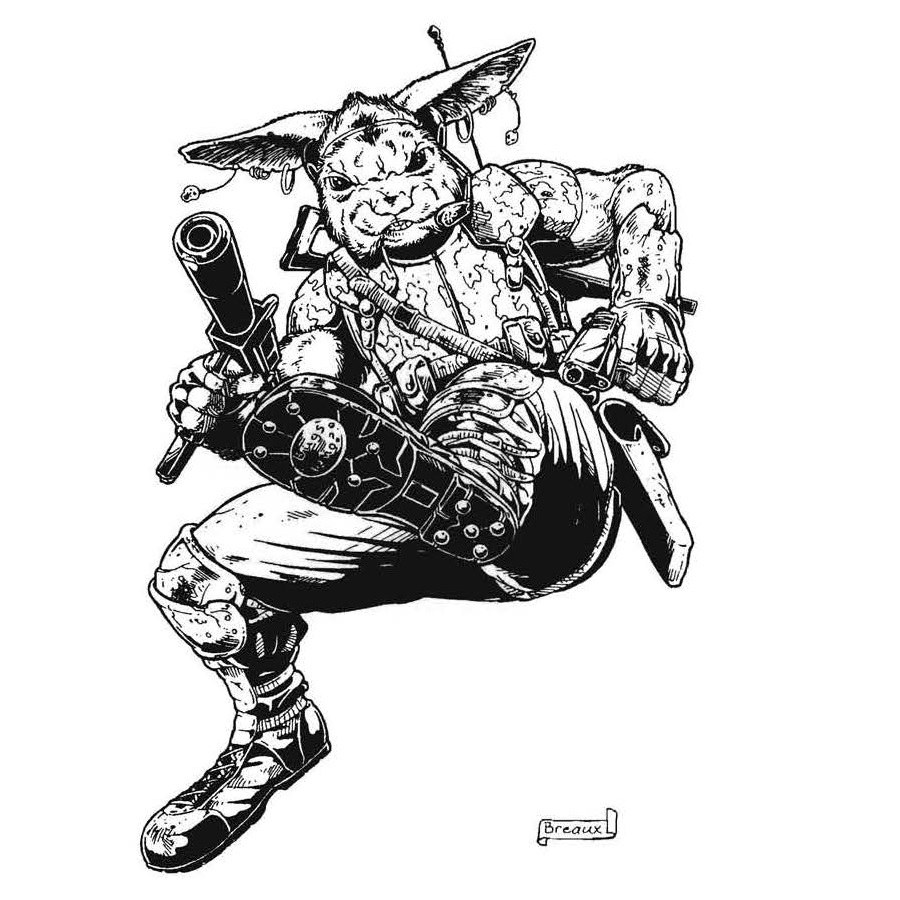
    Jessie the Rabbit is an Impulsive Speaker who Wields Two Weapons At Once


    Tier 3 • Effort 3
    Might 10 • Edge 0
    Speed 14 • Edge 1
    Intellect 20 • Edge 2

    Cypher Limit: 2

    Armor: 1 (light, leather jacket)

    Skills:

    • Inability
      • any task that involves patience, willpower, or discipline
    • Trained
      • initiative
      • Deceiving
      • Persuading
      • Running
      • Speed defense

    Abilities:

    • Dual Light & Medium Wield
    • Double Strike (3 Might or Speed points)
    • Practiced With Light & Medium Weapons
    • Enthrall (1 Intellect point)
    • Fast Talk (1 Intellect point)
    • Spin Identity (2+ Intellect points)
    • Unexpected Betrayal
    • Impersonate (2 Intellect points)
    • Telling (2 Intellect points)
    • Blend In (4 Intellect points)
    • Grand Deception (3 Intellect points)

    Weapons:

    • 2x 9mm Handguns (medium ranged weapon, short range)
    • 2x .38 Handguns (light ranged weapon, short range)
    • 2x knives (cheap, light melee weapon)

    Equipment: Dark clothing, gear harness, flashlight, padlock w/keys.

    Initial Link to the Adventure: You requested a team after you heard rumors about the Road Hogs allying with another faction.

    Connections:

    • You think Cornelius the Chimpanzee is too analytical and needs to be more willing to make quick decisions in the field. 
    • You once mistook Nausicaa the Bird for an enemy and nearly killed her with a grenade. You still regret the results of your impulsive actions that day.

    Monday, July 17, 2017

    Furry Road - The Scout

    Design Notes: Let's start with the basics; Soars Across the Sky is found in In Translation. I wanted to ensure that the character had true flight and this was one of the few foci that provided it, and early enough for this to allow for an interesting pregen character. As a scout I needed to get some perception in there and Sharp-Eyed  worked well at that and provided the "Find the Flaw" ability that I thought made an interesting addition to the character and took her in a slightly different direction with a more military intelligence feel rather than a more "traditional" field scout. Adept was a weird fit, but I wanted two of each type and I'd already run out of Explorers. In this case though I think it worked out to make for an interesting set of abilities when combined with the idea of a mor military espionage & intelligence scout. 


    Nausicaa the Bird is a Sharp-Eyed Adept who Soars Across the Sky
    Tier 3 • Effort 3
    Might 10 • Edge 0
    Speed 15 • Edge 2
    Intellect 17 • Edge 1

    Cypher Limit: 3

    Armor: 1 (flight suit, no penalty)

    Skills:
    • Trained
      • initiative
      • assessing danger
      • Sneaking
      • intelligence gathering 
    • Specialized
      • perception

    Abilities:
    • Find the Flaw
    • Hover (1 Speed points)
    • Flight Suit
    • Flight (4+ Speed points)
    • Flying Punch
    • Protected Flight (3 Speed points)
    • Practiced with Light weapons
    • Push (2 Intellect points; SFX: buffet the target with your wings) 
    • Scan (2 Intellect points)
    • Understanding (2 Intellect points)
    • Subterfuge
    • Flex Skill

    Weapons:
    • Custom .45 Carbine (light ranged weapon, long range, 4 damage)
    • nightstick (light melee weapon)

    Equipment: Aerodynamic flight suit (counts as light armor with no penalty), shotgun microphone, binoculars, gear harness, 2x rations, box of chalk.

    Initial Link to the Adventure: You’ve been noticing some strange things going on, and this all appears related.

    Connections:
    • Anthony the Mouse made you your custom carbine which has served you well in the field. 
    • Jessie the Rabbit once mistook you for an enemy and nearly took you out with a grenade. You still have a few scars from the burns.
    • You are impressed with, and a bit envious of, Nux the Horse's ability with firearms. 

    Monday, July 10, 2017

    Furry Road - The Triggerman

    Design Notes: I'd considered making this a character a bow user early on, but then changed my mind as I realized that the technological capacity of the After the Bomb universe was more than enough for bullets to not be a rare and prized commodity. Carries a Quiver becomes Carries a Rifle and otherwise remains mostly intact. Horses primary have the traits of speed and/or strength. Swift and/or Strong seemed good descriptor options, but I obviously could only use one. Further, I really didn't need excessive strength or Might because the character prefers firearms and so Strong was out. In the end I also decided to forego Swift as well and rely on training and Edge to represent the horse's inborn speed. This allowed me to focus on adding an interesting personality to the group by way of another quirky descriptor. Enter the "Vengeful" descriptor and a character who has some personal stake in the mission at hand... 


    Nux the Horse is a Vengeful Warrior who Carries a Rifle

    Tier 3 • Effort 3
    Might 16 • Edge 1
    Speed 18 • Edge 3
    Intellect 8 • Edge 0

    Cypher Limit: 2

    Armor: none

    Skills:
    • Trained
      • Attack: Rifles
      • intimidation
      • torture
      • tracking
      • Craft: Rifles
      • Jumping
      • Lore: Road Hogs
    • Specialized
      • Craft: Bullets
      • Running
      • Speed Defense
    Abilities:
    • Archer
    • Covering Fire/Double-tap (1 Speed point)
    • Overwatch (1 Intellect point)
    • Pierce (1 Speed point)
    • Successive Attack (2 Speed points)
    • Deadly Aim (3 Speed points)
    • Spray (2 Speed points)
    • Trick Shot (2 Speed points)
    Weapons:
    • AK47 Rifle (Medium weapon, long range, rapid fire)
      • 2x magazines of 30 rounds
    • .308 Rifle (heavy weapon, long range, bolt action)
      • Nightvision scope
    • .45 Pistol (medium weapon, medium range)
    Equipment: Clothing, light tools, functional GPS map, 2x rations, flashlight, duct tape.

    Initial Link to the Adventure: Your gang was wiped out by the Road Hogs and you want revenge, plain and simple. 

    Connections:
    • You are especially taken with Jim the Raccoon's junk-scavenged crafts, and when you use an item in a way that requires a roll, add +1 to the result. 
    • You think that Jessie the Rabbit talks too much and wonder if she really understands the threat of the Road Hogs.

    Monday, July 3, 2017

    Furry Road - The Mechanic

    Author's Notes: This one could have been easy but I wanted the mouse to be small in stature and as it turns out there's not really a good Descriptor for small. The closest I could find was the Halfling descriptor from Alternate Origins (The Strange Fractal), but that descriptor was very tied into the cultural aspects of halflings as much as their physical traits. As a result I decided to build a new descriptor which you will find below. As an adept I am justifying much of the type abilities of this character as bits of gear. Scanning tools, weaponry, and the like. Lastly I want to call out the "Duct Tape" skill, which is meant for jury rigging repairs and creations in short time. Think of the kind of things you'd expect out of MacGuyver. This skill can be used in turns where Crafting would take hours, but the result isn't permanent, and may be prone to failure (e.g. GMI).

    Small
    You are much smaller than your peers, at least half as tall, possibly smaller. Your body is proportional so you are also lighter and then to be less strong as well. You had to learn to look out for yourself and look out for what others were doing lest they harm you accidentally because they failed to notice you. On the bright side you are harder to hit and quick on your feet. 

    You have the following characteristics:
    Nimble: +2 to your Speed Pool.
    Skill: You are trained in sneaking and hiding.
    Skill: You are trained in climbing tasks.
    Skill: You are trained in perception.
    Skill: You are trained in Speed defense.
    Smaller Fit: Because you are smaller you find it harder to find equipment your size. All gear that you need sized for you costs 50% more. On the flip side you are able to fit into tighter spaces including reaching into spaces that your larger peers cannot. 
    Physically weaker: Whenever you would apply Might effort you must spend 1 additional point from your Might pool. 
    Inability: Resisting disease, poison, and fatigue is harder for you. You have an inability with all Might Defense tasks. 

    Initial Link to the Starting Adventure:
    From the following list of options, choose how you became involved in the first adventure.
    1. One of the other PCs saved your life previously, so you’ve (somewhat reluctantly) agreed to help.
    2. One of the other PCs saw the value of somebody your size and asked you to come along.
    3. You made a case for your inclusion based on your abilities regardless of your size.
    4. You want to prove that you are just as capable as your larger peers. 

    Anthony the Mouse is a Small Adept who Crafts Unique Objects

    Tier 3 • Effort 3
    Might 11 • Edge -1
    Speed 15 • Edge 1
    Intellect 18 • Edge 2

    Cypher Limit: 4

    Armor: 1 (ward)

    Skills:
    • Inability
      • Might defense
    • Trained
      • Sneaking and hiding.
      • Speed defense.
      • Perception.
      • Climbing 
      • identifying the function of any kind of device
      • Crafting: Electronics
      • Crafting: Blacksmith
    • Specialized
      • Duct Tape (jury rigging)
      • Crafting: Vehicles
      • Crafting: Gunsmith
    Abilities:
    • Smaller Fit: Because you are smaller you find it harder to find equipment your size. All gear that you need sized for you costs 50% more. On the flip side you are able to fit into tighter spaces including reaching into spaces that your larger peers cannot. 
    • Tinkerer. 
    • Quick Work (3+ Intellect points). 
    • Advanced Taser Mk II (Onslaught)
    • Proton Decay Instigator (Shatter)
    • Armorweave Clothing (Ward)
    • Automatic Diagnostic Handheld (Scan)
    • Machine Efficiency (Tech Flavor)
    • Targeting Eye (Advanced Taser Mk II)
    Equipment: You begin the game with a bag of light tools, the tools needed to make your first-tier crafts, and a bag of heavy tools. Mechanic's jumpsuit, wi-fi enabled camera, beat up quadcopter drone, appropriately sized camping gear, 50' rope & grappling hook (rated for your weight), and four rolls of duct tape.

    Weapons:
    • Pen knife (light weapon)
    • .22 Derringer (Light weapon, short range, 4 shot pepperbox)

    Initial Link to the Adventure: You want to prove that you are just as capable as your larger peers.

    Connections:
    • Nausicaa the Bird has a customized rifle that you fashioned for her. 
    • You are constantly impressed by the things that Jim the Raccoon can assemble from little more than junk.