Showing posts with label Hacking the Cypher System. Show all posts

Wednesday, January 19, 2022

Nuts & Bolts #166 - Hacking the Cypher System: Predation


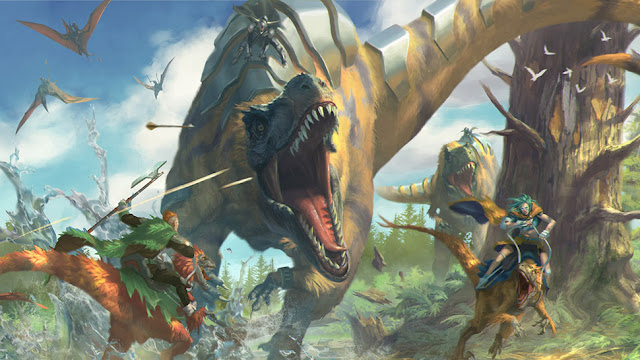
This past weekend I got the chance to play Predation again for the first time in a long time. The session was fun and I was reminded about how interesting the setting was. I was also reminded how the characters each have a dinosaur companion and how each player at the table role-plays the companion for another player. 

After the session I got to thinking about how the companion mechanics were fun, but...

That but really got me though. But, it was sometimes tough to juggle two character sheets. But, it was difficult to remember who was playing which character and which dino (this was exacerbated by using Zoom so it wasn't as easy as just looking to ones left or right). But, I was having a lot more fun with the dino companion than I was with my human character.

Lots of buts. That last one was the kicker tho. I really did have more fun playing a prehistoric chicken than I did playing my (checks papers) Creative Osteon who Crafts Unique Objects.

I wonder if there is any reason why one could not instead split your players roughly into two groups and have half of them play people, and half of them play dinosaurs. Give the dinosaurs actual types and foci to make them more fully realized characters. Problem solved?

Well, doing this would make play a little easier as you wouldn't have to try and play two characters at once. It would also mean less to track for the GM and other folks at the table. It would allow players to get more fully into character since they wouldn't have to worry about the companion dino for another player, or for their primary human. Best of all it would allow for a lot of role-play between players at the table. Imagine the player-player relationship between a "Disobedient t-rex" and an "Uptight scientist," or between a "stealthy warrior" and a "clumsy brontosaur"! By cutting the number of characters in half and allowing the dinosaurs to be more fully realized I think you could gain some really interesting role-play at the table that would otherwise often be minimized during play.

Of course, if you prefer Predation as it stands right now you should keep enjoying it, but I think if I run a game in the future I may consider this as an option to allow the players to choose before we start.

Wednesday, July 1, 2020

Nuts & Bolts #165 - Hacking the Cypher System - Slow Burn Horror Mode

Image Source: Stay Alive! page 71, (c) Monte Cook Games


Horror Mode is one of the many "bolt on" rules introduced in the original Cypher System Rulebook and carried forward in both the Revised edition and the Stay Alive! horror themed book. It's a simple enough rule where the range for player rolled GM Intrusions expands beyond natural 1s. As written it can be really useful for horror games and really help to build tension as the rolling of dice becomes fraught with the risk of a GM Intrusion without the balm of XP. 

A while back I had tried an alien invasion horror survival game I called Invasion! It stumbled early on due to players being unable to make it and I ultimately shut it down rather than try and force it to work with an uncertain roster of players. Continuous stories really require a strong recurrence of the cast at the table, so I felt justified.

Recently I have been prepping to reboot and try again, and part of that is a conscious decision to look at what rules I could add or manipulate to further add to the tone and feel of their weird idea of mine. Horror Mode seems like a good choice but the way that it ebbs and flows wasn't what I wanted in my game. Instead I wanted a slow pressure that would build reliably over time as the alien invasion pressed onward. I built a timeline of events that would take place (assuming the players don't find ways to slow the aliens down), and in the process I had milestones that would put pressure and stress on the setting and characters. It started to resolve that as the aliens hit their milestones things would get more dire for the colonists. 

Horror Mode is the perfect fit here, but at a much slower pace. Days will pass as the aliens execute activities and so days will pass between increases in the GMI range due to Horror Mode. The players may experience several sessions at a GMI range of 1-2 until another alien milestone is hit, permanently raising the range to 1-3. The players may also decrease the range by setting in motion their own actions to either set the aliens back, or make their own positions stronger to either counter the aliens or escape the planet. 

By slowing the increases in GMI range for Horror Mode, and allowing player actions to help roll that range backwards I hope to create a palpable sense of slow burning dread that will help motivate the actions of the characters. Slowing the speed at which Horror Mode ramps up and down is a minor change, but I think it can pay off for Gamemasters who are looking for a very specific slow burn experience at the table. 

Sunday, June 28, 2020

Nuts & Bolts #164 - Hacking the Cypher System - Super Smash

Image Source: Cypher System Rulebook page 272 (1st edition), (c) Monte Cook Games

So, I really enjoy superhero RPGs as a palette cleanser, especially nowadays. Especially when I am kicking off a dark campaign shortly. I use Cypher System a lot of the time (most of the time) because it does a good job emulating the feel without also getting in the way rules wise.

One of the things I like is GM Intrusions (and Player Intrusions) can allow characters to do super stuff that may not be written down on their stats or sheets. I can use it to have a metal guy ring like a bell and stun nearby characters after being hit real hard, or to have a character who cannot fly use a fiery rocket blast to gain limited flight.

One thing that is darn near ever present in the superhero genre (regardless of the sub-genre tones you may use) is that people tend to go flying when hit knocking into objects, smashing walls, or just being tossed away from the melee scrum. Usually in Cypher games I would treat this as a GMI or PI depending on the character and situation, but that doesn't really work in a supers game where it should be happening a lot. And I do mean A LOT. Characters getting knocked and thrown around helps to make combat less static, it moves the action around, and makes players consider the environment more. I think sending a character flying will also help make some of the super strong characters feel stronger. It makes faster characters gain an advantage over slower ones (they can get back into combat faster), and it is exciting as a it gives the impression of the attack really impacting even if it doesn't do any extra damage in the process.

In other words, IT'S EXCITING.

Sadly, I realized this all to late for my most recent game. It was still fun and had some really memorable moments, but I think about the missed opportunities for sending heroes and villains alike hurtling through the air and I wish I hadn't been locked into a mindset that these kinds of reactions were GMIs/PIs.

Instead I should have played it as a feature of the game. A default that such hits would cause recoil and send characters smashing through walls, flying through the air, and skidding along the ground. In the future I will being making a more conscious effort to do this. Non-super strong characters shouldn't send others very far unless they are specifically trying (PI, special ability, or result of a Major or Minor Effect), maybe just one foot per level (or tier) which can largely be hand waived entirely unless geography dictates that it matters.

For the super strong however, each shift in strength will increase this from 1' to 5' to 10' to 20'. Similarly characters with Single Attack shifts should have their attacks hit so hard that they gain a similar increase. An NPC who is level 6 and have 2 shifts in strength could hit another character so hard they would fly 60 feet away! (10' for 2 shifts x level 6 = 60).

This seems an easy fix, and I would rule that a player could opt out of sending their opponent flying by holding back on Strength Shifts or by attacking in other ways. An overhead smash might instead drive their enemy through the street and into the subway or sewers, or simply drive them into the dirt like a nail. The goal in the end is to play up the over-the-top aspects of the supers genre so that not only does it feel like a comic book (or a Marvel movie), but so that it feels different from other games you may run with Cypher System.

Sunday, May 31, 2020

Nuts & Bolts #163 - Hacking the Cypher System - Sidekicks


Editor's note: It's been WAY too long, but sometimes you just don't have anything to give. You can't squeeze blood from a stone. I'm going to try and be better about posting here but these are uncertain times and it's hard to think about happy fun times games when the world is burning down around you.

Superhero RPGs are an occasional fun diversion for me. I don't play regularly for various reason, and as a result I find some of the better superhero RPGs a bit cumbersome because I have to relearn the rules a bit each time. Thankfully the Cypher System is pretty capable for superheroics in most cases (some weirdness aside when it comes to the ability to fly).

One thing that Cypher doesn't do well (IMO anyways) is sidekicks and support characters. Most the time you get a low level critter, robot, or hireling who is some use at Tier 1, and decreasingly useful as you gain Tiers. Often they are rolling unmodified for most actions other than a small handful that they have training for. Without ability to apply effort they can feel very weak against tasks and enemies at level 5 of higher.

In supers games the sidekick can often be very important for certain characters, and they can help a smaller group of PCs punch a little higher than they could otherwise with the power of numbers. Thankfully there is one Cypher game that made an effort to make companions a little more interesting and stronger: Predation.

Predation is a pretty great setting with some interesting rules to support the Dinosaur companions that are nearly ubiquitous within the setting. These rules, like most rules, can be easily adapted or modified to suit other settings and genres to enable PC companions. I already discussed this idea a while back in regards to a high tech or cyberpunk game where PCs can be reasonably expected to have AI assisted drones. Another common genre with a historic trope that fits well with these rules is comic books & superheroes. Oh hey, how topical!

I think the companion rules will work wonderfully for this purpose. With a minimum of additional work required to fit the rules to the genre. While I presented the idea of this prior but did not elaborate on what those changes would look like, this time I would like to present my full hack for Sidekicks.

First thing's first, we need to skin over the dinosaurs into sidekicks. This is really just a matter of renaming them to fit a superheroic game:

  • Tyrannosaurus become Brawlers, sidekicks who are bigger more aggressive fighters than most of their peers (though not likely as big and tough as their hero).
  • Raptors become Hunters, sidekicks who use teamwork and stealth to stalk the the enemy. 
  • Ornithomimids become Speedsters, sidekicks who use their speed to avoid enemy attacks while drawing fire from their hero.   
  • Ceratopsians and Ankylosaurs become Tanks, bigger and tougher but slower than their peers, Tanks can take a lot of abuse and help their hero by sticking in combat for the duration.
  • Pterosaurs become Fliers, sidekicks who can take to the air and aid their hero from a position of advantage above the city.
  • Early Mammals become Scouts, who make up for for their weaker physical ability by being premier scouts, reconnoitering ahead and searching out the enemy's weaknesses. 
The companion ability lists for each type can stay as is, and even those ability names can be retained for the superhero genre. The exception to this is the Temporal Hunter ability which can either be removed, or rejiggered for the setting (example, Mutant/Metahuman Hunter, or the like).

Lastly the companion dispositions from the book. These are the biggest change as I would not use these and instead use the same Descriptor list as the main player characters in the game. This will allow more options and better suit the fact that sidekicks are people, not animals. Descriptor bonuses to pools can instead be applied directly to the sidekick's health stat, and the skills and inabilities can be applied as normal. 

When your hero interacts with their sidekick they should still use the Interaction mechanisms from Predation (pg 49) to represent the development of the sidekick from a trainee to an eventual highly trained hero in their own right. This means that initially they may misunderstand their hero's instructions, or may balk at their orders/mission due to lack of experience. As your hero gains experience so too will their sidekick and they will be more confident and capable following your hero's lead. 

Since superheroes use the power shift rules I would also allow sidekicks to apply 1/2 rounded down the number of shifts that their hero has. These might be different from the hero's shifts as in the case of mutants or sidekicks with different themes from their hero, or they may be the same because of training and similar power themes. Likewise I would grant each sidekick a choice of +4 Health or an level of skill training at Tier 1, and then apply a bonus of +2 Health per tier in addition to the normal progress. This will help these sidekicks last a little longer as the superheroes they serve get stronger and the super-villains they fight likewise gain more power.

Lastly I would definitely suggest that other players at the table play the sidekicks of other heroes. This will allow far more interesting roleplay than if the sidekicks are played by the same player as the hero. Predation got this perfectly and I see no reason why it should change with a new genre.

That's it (I think), a set of perfectly useful rules for making genuinely interesting Sidekicks for use with Superheroic gaming using Cypher System. 

Wednesday, January 23, 2019

Nuts & Bolts #157 - Hacking the Cypher System - Role Play Informed Modifications


I've mentioned before my current Cypher campaign in the Nightbane setting (a Palladium RPG that's proving way more fun in Cypher System). The players are really getting into things and exceeding my expectations for role playing in a horror setting. Horror games can be tough if the players aren't on board for playing horror, but so far this hasn't been the case for this tale of people turned monsters. In the course of the campaign thus far fear and paranoia on the part of the characters has been playing strongly into the actions of the players. Even better the dice seem to be in on the fun and have been supporting things.

Picture the scene ... one of the characters has found that by traveling through mirrors he can access a parallel shadowy earth; a twisted realm known as the Nightlands. He convinces a second character to help him take the bodies of two doppelgangers they killed to the Nightlands for "disposal." This second PC has been pretty freaked out by everything and is reluctant to go to this scary sounding Nightlands place, but he mans up and tries ... and fails. He spends a moment to put some effort into it and tries again ... and fails, again. He spends and XP, and still fails (mind you a lvl 4 task with effort he only needs a 9+). He takes a recovery to get some points back and collect himself and tries, and fails, again.

I mention this not because these moments are amusing and memorable but because I've been taking these role playing moments, and using them in conjunction with a little use portion of the optional rules: XP Advances.

You'll find the text for XP advances in the Cypher System Rulebook on page 230-231. The basic gist is that the player can trade negative character traits for XP. For example a character who is wanted by the law might get ~4-6 bonus XP. Normally such traits and their trade off bonuses are the domain of character creation, but I've started to use the rule in the situations above to give role-play informed modifications to characters in exchange for Advancements.

So in the example above I offered the player a permanent Inability in tasks related to traveling through mirrors (a pretty big deal since the Nightlands are the only place to get Cyphers for this character in this game) and in exchange an advancement for extra edge in a pool of his choice. I did similar for another player whose character continually refused to transform back into their human guise. These are optional for the players and I only offer them when it feels right for the character and the story, but so far it has been well received and has made for interesting character development and roleplay.

If a GM wasn't willing to give out entire advancements they could hand out XP, or other short, medium, or long term benefits. These types of character impacting modifications should obviously be taken carefully and not abused. Let the game guide you and only offer them when it feels earned by the direction of the role-play and the game.

Friday, November 23, 2018

Nuts & Bolts #154 - Hacking the Cypher System - Nightbane & Cyphers


This is a follow up to this post about using the Cypher System, and especially the design aspects laid out by Unmasked, to resurrect one of my favorite game settings: Nightbane.

So after kicking things off successfully with the characters finding their true nature as shape-shifting monsters of shadow and darkness (though really they are more dual nature, and they aren't evil per-se, so monsters may be a bit racist) the third session finally found myself as GM with an opportunity to expand the setting for the characters. While washing the blood off himself one of the PCs found himself drawn into the bathroom mirror and into the shadow-Earth known as the Nightlands.

With his arrival into this place I also had the first opportunity to provide one of the PCs with a cypher. I'm using this game to try out something a little different for cyphers. Firstly, cyphers are going to be PC abilities and not physical objects, kind of like a subtle cypher, but without the need for the effects to be subtle. Secondly the source of cyphers will depend on the character's supernatural nature. A nightspawn (because Todd McFarland can't sue me for using the game's original title!) gain cyphers from the nightlands, the shadowy alternate earth which may also be their home dimension. They essentially get to charge up strange and powerful one off abilities when visiting that realm; abilities that will stick with them until used.

The half-vampire dhampirs gain cyphers by consuming blood, providing them with a very real hero vs. monster struggle for players to (hopefully) have fun with. Human psychics will need to spend time in the astral realm, the dream realm, or during intense meditation (depending on their particular psychic leaning). Ordinary humans will almost certainly be associated with the covert remnants of the legitimate US government (a.k.a. the Spook Squad) and have access to prototypes and special devices that with act as more traditional cyphers.

I'm hoping that this will work to make cyphers feel integral to the setting in the way that they do for Numenera. Likewise, I hope that this will give the players something to sink their teeth into for role-play purposes. Time and more sessions will determine how well this works.

Wednesday, September 26, 2018

Nuts & Bolts #153 - Hacking the Cypher System - Nightbane


Nightbane is not a game that a lot of folks know. I've mentioned it in the past. It's an older game from Palladium Books that I first picked up in college back in 1996 (a fact that I know because I found the receipt in the back of the book last night). I've long since given up on Palladium's house system because I just find it to be too much, and as a result a lot of the games I played when I started gaming have sat on bookshelves and waited for their turn to come back around again. Always I would see them and want to play but every time I tried the rules stopped me cold.

When the Cypher System Rulebook came out a couple of years back I really started to look at Cypher as a way to bring back Nightbane for myself and my friends. The focus changing aspects of The Strange had shown me that there a way forward, but I still couldn't quite break the problem of the core characters, the titular nightbane. Nightbane are supernatural shapeshifters. The have a human facade and a monstrous morphus. The facade form is just human, no powers, no abilities beyond that of a normal non-heroic person, but the morphus is a powerhouse.

Thankfully Unmasked came along and gave me the final piece of the puzzle. A duality for form can exist no just by replacing a part of the character's sentence as in The Strange, but by omitting it entirely. The teens in Unmasked are given only a few pool points and a descriptor. Their masked alter egos gain not only a full character sentence but shifts as well. My eyes were opened and I knew, at last, how to make the nightbane work.

I started my players with a descriptor and an occupation, a Hideous Gravedigger, a Perceptive Electrician, and a Creative Tech Consultant. These were the human guises of the players, the as yet unaware of their true nature nightbane player characters. Each character started with 5 points in each pool, modified by their descriptor as appropriate, and that was it. This is less than the teens in Unmasked, and may seem harsh, but Nightbane is, in part, a horror game and the mortal facade form needs to feel weak and vulnerable.

Their morphus forms however gained not just a type and descriptor, becoming a Hideous Warrior who Rages, a Perceptive Explorer who is Sworn to the Seal*, and a Creative Adept who Needs no Weapons, but they also gained shifts, assigned by me, based on the appearance of their twisted and monstrous nightbane morphuses. These we determined the old fashioned way, using the tables in the original RPG's book.
*Sworn to the Seal is a rename of Sworn to the Crown, but this character is loyal to the US Government instead.
Getting back to my gaming past proved a wonderful experience and CYpher proved more than equal to the task of taking an old Palladium Books game and breathing new life into it for my friends and I, much in the same way that it had for Palladium's After the Bomb at Gen Con 2017 when I ran Furry Road.

Wednesday, September 12, 2018

Nuts & Bolts #152 - Hacking the Cypher System - Minions & NPCs


Minions in Cypher System have always been a bit of a mixed bag. The level system makes minion stats very easy to determine and their approximate power easy to gage. However because of the simplified way that minions operate they tend to suffer diminishing returns later in the game state as their skills do not generally increase nor do they gain the ability to apply effort to their rolls. As a result as antagonist NPC levels rise the target numbers for NPCs and Minions steadily increase and reduce the effectivity of the Minion or NPC.

This has been observed and discussed in the past with both fans and creators proposing ways for NPCs & Minions to grant assets, or apply effort out of their health, and similar. Ultimately however, none of these solutions have really solved the core problem. If a level 5 NPC face off against a level 6 NPC that level 5 is pretty much destined to lose. While defeat may be inevitable, there should be a way for that level 5 NPC to affect the level 6 without relying on 15% of rolls to be able to do anything. Likewise a level 6 NPC should be able to make short work of a level 2 NPC without the risk of poor dice rolling.

I'm proposing a simple fix, one that doesn't require the GM to pick up dice, that will help even low level creatures contribute (even if only a little), but that also allows high level NPCs to act accordingly. Best of all, it's super simple.

  1. Determine level of task the NPC/Minion is attempting
  2. Subtract the NPC/Minion level from the level of the task, the remainder is the final difficulty level
    1. If the remainder is positive this number x3 is the d20 target for the player rolling the dice.
    2. If the remainder is zero no roll is needed, the NPC performs the task, and if an attack deals their normal damage.
    3. If the remainder is a negative number the NPC/Minion applies that many levels of free effort, or may provide an asset to the PCs or other NPCs on a one for one basis. 
Easy right? How about some quick examples:
  • A level 4 minion attacking a level 7 creature that it's master is fighting. The player rolls at a level 3 (9+) for the minion (instead of a 21+ using the rules as written).
  • A level 6 NPC ally attacks a level 2 creature ambushing the group. It applies 4 levels of effort (potentially one hit killing it) or can provide as many as 4 assets to the PCs.
  • A level 3 minion trying to defend against a level 3 creature succeeds with no roll required. 
The GM can always use an intrusion to allow lower level NPCs to succeed on higher level tasks of course, which also means that the GM gains the leverage to keep the story momentum going where they need it. 

Wednesday, March 21, 2018

Nuts & Bolts #149 - Hacking the Cypher System - Shifting into Theme

Image Source: https://www.deviantart.com/art/Vulcan-210359334

I mentioned a while back (here and here) how I liked that Unmasked really embraced Shifts as a tool rather than a set list of options. Part of that is that there are so many ways to use Shifts in this way that weren't really possible before. I like this not just for Unmasked, and not just for other super-heroic games, but especially because of what it means for Gods of the Fall. I think that this kind of approach will make it easier to generate god PCs and NPCs in Gods of the Fall because a godly dominion can be used nearly directly for the character's shifts.

Consider a god of Fire. Previously when gaining shifts one would allocate perhaps a shift to Resilience and two more to Power for a specific fire power. Instead you could allocate all three to God of Fire and this would allow true divine mastery over the dominion of fire. Instead of having 1 armor against all attacks and 1 step better with all Might Defense the character is now +3 armor against heat and fire and 3 steps better on Might defense to resists heat, fire, smoke, and the like. In addition in place of having a single fire power that is two steps better all of their Fire themed powers are now 3 steps better.

Sure, this may result in a little more "bang for the buck" but it's also balanced into the character's theme. This also means that the player can champion their theme where appropriate, and allows the GM the freedom to adjudicate as they see fit for their game. This paves the way for less traditional themes which may not have been as easy to work with previously. It also still leaves room for the player to take other shifts accordingly; your god of fire may also be exceptional dexterous, or may also have a lesser dominion over crafts (in the way Vulcan did as god of fire, volcanoes, metalworking, and the forge).

This also means that if a GM wanted to create special shifts related to a given pantheon they could. In real world mythology gods of a given pantheon tended to share certain traits. The gods of Egyptian myth, for instance, all had strong relationships with the realm of Duat, the realm of the death. A divine shift in this pantheon specific shift would allow the god to enter the underworld, and provide them with some level of ability over the souls of the dead, based on their theme.

Opening up the design space of power shift rules with the guidelines of being "Clear," "Restricted in scope," and "Indicative of the PC they are attached to" will really help both players and GMs to create interesting and unique characters with powers that strongly match their themes rather than forcing a character to bend to accommodate their shifts.


Wednesday, February 21, 2018

Nuts & Bolts #148 - Hacking the Cypher System - Skinchangers: The Wolfkin

Image Source: https://www.deviantart.com/art/wolf-10458909

The wolfkin are born with the soul of a canine. Stuck between two very different states of being the wolfkin must find a path between their human and animal selves. Contrary to the myths and legends, and despite the appellation, wolfkin can be ensouled with the essence of dogs, coyotes, and even jackals in addition to wolves. Being wolfkin means having to find a balance with the animal inside. Depending on the cycle of the moon the wolfkin was born into that balance may be canted toward the human, the animal, or may truly be an equal share. Regardless each wolfkin can transform from human form to the form of their animal soul and back. Unlike the Hollywood stories of the man-animal hybrid the wolfkin most commonly transforms fully into the same animal type as their soul and can do so at any time regardless of the phase of the moon.

At Tier 1 you select a moon phase. This indicates the phase of the moon your character was under, and indicates where they have found balance with their animal soul.

Full Moon
You were born during the fullest portion of the moon, on or within a few days of true full on either side. Your animal nature is strongest and even in human form you tend to prefer the outdoors and a more natural lifestyle. This does not mean you are savage or uneducated, though this is also possible. Full moon wolfkin tend to act, and react, from instinct and think things over later. Likewise wolfkin of this phase tend to eschew technology in favor of natural abilities and simple tools. To be a full-moon wolfkin is to embrace your animal nature at the expense of your humanity.
  • You have Incompetence in Transformation to Human Form
  • You are Specialized in Transformation to Wolf Form 
Gibbous
The gibbous phase wolfkin are canted toward their animal nature, though not as much as full moons. Gibbous wolfkin struggle with their natures, with the animal winning out most often
To be a gibbous moon wolfkin is to struggle with your humanity and find it often out of reach, or to ignore it in favor of one's animal nature.
  • You have Inability in Transformation to Human Form
  • You are Trained in Transformation to Wolf Form 
Half-Moon
Being born during the period of half moon these wolfkin are the most able to balance the two sides of their natures. The half-moon embrace the best of both sides and most easy set aside the worst of each as well. They easily strike a balance between the animal's instinct and man's rationality, the animal's love of nature and man's use of technology. To be a half-moon wolfkin is to be at peace with both sides of yourself.
  • Gain no advantage, nor suffer any penalty, when transforming between man and wolf form , or back.  
Crescent
The crescent moon is nearly dark and as such the human side of your soul is the stronger for it. Wolfkin of the crescent moon tend to be less attuned to nature in general, and often view their wolf soul as an inconvenience or a tool, and less a true part of themselves.
  • You are Trained in Transformation to Human Form
  • You have Inability in Transformation to Wolf Form 
New Moon
Human nature is your nature. Your wolf self is distant and difficult to embrace. You probably grew up in a big city and seldom spent time in nature as a child. All of this gives you greater centering on the human side of your existence.
  • You are Specialized in Transformation to Human Form
  • You have Incompetence in Transformation to Wolf Form 
Because I needed a term for character with two negative steps of "training" I brought it up on the G+ group for ideas. Ultimately I liked "incompetence" best as I think it suits the condition the most.
Incompetence - Like an inability Incompetence represents an area of diminished ability. The opposite of Specialized a character attempting a task for which they have an Incompetence increases the difficulty of the task by 2 levels.
At Tier 1 a wolfkin character must give up one of their normal Type abilities to that the first rank of Wolfkin. Thereafter at each tier a character may give up a Type ability choice to instead choose from one of the corresponding Wolfkin tier options.

Wolfkin Tier 1
  • Transformation (1 Intellect) - The Wolfkin transforms from human form into wolf form, or back. This requires a successful Level 3 Transformation roll (and Intellect based Task). The GM should feel free to adjust this depending on circumstances. It is more difficult to become a beast when not in nature, and harder to become a human when in combat for instance. During the phase of the moon corresponding to their birth phase gains an asset to this task. Action to initiate, the transformation itself takes 1 minute.
    • While in the form of a wolf the character gains the following:
      • Movement increases by one increment, the character can move a short distance and still take an action, up to long range without a roll (or with a roll and still take an action), or up to 200 feet with a normal roll.
      • The character is considered to have an asset for all tasks related to seeing in the dark and stealth, and two assets for smell-based perception, and hearing-based perception.
      • The character's unarmed attack becomes a bite that acts as a medium weapon.
      • Pack tactics: The character gains an asset to any task the an ally has attempted this round (including attacks but not including defense). 
    • There are drawbacks to being a wolf however. In addition to looking like a wild animal you suffer the following:
      • The character lacks hands and is unable to activate and use even the simplest of devices designed for hands or requiring fine motor control. 
      • Your transformation does not extend to your clothing or any carried possessions. When you transform back to human you'll be naked. Your personal sense of modesty will determine what happens next. 
    Wolfkin Tier 2
    • Canine Communication (2 Intellect) - For the next hour you can communicate with other canines, being understood, and understanding their replies. They are generally favorably disposed to you (you gain an asset to all such tasks) but are still limited to animal intelligence and understanding. Action to initiate.
    • Faster Transformation - Your transformation is faster, if not any easier, and takes only a single round. Enabler.
    Wolfkin Tier 3
    • Improved Animal - As the tier 3 Howls at the Moon ability, Greater Beast Form (CSR pg. 135)
    • Partial Transformation - With a successful transformation roll when using the Tier 1 Transformation ability you can shift only part of your shape into your animal form. You may choose one of the four animal form bonuses and use that while remaining mostly human in appearance. Your form will shift to accommodate the ability (golden eyes, dogs ears, and a more animal-like nose for senses, quadrupedal running for speed, etc.
    Wolfkin Tier 4
    • Alpha (5 Intellect) - You can call and command up to a dozen canines to form a pack around you. They will follow you as their alpha to the best of their ability. This does not allow you to understand them or issue complex commands (see the Canine Communication ability) but they will follow you and try to anticipate you needs and come to your aid. The pack is made up of up to a dozen level 3 canines, or fewer level 4 canines (as determined by the GM). The pack will follow you for up to 12 hours, or indefinitely if you are their master normally. Action to initiate.
    • Hamstring - As the tier 4 Stealth Flavor ability, Debilitating Strike (CSR pg. 53).
    Wolfkin Tier 5
    • Dire Wolf - As the tier 5 Howls at the Moon ability, Enhanced Beast Form (CSR pg. 135)
    • Go for the Throat (4 Speed) - You know the right time and place to strike for maximum effectiveness. Your next attack deals 6 extra damage if it hits. Enabler.
    Wolfkin Tier 6
    • Unnatural Transformation (5 Intellect) - Instead of transforming into a wolf or a man you transform into an unnatural hybrid. Such creatures are the melding of the best, and worst of both and few wolfkin are willing to attempt such a transformation. 
      • You gain the following:
        • +15 points to your Might Pool
        • +10 points to your Speed Pool
        • +2 to your Might Edge
        • +2 to your Speed Edge
        • Regeneration: Any remaining Recovery Rolls you have for the day become 1 Turn Recovery Rolls
        • Tooth and Claw: Your unarmed bite and claw attacks do 6 damage. 
      • You also suffer the following:
        • Savage Instinct: All Intellect tasks other than Intellect Defense tasks are 3 levels more difficult. 
        • Apex Predator: Any round in which you suffered damage you must make an attack or move full out to get into attack range. Discerning friend from foe is a level 7 Intellect task (the penalties of Savage Instinct are already applied).
        • Horrifying to Behold: Any non-supernatural being witnessing you in this form must make a level 6 Intellect task to resist terror. If they fail they must attempt to flee from you. This includes allies, both human and canine.

    Wednesday, February 7, 2018

    Nuts & Bolts #147 - Hacking the Cypher System - Costs, Initial and Direct


    Back in N&B #108 I lamented how underused Initial Costs are and I made a promise to make an effort to use the rule more at my table. Having been running a Freeport game with reasonable consistency over the past 6 months I've had a chance to do just that and it has given me ideas.

    First and foremost I've ruled that at my table Initial Costs bypass Edge. I think this may, technically, go against the rules as written in the book, but I also allow players to use whatever pool they want if they can justify why that pool works. E.g. a warrior may pay 3 might to push a boulder out of the way, but an Adept may pay 3 Intellect to blast the bould to pieces with magic. Either way they pay 3 points.

    Secondly I'm moving more and more to using Initial Cost in place of certain skill checks. Sometimes it's an offer to the group, "You can either all undergo a skill contest to chase down the target, or you can pay a cost of 4 points." This allows the group to decide if they want to risk the enemy getting away, or possibly being split up because one or more members couldn't keep up the pace and a fixed cost that they cannot avoid. It's resource management for the players and resource depletion for me as GM. In other instances the cost is the cost and I use this to ensure that critical information or actions that the adventure requires happen. If your whole adventure is predicated on the PCs bypassing a locked door and none of them manage a way past via skills, cyphers, and abilities, I set a Cost and allow them to bypass the obstacle. I usually do this only if there is no other good path forward and the PCs are in danger of stalling out and frustrating the players.

    Thirdly I use it as a "mop-up tax" in combat. In the most recent session the PC, already quite resource depleted, got into a combat against six serpentfolk and a low level priest of the Unspeakable One. After several rounds saw them slay 4 of the serpentfolk and the priest, rather than drag out the last few rounds of combat I said that if each of them paid 2 points we'd jump to their inevitable victory. I could force the combat, potentially get some damaging hits in, and possibly send a character down, but after several rounds of combat this would have been somewhat not exciting and would have dragged the session down. I've done this several times in this campaign and the players seem to like the ability to clean up the no-name minions in this way after the big-bad is downed.

    I probably use the Initial Cost rules as written (an initial cost required prior to a skill check) the least, though I do try to also do that. I think that the "Direct Costs" I've laid out above have made for a game with a grittier feel and allowed me to make the city of Freeport, with its pirates and cultists and dark gods, an appropriate level of dangerous for the PCs. I've also seen a lot more table discussion of rest and resources and how much more the characters can endure by doing this. For my money that's worth every point of effort spent as GM.

    Wednesday, January 10, 2018

    Nuts & Bolts #146 - Hacking the Cypher System - Blowing Up Advancement


    The magic number is Sixteen right? Or is it? Four EXP per advancement. Yes, that's correct. Four advancements to gain the next Tier. Yes. No. Maybe.

    I've been running a Cypher System game set in Freeport since this summer. We try to play weekly, but it's working out more like 2x per month right now because we are at minimum group size (IMO, 3 players and a GM is minimum, I know some folks will run for fewer PCs, but for me 3 is the bare minimum). The players are all somewhere in the midst of Tier 2 right now. They are pretty capable. They can combat like the best of them. They have some cool toys. They even have some strengths in certain kinds of tasks.

    The more we play though, the more I am seeing that the characters are pretty threadbare for skills. This is the first time I'm really running into this in Cypher and I think it's because I've been making an effort to really throw in a variety of applicable skills. Lore: Local Knowledge helps when churning the rumor mill, or knowing current events. Lore: Magic for all those useful instances of "what the heck is going on"? Jumping, climbing, sneaking, speaking, running, tracking, and observing. Heck, even cooking has come up.

    Sometimes the players have the skills they need sometimes they don't. The Cypher System isn't a super skill heavy game system the way other systems can be. There's no barrier to entry for tasks based on skill. If you aren't trained in locating secret doors or navigating that just means it'll be tougher for you. This works well and I wouldn't change that aspect of the system, but one thing I do thing I want to change is the acquisition of skill training.

    And in the process I'm going to change the advancement process for my game. Possibly for all my games henceforth.

    At the moment Advancements include: Effort, Pools, Edge, and Skill. BUT there's the option to ditch one Advancement for one of a number of other options. Note that while this is commonly thought to replace the Skill it can replace ANY of the "core four" Advancements. Also note that the list of options is different depending on the book you're using. Numenera (pg. 112) allows for a Type ability, while the Cypher System Rulebook (pg. 223) and The Strange (pg. 124) do not. Maybe this is a change Monte made after getting more time with the system, or maybe it was a matter of layout space and not wanting drift onto the next page (since all three of those pages are also the last of their respective chapters).

    I mentioned to my group that I was going to change this last option. Instead of allowing it as a replacement for the standard four, I'm going to add it as a new Advancement entirely. Edge, Effort, Pools, Skill, and "Training". Personally I prefer the Numenera allowance of an extra Type ability so "Training" will be either, a recovery bonus, an armor penalty reduction, or a new Type Ability. This would also be a prime place to place "Guild training" for character's who join organizations that grant special abilities.

    This has two immediate effects on character advancement of course. The first and most obvious is that characters now have to buy 5 Advancements before they tier up. They also will always gain training in a skill, the most commonly replaced Advancement, as a result of this. However there is a derived effect that may not be initially obvious. Each Tier get's a little longer. It now takes 20 EXP to tier up rather than 16 EXP. That means that Tier 6 is a minimum of 100 EXP away rather than 80 EXP. This may help some of you to run longer campaigns (I see people asking about that from time to time).

    What's the in-game impact? Well, the direct impact is that character's will be even stronger late in the game. They'll either have more Type abilities to draw on, or they will have much more powerful Recovery rolls, or be able to wear the heaviest of armor without care. They'll also have more skills in all likelihood. Is this a problem? It could be. I have never GMed a game for Tier 6 PCs. I've never even played in a game past the Tier 4/5 tipping point.

    Maybe it's a terrible idea.

    I would imagine that in a Gods of the Fall game it would have barely any impact on the PCs who with shifts and Divine Cyphers will certainly be absurdly capable at Tier 6 already. On the other hand it'll make PCs in a "grim n gritty" game too strong. They'll have too much power.

    Which is why I think I'd be OK doing the opposite for such games and having only 3 Advancements per Tier (or even 2 if you were planning an intentionally short campaign). If you wanted to give the players less power make them have to choose between their gains because they simply cannot do everything. You can alter the cost of Advancements as well. A game where players have to spend 8 EXP for an Advancement but gain a tier after only two Advancements is still 16 EXP per Tier, but results in weaker characters. I suspect that this would actually run longer as a campaign as well because the players will have more EXP available during games as they need to bank more. This will mean that they will more often have the ability to re-roll or reject a GMI, and need to choose which is more important in the moment; all of which will probably help to build the risk-reward balance that a "gritty" campaign style needs.

    Lastly (because this is already a long and rambly post), if you decide to run with fewer Advancements per Tier that cost more EXP each, you can also start to play with either/or choices. Effort OR Edge but buying one locks you out of the other for that Tier, for instance. This will further drive the players to make critical choices and have limited resources. I'd suggest a pairing of Skill/Effort and Pools/Edge personally, but you may have different ideas. In a gritty style game I'd probably do away with the optional armor training and recovery roll Advancement awards entirely to help keep the game firmly grounded.

    I'm sure there's other ways that a GM could tweak the Advancement and Tier mechanics to suit their game. I've heard of people charging EXP for Divine Shifts in Gods of the Fall, and I could imagine using EXP mechanics for Companion upgrades in Predation. Advancement is just another type of Long-Term Benefit so perhaps in certain games a GM may require players to buy one of those for Advancement (I could see needing wealth or a home in a Birthright-esque game for instance). Hmm, now that gives me other ideas for Gods of the Fall ... but that'll need to wait for another column.

    Wednesday, December 13, 2017

    Nuts & Bolts #143 - Hacking the Cypher System - Still More on Shifts


    Unmasked was released recently. I wrote about it last week (here), and mentioned that regarding the Cypher System's Power Shift mechanic there was "more that enough for a whole different article about that specifically." Well, welcome to this week and another article about power shifts! I have written about the topic a few times previously.

    Unmasked's chapter on Shifts actually resonates with that second article, and I think there's a lot to unpack and a lot to learn, not just for Unmasked, not just for using Cypher System for Supers, but for any use of Shifts in a Cypher game, including those in Gods of the Fall.

    Chapter 8 isn't a long one, which makes it all the more powerful. It's the mechanical and narrative equivalent of Bruce Banner. It looks unassuming but it contains a powerful force. Heck I guess that fits with the whole theme of Unmasked. By page count the chapter looks like a Teen, but the content reveals that it's more of a Prodigy, and mask-form capable of wielding tremendous power that seems to defy logic. Perhaps I'm hyperbolizing a bit, but you'll have to be the judge of that for you. Me, I think there's some amazing stuff in these three, yes 3, pages!

    Firstly, Unmasked basically rips the training wheels off. Instead of just pointing back to the Shift categories in the CSR (page 270) it offers the following.
    Players should feel free to be creative with the three power shifts they can place on abilities in their new mask-form. There is no definitive list, because power shifts can be used on nearly anything. GMs should work with their players to establish what does and does not make sense for a power shift. (Unmasked, page 62)
    That's HUGE. Instead of limiting players and GMs to the list in the book (insomuch as they are actually limited, MCG isn't going to HALO drop into your dining room to force you to follow the rules strictly) they are explicitly opening Shifts up to 11. This game goes full throttle in a way even Gods of the Fall didn't. However, you can't just tell players and GMs to make stuff up without giving some guidelines (at least not without people then asking you for guidelines). And guide it does. With three simple suggestions it gives people all the tools they need, it's now in the hands of the players and GMs to use them.

    Power Shifts are suggested to be "Clear," "Restricted in scope," and "Indicative of the PC they are attached to." And with those three simple suggestions, and some prose to explain the intent, Power Shifts go from a pick and play assortment of prefabricated cookie cutter boosts to something that can be incredibly versatile and, best of all, flavorful and thematic. A whipping sixteen examples, a mix of the CSR shifts and entirely new ones, are then presented and further drive home just how much you can do when given the right tools.

    I think this will be incredibly useful for Gods of the Fall where sometimes shifts were really difficult to fit for Gods with more esoteric Dominions. A God of Shadows for instance could have a shift called "At Home in Shadows" that would give a boost to any action where the God was hiding in shadows, attacking from shadows, or the like. A God of Chance could take a shift in "The Odds are With Me" and gain a shift on games of chance/gambling, and all re-rolls from spending XP as another example.

    Lastly in a sidebar this chapter tosses out an interesting new optional rule: Pushing It. This reminds me of similar mechanics from other supers games like Power Stunts and Extra Effort from Mutant & Masterminds, or the effects of Hero Point or the like in any number of other games such as Savage Worlds.

    The idea is that during a dire situation the player can spend some XP to have the hero temporarily move shifts from one area to another to affect the outcome of a roll. A mastermine character with shifts in "Smart as Sin," which usually affects their Intelligence and knowledge skills, to a one round bonus to Speed defense to avoid being hit by a bus thrown at them by a villain. It's a nice way to help balance the huge disparity in power that can come from shifts and I think it also fits the superheroic genre quite well. It'll also fit nicely into Gods of the Fall, because it's hard to think that a God can't occasionally do a little extra something something when needed.

    All in all I think that despite being rather a short chapter the value of the advice here is going to come back tenfold or more. The Cypher System has always been open and welcoming to player and GM innovation but never has that mindset been so fiercely and advocated for and embraced. Taking these steps to a more toolkit oriented ruleset is something I encourage every GM to try. I think it'll help you and your players to engage more with both the settings and characters.

    Wednesday, November 1, 2017

    Nuts & Bolts #139 - Hacking the Cypher System - Damage Tracks (Again)

    The damage spiral from the Hordes miniatures game.

    Two weeks ago I posted about an alternate damage track for games where insanity and mental degeneration was needed. It also works well for games of social intrigue where you are trying to unnerve your opponents and force them into actions that are advantageous to you. Since then I've been thinking that with just one more alternate damage track for Speed you could transform Cypher's heath system pretty radically. Yes, it would mean more bookkeeping, and yes it's a bit more complicated, but consider the advantage of characters having more than just a single way to be taken out of action, and having more thematic effects from various types of stress and harm.

    The Core rules for Impaired, Debilitated, and Dead work very well for Might, with the character becoming Impaired after half their Might is gone, Debilitated when they hit zero points, and Dead if they suffer any additional damage. As always a GM can have creatures who have special attacks (poison, necromancy, etc.) that can bypass the pool points and deal damage direct to their Might damage track. Coupled with the Mental Damage Track from two weeks back (click here) we're 2/3 of the way done!

    Speed pool is all that remains and a speed damage track is actually pretty easy. The following kick in when a character's speed pool reaches 1/2 its normal value and then when they reach zero. Alternately special attacks like stun weapons, sleeping gas, painkillers, and the like may move the character directly down the damage track.

    • Fatigued - The character is starting to tire. The character finds that actions take a little more of their reserves to execute.
      • Gathering one's energy is difficult. A fatigued character must spend 1 additional point when using any special ability take has a cost. 
    • Exhausted - The character's reserves are spent, they may be in otherwise good physical health (e.g. no Might damage) but their exhaustion shows in shaking muscles and general exhaustion.
      • Exhaustion robs the character of much needed mobility. They are treated as having an Inability in all tasks related to movement including Speed Defense, running, swimming, jumping, etc. In addition all movement rates are halved. 
    • Unconscious - Insensate. Asleep. Knocked-out. 
      • The character is out and unable to perceive their surroundings, defend themselves, and the like. They'll wake after a duration equal to their next available recovery roll, and may well not know where they are. 
    Taken in conjunction with the previously proposed mental damage tracks players will be encouraged to build more well rounded characters. It also allows the GM a wider variety of options for disabling characters without killing them or ruling directly from GM Intrusion to render them unconscious or otherwise at the mercy of enemies or situations. 

    Wednesday, October 18, 2017

    Nuts & Bolts #137 - Hacking the Cypher System - Mental Damage Track


    So you're playing a horror game and want to have a better way to show character mental trauma. Or maybe you are playing a game with a lot of social "combat," people arguing, vying for control, political deception, and such and you want a way to track a person's demeanor. As designed the Cypher System isn't terribly granular in this regard, but that's not something that cannot be fixed. The damage track does a great job of tracking physical damage and stress, and in games of exploration and combat the loss of a damage level from mental assault and/or fatigue works well but when focusing heavily on those more social times it starts to work a bit less well.

    Social and mental damage is certainly easy to integrate as damage to Intellect pool. Instead of going to Impaired however these kinds of "attacks" could go to a new type of damage level: Provoked, Disturbed, and Unhinged.
    • Provoked - The character is saddened, angered, or off put. They are still in control but on edge and starting to lose control. While a character is Provoked they count as having one less armor for the purposes of mental and social attacks (this may mean having a -1 armor and therefore taking 1 extra damage from such attacks). 
    • Disturbed - The character is now on the verge of breakdown. They are furious, grief stricken, or offended. Their control is beginning to slip and they are prone to making poor choices and taking reactionary actions without considering the consequences. While a character is Disturbed they gain an Inability in Intellect defense tasks, and must also make a level 4 Intellect task to act counter to their emotional state (e.g. a roll to not act in anger but instead stay one's hand). 
    • Unhinged - The character has now fallen into a an uncontrolled state of wrath, anguish, outrage, or the like. At this stage the character's actions are dictated by their mental state as advised by the GM with player input. Should the character try not act as dictated by their mental state they must succeed on a level 5 Intellect task. 
    Unlike the traditional physical damage track these damage conditions are tied to the character's Intellect pool only. They act as a way to track a character's mental state. When a character takes Intellect damage from a social or mental attack that puts their pool below half they also take the next available level of Mental/Social damage. When their Intellect pool falls to zero, they then take then next level of Mental damage. Should they suffer further social or mental attacks while their pool is at zero they suffer an additional level of mental damage. A GM can of course use a GM Intrusion to directly inflict a level of mental damage in appropriate situations.

    Recovery on the mental damage track can be done by taking a recovery roll and succeeding on a level 3 Intellect Defense task. Success means they recover a level, failure means they do not. Taking a 10 hour rest always recovers 1 level of Mental Damage. 

    As usual, these rules are not tested, so if you use them for a horror game or a Game of Thrones style political game I'd love to hear about it. 

    Friday, July 28, 2017

    Nuts & Bolts #129 - Hacking the Cypher System - A Visit to Freeport

    Note: Because I'm taking August to do #RPGaDay and this is fairly fresh, I decided not delay it to September. Hopefully nobody gets too angry at the lack of Predation/Gods of the Fall stuff. 


    Over the past few weeks I had the opportunity to step into the GM seat for my current Monday night group. Being that it was going to be a finite thing and how busy my day to day is at the moment I decided to run Death in Freeport. Freeport is a drop in city setting and, one of my favorite RPG settings. Death in Freeport is an adventure I've run before as well so I could spend my effort adapting it to Cypher rather than learning the adventure. As a D&D 3e adventure this also offers an opportunity for me to see what it takes to adapt adventures from d20 System to Cypher. Here are some of my lessons learned in doing so.

    Difficulties
    The d20 system uses Difficulty classes that span from 0 to 40, usually in increments of 5. This is pretty similar to Cypher's 0 to 30 in 3 point increments. Unortunately this also means that I cannot simply use the existing DCs and divide by 3, as the result would scale more difficult than intended. Likewise I cannot set level by dividing the DC by 5 as this the d20 scale has fewer increments. Instead I would need to come up with a rule of thumb that would cover most situations, but still give me some wiggle room.

    Initially I used a of DC 10 as level 1. From there I can add levels equal to 1/3 the difference.

    • Ex: DC 15 = level 1 + [(15 - 10) / 3] = 1 + [5 / 3] = 1 + 1 2/3 = level 2 or 3
    This will occasionally leave some remainder and you can decide if you want to round those up or not. Per the formula for instance a DC 15 is a level 2 or 3 depending how you want things to feel. With more time however this didn't quite feel right, and also required a little more mental math (albeit simple) than I wanted to do on the fly at the table. 

    With some thought on the issue I settled on a simple solution of dividing the DC by 4. In this way the d20 system's 40 point difficulty range could be be adapted from 8 increments of 5 to 10 increments of 4. Remainders will be had, and as before you can round up or down, I tend to round up if the remainder is a 3 and down on a 1 or 2. So a DC of 15 becomes a level 4 (15/4 = 3 remainder 3 = round up to 4). Erring a little more difficult in Cypher is less damaging because the character's often have multiple means to reduce difficulty including training, assets and cyphers. 

    Challenge Ratings and Enemy Levels
    Challenge rating was where I really stumbled. My early attempts at using CR to determine the level of the enemy led to some easy encounters. The character level scales between d20 and Cypher are just too vastly different for this to end up being an easy one size fits all solution. In the end I had to rely mostly on gut estimates of how difficult the encounter needed to be, or how difficult I wanted to make it. 

    At a rough estimate the level of the enemies for Cypher should be around 2-3 times the CR. Alternately one can use the health of the enemy to gauge it's level. In encounters with numerous weak enemies you can either use mob rules as normal to make a number of lower level enemies a higher grade of challenge.

    Initial Costs as Combat Bypasses
    During play there were two "speed bump" encounters. The first was a bunch of serpentmen and I ran it normally with the serpentmen as level 3 creatures with level 4 for attack and defense. The second was a bunch of level 2 skeletons. There were 8 skeletons in the room, most of whom had fewer than 5 HP in the adventure. I quickly realized that this was not going to be a challenging encounter on its own. I didn't want to use the mob rules as this wasn't story-centric, but I didn't want to run the encounter in full either. 

    In the end I settled on making up a new rule. Using the idea of Initial Costs from the Cypher System I proposed to my players that they could pay to narrate their way past the encounter. I gave them an initial cost, in this case 2 points from a pool of their choice, to allow them to just defeat the skeletons without further rolling. The cost in points was equal to the level of the creatures and helped to show that although they quickly moved past the encounter the character's did have to fight it out and get "tired" by the effort. This worked out well enough that I will likely use it in the future as a way to drain character resources without draining player table time. This is especially useful for "side encounters" that do not further plot but do make sense in the game world.

    Closing Thoughts
    Running a d20 adventure for Cypher really didn't require much work, and opens up a vast catalog of great stories for the GM on the go who may not have time to develop their own adventures. The effort investment to adapt is light, and much can be done on the fly in the way that Cypher is especially well suited for. I'm already planning to follow up with Terror in Freeport with the same group when next there's a break in the normal Numenera campaign, and I'm hoping that I can finish the Freeport Trilogy with Madness in Freeport as well. 

    Wednesday, July 5, 2017

    Nuts & Bolts #126 - Hacking the Cypher System - P.E.T.S.

    Image Source: http://www.deviantart.com/art/Vangaurd-654639758

    One of the big features that Predation is likely to sell books on is its Companion dinosaurs. I think that's great because it obviously a cool idea that catches the imagination of a lot of folks. I think it's also great for the Cypher System in general because I think the companion rules are pretty fun and a nice addition to the continually expanding tool set that is the Cypher System.

    It doesn't take a lot of effort to reskin the dinosaur and upgrade names to something that suits your campaign world. It could be various fantasy type creatures for a Gods of the Fall game (or something more D&D-ish if you prefer), or it could be strange aliens in a game world similar to Avatar (the blue people one, not The Last Airbender one).

    For my money though I think that these could also make great robotic companions, or as I am wont to call them: P.E.T.S.

    That's Personal Electronic Technical Servants. Small drone-like but semi-independent robots that would fit great into a science fiction game. These could be small recon bots, larger combat models, or even semi-sentient and autonomous "vehicles" that can carry a rider or act on their own. Unlike a game of Shadowrun where only the rigger has drones, everybody (or nearly so) in a setting with P.E.T.S. would have one to help them out and act as a companion. In fact people find that even though the limited AI of these drones sometimes misinterpret their commands, they are more than worth having around because the personalities they develop over time make people bond with them as they would a dog or cat.

    In such a setting the need to roll to "convince" your P.E.T.S. to do what you want is a result of the stock AI needing to learn it's owners vocal and non-vocal queues and signals. When fresh out of the box these AI tend to get easily confused by the unconscious signals a human makes without realizing. Over time however the AIs better learn their humans and become less prone to confusing mixed signals.

    It's not a very big hack, but I thought I'd share the paradigm shift.

    Wednesday, June 7, 2017

    Nuts & Bolts #122 - Hacking the Cypher System - An Aspect of Fate


    I've been noodling this idea around for a bit now. Thankfully it's one that requires almost no real effort to implement, and has a pretty easy learning curve for players and GMs. Also, it's probably something that people are doing without realizing it already. Basically I'm going to steal the idea of Aspects from FATE for use with Cypher. 

    First, a bit of background for those of you unfamiliar with FATE and therefore aspects. From the FATE Core System Rulebook, "An aspect is a phrase that describes something unique or noteworthy about whatever it’s attached to." (p.56) Now in FATE there's different types of aspects; High Concept, Trouble, and then regular aspects. Player characters get one each of the first two and three of the last. 

    The great thing about Cypher is that your character sentence is basically the character's High Concept. Indiana Jones is a Tough Explorer who Hunts Relics, does exactly what the high concept is intended to do and wrap your character up in a neat little one-line package. 

    That just leaves a Trouble and however other aspects the GM wants. The Trouble aspect is pretty self explanatory, being a character flaw or such that leads the PC into temptation or bad choices. Think something like Indy's That belongs in a museum! that got him into hot water twice in the first hour of The Last Crusade

    Any other aspects just help fill in the blanks. In Fate they are crucial to other parts of the system, but in Cypher they could be used to hit on character traits that aren't easily defined by Type or Focus abilities. This could be something like Opposable Feet, or something like, Branded by the Devil. 

    OK, so now that I've laid out what Aspects are let's talk about what they would do in a Cypher System game. It all boils down to two parts of the game: GM Intrusions, and player assets. Now, I'm not proposing that there is anything wrong with GMIs, far from it, it's one of the high water marks for Cypher, but at times as GM I just struggle to do a GM Intrusion that fits the scene. Having a character's Trouble aspect handy would be a great reminder of how to do very character driven and personal GMIs. Indy just can't resist a good adventure to find lost cultural treasures, and protect them from Nazi's after all!

    As for assets, I feel like, in my experience, players don't always have good ways to grab assets. They have their skills and effort, and maybe an obvious asset from equipment but there are times I wish that somebody would ask, "Hey, Indy is a Tough Explorer who Hunts Relics, can I gain an asset to figure out if this pedestal that the idol sits on has some kind of trap?" Because A) that would be awesome, and B) I would reply "Hell Yes."

    And then there are the weird instances of characters. Characters like the mutant Chimpanzee that I created as a pre-gen for Furry Road and posted earlier this week. As a chimpanzee he has opposable feet, meaning that unlike I silly humans he can easily grab and manipulate things with his feet. Maybe not as well as a human hand, but way better than a human foot. This should count for something, but it's not something easy to quantify as a skill, or even a Type or Focus ability. I even checked the mutations in Numenera and The Strange and didn't find something I liked. I built a custom ability, but I think that just having "chimpanzee" as part or whole of an aspect would probably have worked just as well. In fact I'm going to probably do all the Furry Road pre-gens in this way to help cover all the little bits I cannot otherwise catch mechanically with abilities. 

    I'm not advocating the creation of actual aspect phrases for Cypher System characters, but treating the character sentence as a kind of aspect and using that as GM to help guide GM Intrusions and assets cannot be a bad thing. Much like the One Unique Thing, Icons, and Fractal Design I think Aspects have potential to inform gameplay in other game systems, or, for GMs and players who like, they can even be lifted directly into other games to help bridge character concept with character rules.  

    Wednesday, May 31, 2017

    Nuts & Bolts #121 - Hacking the Cypher System - Re-rolls & the XP Economy


    I put the poll shown above up a few weeks ago. I was curious to see if my experience at the table, a frequent re-rolling of 1's, was true or not. I expected to see a high skew toward natural 1's being re-rolled, but in fact the opposite was true. Color me surprised.

    This got me thinking on the nature of re-rolls and ... well, I realized that maybe it's just not a thing that can be quantified. Some folks are going to re-roll all the time, others will hoard that precious XP for advancement. Some GMs will be stingy with XP, thus making re-rolls rarer because the currency is more valuable, while others will be generous and re-rolls will come cheaply. Still other GMs may be cruel with their Intrusions, causing players to be more willing to avoid them, while others will be more even handed and players will be less prone to avoid them.

    I'd assumed that re-rolls were fairly common, but by the numbers the poll shows that 55% re-roll only rarely or infrequently. So where at the outset I had been thinking of this blog being ideas to help curb overly common re-rolls now I see that this is a problem that isn't terribly common. So instead of a hack to fix a perceived issue I see now that it's a matter of play style, both player and GM, and a matter of the XP economy.

    As far as fixing any perceived issue with the XP economy that's up to you and your players. A frank discussion is well advised, and it may be that you need to balance your XP awards better, or remind players that unlike other RPGs Cypher's power curve is steep and the end is far less far away than in other games. It only takes 24 advancements to hit Tier 6. If your players are taking an advancement after every session that's a years worth of gaming if you play every other week, and only 6 months on a weekly basis. So remind them that hoarding XP for advancements isn't always ideal. Conversely if you are seeing too many re-rolls you may also see a slower power progression. This isn't much of a problem, so long as the players are OK with the slower rate of advancement. 

    Wednesday, March 15, 2017

    Nuts & Bolts #111 - Hacking the Cypher System - Mastery

    Image Source: https://www.quotespick.com/tags/the-princess-bride.php

    inability. Untrained. Trained. Specialized. Cypher System players will no doubt instantly recognize these terms and the significance of them. The skill spectrum assumes that Untrained is the default state; that any character can attempt any task with this basic level of competency. Depending on your type, focus, and descriptor you may have a few, or many skills at levels other than default. Of course, beyond their level of training characters can apply effort to varying degrees to make tasks easier beyond even that which their training affords.

    The Cypher System Rulebook introduced a new variable into the dynamic when it brought us Shifts. Shifts are incredibly powerful, which fits their use within Superhero games and the players as divinities setting, Gods of the Fall. Using shifts turns a character to 11. Not only do Shifts grant what is essentially a permanent and free level of effort, but depending on the shift type these can apply to a very wide scope (such as with Dexterity or Intellect shifts) or a great depth (such as with Single Attack shifts adding both a level bonus and additional damage).

    I've said in the past that at its default style of play Cypher System is very well suited to games with a pulpy tone. The characters are very capable, very robust, and stand out from the norm with special abilities or skills (foci). The mechanics of effort and recovery further increase this feel. Characters can take their chances on less important tasks but with effort they can make success of more important tasks more routine. Likewise the ease of recovery (at least the first two recoveries) allows for characters to bounce back quickly at first.

    Why am I detailing all of this? Because there are times when I feel like a step between basic Cypher and Cypher with Shifts would be nice. While one could certainly limit the number of shifts given to characters the breadth & depth of scope would still greatly alter game play. So what's a GM to do if they want to add just a little more punch to their PCs in keeping with something like a Golden Age Supers game, or a more heroic game of myth?

    Mastery.

    Mastery works a little like a Shift and a little like an extra level of Training. Mastery is applied to a skill the character has already gained at least a level of Training in and grants not only an increase in the level of training, but access to a higher level of skill competency: Mastery. Characters with Mastery in a skill reduce the difficulty of tasks associated with the skill by three levels. It's as simple as that. In order to gain the most from Mastery characters will need to already be (or soon to gain) Specialized in the skill in question, and taking Mastery makes them one of the (if not THE) best in the field. These are the peerless Samurai, the genius mechanics, the bleeding edge scientists and engineers.

    I'd suggest granting not more than one, maybe two, levels of Mastery to characters to hit that sweet spot of allowing characters to truly excel. The use of Mastery can help differentiate between characters of similar type and role. A pulp aviators game (such as Skyward) may find itself with two characters specialized in piloting and mechanics, but one may choose Mastery in the former skill, where the other applies Mastery to the latter. Instead of stepping on each other's toes one becomes the undisputed best pilot and the other the best mechanic.

    I've not tested this idea out, but I hope to eventually. In the meantime, if you get a chance let me know how it went.