Wednesday, July 11, 2018

The Alphabet of Outer Beings - J is for Janissary

Image Source: https://www.deviantart.com/cg-zander/art/Viper-Janissary-481839206

J is for Janissary

Janissaries are elite warriors who act as the bodyguards for powerful or important individuals or households. Unlike crusaders, paladins, and zealots the sole responsibility of a janissary is to protect their charge. Janissary battalions are created by powerful patrons, as yet another means of control and influence over the mortal world, and by powerful churches to protect their highest ranking clerics and most treasured holy sites.

Table J1: Janissary Signature Weapons (roll 1d6)
Janissaries are often known for using a special weapon that is not commonplace outside of their ranks.
  1. Enchanted or Blessed weapon (gains +1 die increment to damage)
  2. Wands (contains 1d10+5 charges of an attack spell)
  3. Heavy Crossbow (Increase damage die 2 increments, takes a full action to reload)
  4. Compound Bow (Increase damage die 1 increment)
  5. Alchemical Grenades (thrown explosive that deals 3d6 damage to target, 2d6 in a 5' radius, and 1d6 damage, from 5' to 10' radius)
  6. Black Powder Muskets/Rifles (treat as a Heavy Crossbow (above), also ignores armor on attacks (or gains an attack die increment), and all fumbles results are automatically the highest possible result). 
Table J2: Janissary Specialized Support (roll 1d6)
Janissary battalions often benefited from specialized support that enabled them to focus on being purely military units.
  1. Cadre of elite surgeons or clerics specialized in healing and treating of wounds. 
  2. Artillery support via the use of ballista, catapults, black powder cannons, or magic  
  3. Engineering corps who clear or prepare the roads ahead (ensures faster movement)
  4. Service support who travel ahead of the main force to prepare camp (ensures better rested warriors)
  5. Armorer corps who maintain and provide weapons and armor
  6. Roll again twice.
Table J3: Codes of Conduct
Janissary units are held to very strict codes of conduct and loyalty. In addition to their unwavering loyalty to their employer, be it temple or or wizard, they are expected to follow strict codes of behavior. Janissaries belonging to a religious order are also expected to be devout and uphold the tenants of their religion.
  1. The Janissary may not marry.
  2. The Janissary must always be armed and armored in public.
  3. The Janissary may not practice any skill other than those of a warrior.
  4. The Janissary must accept all offers of surrender from their foes.
  5. The Janissary may not grow facial hair.
  6. Roll again twice. 

Tuesday, July 3, 2018

MCC Claws (a.k.a. Screamers) - Glowburn Episode 14


My first appearance on Glowburn Podcast, before I was added to the show as a co-host, I detailed the Claws/Screamers from the Philip K. Dick story "Second Variety" and the movie screamers for the Mutagenesis segment of the show. Below are the slight cleaned up show notes from that appearance.

Claws

So there’s this Peter Weller movie called Screamers based on a Philip k Dick story called Second variety. The story is great, and the movie was pretty good. Both have stuck with me since High School.

In the movie the screamers are more like little burrowing creatures in design, in the story they are whirling balls of doom. Either way they are self replicating robots that were made to win a war. They hunt people based on their heart beat. These are the type 1s.

The kicker is that the self autonomous factories that churn out these killer robots started to design new and better types: claws that look like us.

Type 1 Claw

Init +5; Atk claw +4 melee (1d5); AC 14; HD 2d6; HP 8; MV 30’; Act 1d20; SP Straight for the Heart, immune to mind control; SV Fort +2, Ref +3, Will +1.

Straight for the Heart: On an attack roll of 20 instead of rolling for a critical hit the Claw has attacked the target’s heart. In addition to normal damage this attack deals 1d10 damage direct to the targets Stamina as the heart is systematically destroyed.

Wednesday, June 27, 2018

The Alphabet of Outer Beings - F is for Festival

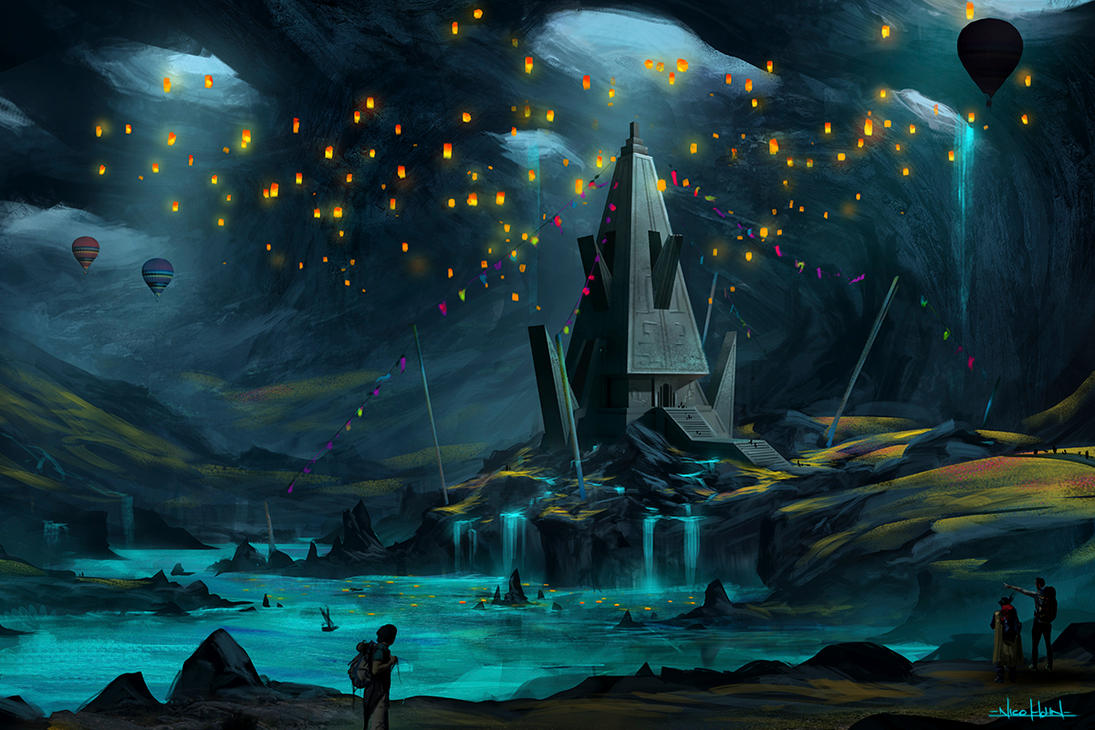
Image Source: https://lordoguzhan.deviantart.com/art/Perselia-and-the-Festival-of-the-Stars-751144027

F is for Festival

Festivals are, broadly, celebrations of religious holy days, or other significant and important dates. They are often celebrated through feasting, music, ritual, ceremonies, and/or other observances. Festivals for patrons may be times when the patron's followers are required to enact a certain ritual during a cosmic event such as an alignment or solstice. Religious holy days commemorate the important events within the religion and/or the life of the deity. While many festivals are celebratory some may be sombre occasions, or may be preceded by fasting or other periods of denial.

Table F1: Duration of Festival (roll 1d6)
  1. 1d3 days (calendar)
  2. One day (sunrise to sunset)
  3. One full day (calendar, sunrise to sunrise)
  4. One night (sunset to sunrise) 
  5. 2d4 nights (observances only after sunset)
  6. 2d3 significant hours (e.g. the hours around midnight, sunrise, the solstice, etc.)
Table F2: Purpose of Festival (roll 1d3 and 1d3)
  1. Remembrance of...
    1. a significant battle
    2. the death of a saint
    3. one's ancestors or dead relations
  2. Celebration of...
    1. a miracle
    2. a major celestial event
    3. a saint (birth, canonization, etc.)
  3. Observance of...
    1. Harvest Season
    2. New Year
    3. Planting/Spring
Table F3: Festival Focus (roll 1d8 twice and combine)
  1. Food
  2. Drink
  3. Music 
  4. Dancing
  5. Contemplation of religious teachings/writings
  6. Ritual Sacrifice (see S if for Sacrifice)
  7. Games or contests
  8. Reflection on the meaning of the festival
Table F4: Prohibited Conduct (roll 1d6)
  1. Overindulging
  2. Singing
  3. Working during the festival
  4. Preparation of food during the evening hours
  5. Consumption of food during the daylight hours
  6. Consumption of a specific substance
Table F5: Festival Accoutrements (roll 1d4)
  1. None
  2. Specific style of dress (e.g. traditional, costumes, lack of clothing, etc.)
  3. Symbolic Decoration (e.g. use of decorated eggs to symbolize the changing of winter to spring)
  4. Iconic Decorations (e.g. images of ancestors/relatives, Idols of a Deity, etc.)