Sunday, May 31, 2020

Nuts & Bolts #163 - Hacking the Cypher System - Sidekicks


Editor's note: It's been WAY too long, but sometimes you just don't have anything to give. You can't squeeze blood from a stone. I'm going to try and be better about posting here but these are uncertain times and it's hard to think about happy fun times games when the world is burning down around you.

Superhero RPGs are an occasional fun diversion for me. I don't play regularly for various reason, and as a result I find some of the better superhero RPGs a bit cumbersome because I have to relearn the rules a bit each time. Thankfully the Cypher System is pretty capable for superheroics in most cases (some weirdness aside when it comes to the ability to fly).

One thing that Cypher doesn't do well (IMO anyways) is sidekicks and support characters. Most the time you get a low level critter, robot, or hireling who is some use at Tier 1, and decreasingly useful as you gain Tiers. Often they are rolling unmodified for most actions other than a small handful that they have training for. Without ability to apply effort they can feel very weak against tasks and enemies at level 5 of higher.

In supers games the sidekick can often be very important for certain characters, and they can help a smaller group of PCs punch a little higher than they could otherwise with the power of numbers. Thankfully there is one Cypher game that made an effort to make companions a little more interesting and stronger: Predation.

Predation is a pretty great setting with some interesting rules to support the Dinosaur companions that are nearly ubiquitous within the setting. These rules, like most rules, can be easily adapted or modified to suit other settings and genres to enable PC companions. I already discussed this idea a while back in regards to a high tech or cyberpunk game where PCs can be reasonably expected to have AI assisted drones. Another common genre with a historic trope that fits well with these rules is comic books & superheroes. Oh hey, how topical!

I think the companion rules will work wonderfully for this purpose. With a minimum of additional work required to fit the rules to the genre. While I presented the idea of this prior but did not elaborate on what those changes would look like, this time I would like to present my full hack for Sidekicks.

First thing's first, we need to skin over the dinosaurs into sidekicks. This is really just a matter of renaming them to fit a superheroic game:

  • Tyrannosaurus become Brawlers, sidekicks who are bigger more aggressive fighters than most of their peers (though not likely as big and tough as their hero).
  • Raptors become Hunters, sidekicks who use teamwork and stealth to stalk the the enemy. 
  • Ornithomimids become Speedsters, sidekicks who use their speed to avoid enemy attacks while drawing fire from their hero.   
  • Ceratopsians and Ankylosaurs become Tanks, bigger and tougher but slower than their peers, Tanks can take a lot of abuse and help their hero by sticking in combat for the duration.
  • Pterosaurs become Fliers, sidekicks who can take to the air and aid their hero from a position of advantage above the city.
  • Early Mammals become Scouts, who make up for for their weaker physical ability by being premier scouts, reconnoitering ahead and searching out the enemy's weaknesses. 
The companion ability lists for each type can stay as is, and even those ability names can be retained for the superhero genre. The exception to this is the Temporal Hunter ability which can either be removed, or rejiggered for the setting (example, Mutant/Metahuman Hunter, or the like).

Lastly the companion dispositions from the book. These are the biggest change as I would not use these and instead use the same Descriptor list as the main player characters in the game. This will allow more options and better suit the fact that sidekicks are people, not animals. Descriptor bonuses to pools can instead be applied directly to the sidekick's health stat, and the skills and inabilities can be applied as normal. 

When your hero interacts with their sidekick they should still use the Interaction mechanisms from Predation (pg 49) to represent the development of the sidekick from a trainee to an eventual highly trained hero in their own right. This means that initially they may misunderstand their hero's instructions, or may balk at their orders/mission due to lack of experience. As your hero gains experience so too will their sidekick and they will be more confident and capable following your hero's lead. 

Since superheroes use the power shift rules I would also allow sidekicks to apply 1/2 rounded down the number of shifts that their hero has. These might be different from the hero's shifts as in the case of mutants or sidekicks with different themes from their hero, or they may be the same because of training and similar power themes. Likewise I would grant each sidekick a choice of +4 Health or an level of skill training at Tier 1, and then apply a bonus of +2 Health per tier in addition to the normal progress. This will help these sidekicks last a little longer as the superheroes they serve get stronger and the super-villains they fight likewise gain more power.

Lastly I would definitely suggest that other players at the table play the sidekicks of other heroes. This will allow far more interesting roleplay than if the sidekicks are played by the same player as the hero. Predation got this perfectly and I see no reason why it should change with a new genre.

That's it (I think), a set of perfectly useful rules for making genuinely interesting Sidekicks for use with Superheroic gaming using Cypher System. 

Wednesday, October 30, 2019

Nuts & Bolts #162 - Here There Be Dragons

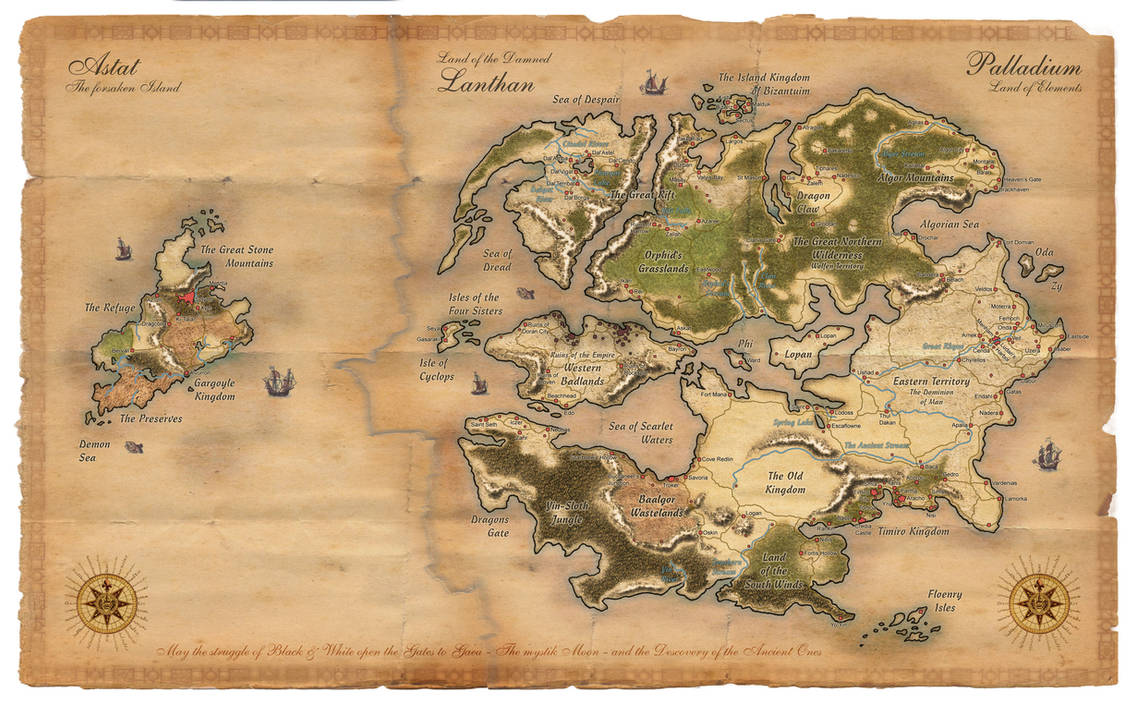
Image Source: https://www.deviantart.com/dawn2069ms/art/Palladium-Fantasy-Worldmap-61746603

The map of the world. A staple in fantasy games. The map may be something that the players know well, especially for well published settings, or it may be something only the GM knows. Both cases have their pros and cons. 

If the players know the map it makes placing them geographically easier for the GM during each session. They can look at the map, decide where they next want to go, and then clearly and concisely tell the GM that. The players know where they are and where they are going, and the GM doesn't need to contend with player aimlessness or confusion. 

The map can also present a way for the players to self direct. Maybe they see the name and icon of a strange ruin marked on the map and want to find out more. Such self direction is difficult when the map is unknown to the players and/or the characters. Which in turn puts the onus on the GM to drive the game from location to location and provide things for the player to do, at least early on. 

The flip side however isn't all bad. Sometimes the players will see that lack of a bigger picture of the world as an incentive to go out and explore. The lure of the unknown is a powerful one, and the joy of a hex crawl or similar style of exploration focused game can be significant. In such cases it also bonds the characters by making them have a common point of reference for the world. They may be all from the same village, or they find themselves all new residents of a demiplane of a well known vampire named ... Brad? Regardless of their other commonalities and differences they are all aware of only a limited portion of the world they inhabit. 

In such a case the GM should provide some teases to entice exploration. A range of dark hills to the east with a broken tower rising above the treetops. A sea to the south that the local fishermen say hides a place of great power. A well paved (in strange exotic materials ideally) that leads northward toward a rumored city of some other exotic or strange building material. These visual or verbal clues can set the players & their characters to put one foot in front of the other. 

A valid third option of course is to have the characters get lost. Maybe the game is set in a familiar setting but due to circumstances the players find themselves in a portion of the word that is less inhabited and more wild. They are lost (barring some very clever use of skills to narrow things down), and must explore the local world until they can find a place to allow them to orient themselves, a city or town of sufficient size that one or more of them have heard of it and know at least approximately where it is. 

At the beginning of the day, the GM needs to decide how to present the world to their players, and how important exploration will be for their game. The map, or lack thereof, can help to drive certain behaviors and open up certain options for both players and GMs alike. And at the end of that same day making some informed choices up front can help the GM to avoid the game progressing (or not progressing) in ways that they didn't intend. 

Wednesday, October 9, 2019

Nuts & Bolts #161 - Gotta Get Away


So, last week over on his blog Andrew posited some ideas for GMs looking into introduce a big bad and enable their escape from the players. (you'll want to read that on first, go on, I'll wait). We've been having sort of semi-related back and forth but I'm going to do a direct rebuttal this time as I think some of Andrew's ideas are great but I don't agree with others. 

To set some ground rules:
  • This is all opinion, and so neither of us is implicitly "right" for all GMs & player groups...
  • ...also for all game systems.
  • The entire point of both this post and Andrew's is setting up the villain to escape, not final showdowns, not how to run those villains the rest of the time, just villainous escapes.
  • Quotes from Andrew's blog in italics.
OK let's rock and roll...

Scene
The players have finally made their way into the Throne Room\Lair\Laboratory\Warren of a Big Baddy. On the Baddies home turf, the heroes are in for a fight.
So Andrew posits the scene as the villain's lair, and that's totally appropriate, but so too are situations in the world at large. The villain should be just as able to flee the burning of a village or the arcane destruction of a city (scale as appropriate to the villain). Why is this relevant? Because I think the first intro to the villain should be in the world and not in their lair most times. If you introduce them as "just another bad guy" their eventual escape and return can build up their rep with the party directly rather than building the hype indirectly leading up to the first meeting. This is probably just a style thing, but it bears mentioning.

Mood
The mood of these fights should always be a little tense, for you and the players.  For you never want to create an encounter like this that is a pushover for the players, nor should you want a TPK.
I pretty much agree wholeheartedly here when the players already know the bad guy is he villain. When they don't yet know that however, you can easily mood shift into either horror or terror if the villain is more powerful than the PCs. Consider a powerful necromancer who is slaughtering a town and using the corpses and souls to build a) an undead army, 2) a grotesque abomination of flesh, 3) a portal to realms beyond. At this stage the villain is so powerful that he can brush off the PCs as an annoyance, and his "escape" is instead played out after he completes his task and has no further need to stay. The PCs now have a long term goal to find a way to defeat this evil!

Alternately you could pose the scene heroic for the PCs and run the villain's escape as a victory for the players instead of a soft loss. The PCs drive off the warlord and his marauders saving the village, but now he has a score to settle with them later! This flips the script a bit and let's the next encounter be at the villain's impetus.

Regardless of how you parse the scene you do need to be prepared for the dice to turn things away from your intent. I suggest running things outside of strict "combat mechanics" if possible to allow you more leeway to set the long term story but still take account for player actions and avoid laying down rails. 

Threats
The Big Bad is a threat, but for the first meeting, they should not be fighting alone.
One word: Dragon. Sure a warlord should have an army, and a mage will likely have summons of some flavor, but what about something so beyond the player's current capabilities that it needs no help. A dragon would not stoop to having minions, it can raze a town and carry off the virgins by itself thanks very much. Granted lieutenants and flunkies can certainly give the players opportunities to get their fight on while the big bad gets away, but that doesn't work for every villain. Sometimes a single creature can, with multiple attacks and/or area effect powers, present not just a challenge but an overwhelming threat all on their own. 

Summons & minions can make great diversions however, as can unleashed beasts/monsters. But so too can out of control fires, frozen or buried townsfolk, and other non-monster/NPC threats. Such cases give you a great chance to leverage player alignment, reputation, motivation, and the like to drive the characters to let the villain escape while they rescue innocents, or prevent the destruction of a sacred site, important artifact, or similar. Also consider than spells like Banishment can work against the players and flip the script on "escapes."

Mechanics
If the Big Bad has their own way instantly get away, via magic item or special ability, make sure the players know about it beforehand. 
I actually don't agree here. Especially if your intent is to allow the villain to escape. The reveal of this power should be a major pain point for the characters, and should drive them to find a way to shut it down prior to their next encounter. This drives engagement and drives story progression. If the players are mad about the villain teleporting away they will have the characters drive the story to find a solution for said boss ability. This is a good thing in my mind.
Other than Special Powers or Items, make sure the description of the room describes the ways of egress from the room.
This I agree with. Describe your scene well. This engages the players, and obvious things like teleport circles, summoning circles, arcane doorways, astral rifts, ad nauseam are all things the players should know about. The ability to cast Teleport, or having a Wand of Plane shift, are both things that the players probably will only know about after one or more encounters with the boss, so depending on the characters' history with the villain you may need to keep some of this hidden. Let me repeat that: You are not beholden to telling the characters about all the big bad's abilities!

Tips
I’ve thrown in tips throughout this whole article, but the biggest tip I can give is don’t force the escape. Players are crafty and they may have come up with a plan that nullifies the big bad’s escape plan, or the rolls swing the wrong way and they have the big bad dead to rights. Let it happen. Lose the Big Bad. 
I agree with this entirely. No plan survives contact with the players. An anti-magic artifact, a counterspell, or clever application of any number of crazy player ideas can foil the mechanism by which you had planned for the villain to escape. I agree with Andrew and suggest you let it happen. The key then is to have a backup plan. Consider the following:

  • The warlord's cavalry are prevented from whisking him away or the party's warrior get's a timely critical hit. Suddenly the conquering villain is dead at the feet of the PCs and it looks like the marauding horde will be leaderless.
    • Instead of simply dissolving into disparate tribes or smaller forces, the loss of leadership unleashes the army to their own devices and the PCs now have to deal with numerous lesser threats. They simply will not be able to stop all of them before something precious is lost, a key locale, an important NPC, or a vital resource. The next steps of the campaign involve putting down these lesser threats and then recovering from the losses they were unable to stop.
    • The warlord had a general who was not part of his race or ethnic group, but was a military genius. It was this general who developed the strategies behind the warlord's actions. They now seize control of the army and change tactics entirely. The players still have a large force to deal with but now with entirely new and innovative tactics.
  • The necromancer is defeated. But the death of such a powerful practitioner of the dark arts releases a cascade of magics that result in unintended and unforeseen consequences.
    • Older evils that rest in the world wake and position themselves within the power vacuum left by the necromancer. This could be a similar foe such as a vampire, lich, or the like, or an evil creature of magic like a dragon or demon.
    • The undead army the necromancer controlled do not fall to the ground inactive with the death of the necromancer. Instead they gain the power to be self animated and some even gain a hint of intellect. Now a scourge of undead wash over the land under no control, or new control, and the characters have to deal with it.
Closing Thoughts
Do plan devious ways for enemies to escape, especially those you have hopes of becoming on-going foils for the PCs. Do allow the PCs to find out ways to foil the enemy powers they know about, but also do give the villains nasty new tricks. Don't shy away from the "untimely" death of the villain; the PCs earned it, and you CAN come up with better stories afterward. Do have backup plans for when the villain bites it.

Also have fun, maybe the villain was actually a tiny alien in a robot, or a demon that possesses bodies who can survive being slain, just remember to drop hints so the return of a dead antagonist isn't just you being crappy.